Moroccan football mourns passing of trailblazing referee Jilali Gharib
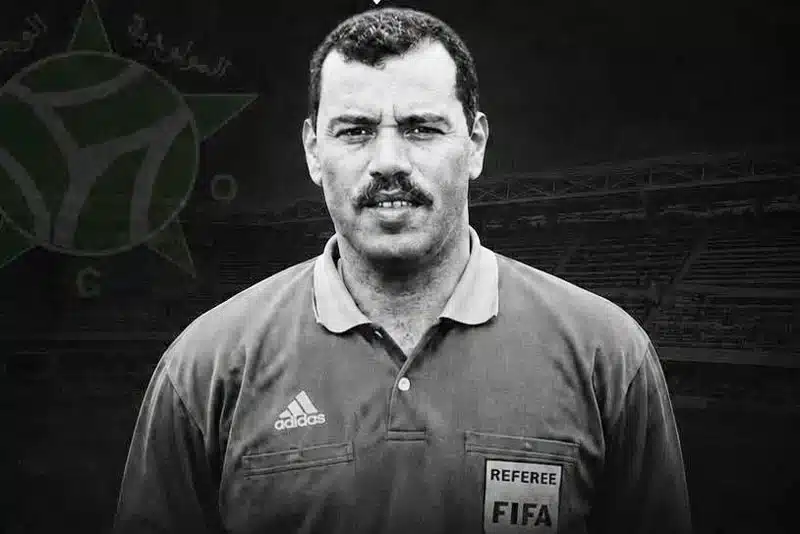
Moroccan football has been plunged into mourning following the death of former international referee Jilali Gharib, one of the most respected and influential figures in the history of refereeing in the North African nation.
The veteran official, whose career spanned some of football’s biggest stages, passed away on Sunday, prompting an outpouring of tributes from across the Moroccan football fraternity, including officials, former players, referees and supporters who recognized his immense contribution to the development of the game.
Among those who paid tribute was Fouzi Lekjaa, president of the Royal Moroccan Football Federation (FRMF), who expressed his profound sadness at the passing of a man widely regarded as a pioneer of Moroccan refereeing.
Lekjaa extended his deepest sympathies and heartfelt condolences to Gharib’s family, relatives, friends and the entire Moroccan football community, acknowledging the late official’s lasting impact on the sport both nationally and internationally.
The Royal Moroccan Football Federation described Gharib as one of the most distinguished refereeing figures in the country’s history, highlighting a career marked by professionalism, excellence and groundbreaking achievements that elevated Morocco’s reputation on the global football stage.
One of the defining moments of Gharib’s career came in 1994 when he became the first Moroccan referee to participate in a FIFA World Cup. His selection as an assistant referee for the tournament in the United States represented a historic milestone not only for him personally but also for Moroccan football as a whole.
His appointment to the World Cup broke new ground for Moroccan officials and opened the door for future generations of referees to aspire to the highest levels of international football. Many within the game regard his achievement as a turning point that helped establish Morocco as a respected producer of elite match officials.
During the 1994 World Cup, Gharib was entrusted with officiating responsibilities in several matches, further demonstrating the confidence FIFA had in his abilities. One of the most notable assignments of his career came when he was selected as part of the refereeing team for the third-place playoff between Sweden and Bulgaria on July 16, 1994.
That match, played before a global audience, ended in a convincing 4-0 victory for Sweden and remains one of the memorable fixtures of the tournament. Gharib’s involvement in such a high-profile encounter underscored his standing among the world’s leading match officials at the time.
Beyond the World Cup, the Moroccan referee also enjoyed an extensive international career that saw him officiate at several prestigious competitions. He took part in the Asian Cup finals and the Asian Games, adding further distinction to a résumé that spanned multiple continents and major international tournaments.
His presence at these events reflected the respect he commanded within global refereeing circles and showcased the quality of Moroccan officiating on the international stage.
Throughout his career, Gharib earned admiration for his discipline, fairness and deep understanding of the game. His success inspired countless young referees across Morocco, many of whom viewed him as a role model and a symbol of what could be achieved through dedication and hard work.
The FRMF noted that his legacy extends far beyond the matches he officiated. His pioneering accomplishments helped lay the foundation for the emergence of Moroccan referees on the world stage, creating opportunities for future generations to follow in his footsteps.
As tributes continue to pour in from across the football world, Jilali Gharib will be remembered not only as a distinguished referee but also as a trailblazer whose contributions helped shape the history of Moroccan football. His name remains firmly etched in the annals of the sport, and his influence will continue to be felt for years to come.
-
 Maghreb de Fes and ASEC Mimosas reveal probable line-ups for CAF Champions League tie Oct 17, 2026
 -
Maghreb de Fes face a l’ASEC Mimosas in first-ever CAF Champions League meeting Oct 17, 2026
-
Leeds v Manchester United: Mbeumo backed at 3.4 as sides meet in Premier League derby Oct 17, 2026
-
Abongile Tom backed despite two contentious MTN8 final penalty decisions Oct 17, 2026



-
AFCON 2025: Fixtures, Results, Scores and Standings Jan 18, 2026
-
Match hero Taiwo Awoniyi reflects on team effort after Chelsea triumph May 5, 2026
-
Leadership and long-term vision key to rescuing Zamalek and inspiring Egyptian football – Hany Abou Rida Nov 5, 2025
-
South African giants Orlando Pirates set to lose influential forward Monnapule Saleng Mar 19, 2025




-
Real Betis v Barcelona: kick-off time, TV details and match preview Oct 16, 2026
-
Roma v Real Madrid: home side tipped to score first in Champions League clash Oct 12, 2026
-
Atletico Madrid v Manchester United: probable line-ups for Champions League clash Oct 12, 2026
-
Celta Vigo v Juventus: Probable line-ups for Europa League encounter Oct 14, 2026