World Cup 2026: Cape Verde’s remarkable journey from island nation to knockout history against Argentina

The story of Cape Verde at the World Cup has become one of the defining narratives of the tournament, as the island nation secured an unprecedented place in the knockout rounds.
Representing a chain of just 10 islands in the Atlantic, Cape Verde have now become the smallest country ever to reach the last 32, a milestone that reshapes expectations of what is possible at global football’s elite level.
Their place in the knockout phase was confirmed in dramatic fashion after a goalless draw with Saudi Arabia, followed by a tense wait as results elsewhere aligned in their favour.
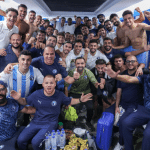
The squad gathered around a mobile phone on the pitch, watching the closing moments of Spain’s win over Uruguay, a result that confirmed them as Group H runners-up.
“Tears of pride and joy all around the stands,” said BBC Radio 5 Live commentator Rob Law in Houston.
He added: “There was a beautiful moment where they were all huddled around waiting on their phones, waiting for the full-time whistle to go.
“When it did, tears flowed on the pitch and in the stands as well. What a moment. The moment of the World Cup so far.”
From resilient draws to global recognition
Cape Verde’s qualification was built on a foundation of resilience rather than dominance. They opened with a remarkable goalless draw against Spain, where veteran goalkeeper Vozinha produced a commanding performance.
That was followed by a spirited 2-2 draw against two-time world champions Uruguay, underlining that their progress was no accident. Former Spain international Juan Mata described the achievement on ITV as evidence of consistency rather than a one-off shock.
“It’s incredible what they are doing, it wasn’t just one game against Spain, it is three games at the highest level,” he said.
The results have forced a reassessment of Cape Verde’s place in world football, particularly given their population of just over half a million and their ability to outperform established African powers such as Cameroon.
Diaspora strength and long-term planning
A defining factor in Cape Verde’s rise has been the strategic use of its global diaspora. Historical migration patterns, shaped by colonial ties to Portugal and economic movement across Europe, have expanded the national talent pool far beyond the islands themselves.
Fourteen members of the 26-man squad were born outside the country, including six from Rotterdam in the Netherlands. Among them is forward Dailon Livramento, who scored a decisive goal in qualifying against Cameroon.
The federation’s approach has included unconventional recruitment methods, including the well-documented identification of defender Roberto Lopes through LinkedIn. Former Portugal youth international Bebe also previously featured in their continental squad setup.
Parliamentary figure Josina Freitas Fortes praised the long-term vision behind the project, stating: “The FCF has made significant progress through passion, commitment and a clear technical plan.”
Lopes himself has spoken about the mentality within the squad, insisting belief has never been in short supply.
“There is an inner confidence in this team that we are good enough to mix with the best teams in the world,” he said.
Tactical identity and coaching stability
Much of Cape Verde’s success has been shaped under head coach Bubista, who has overseen the team since 2020 and provided rare continuity in international football.
A former international defender, Bubista has built a disciplined and compact side, blending defensive organisation with technical quality in midfield and attacking sharpness. Their progress included a strong showing at Africa Cup of Nations 2023, where they reached the quarter-finals.
Their defensive record against Spain stood out, with just one foul conceded and goalkeeper Vozinha making seven saves in a standout display. Defender Sidny Lopes Cabral described the approach as instinctive rather than improvised.
“This is our personality as a team and as defenders.”
Against Uruguay, Cape Verde showed a more expansive edge, twice coming from behind to secure a valuable point. Bubista emphasised identity over result.
“More important than the result is to be able to show our identity as a team, our strength, our unity, and also our resilience,” he said.
Argentina await as belief grows
Next comes the ultimate test: a last-32 meeting with reigning world champions Argentina, led by Lionel Messi, in Miami.
Bubista, draped in national colours, struck a defiant tone after qualification.
“To us, nothing is impossible,” he said.
Midfielder Deroy Duarte added: “Honestly, it’s mad. I feel like I’m in a dream.”
Former managers and pundits have praised the achievement, including Ange Postecoglou, who described it as “just a great story for what the World Cup is all about,” while Gary Neville highlighted the symbolic impact of their run.
-
 Tactical balance: Nebojsa Kapor promises Hearts of Oak will adapt at Bibiani GoldStars Sep 11, 2026
 -
Special tribute: Algeria prepare emotional farewell for Riyad Mahrez and Aïssa Mandi Sep 11, 2026
-
Lazio v AC Milan: probable line-ups for Serie A fourth-round clash Sep 11, 2026
-
Mezian Mesloub makes Champions League history with Lens at 16 Sep 11, 2026


-
AFCON 2025: Fixtures, Results, Scores and Standings Jan 18, 2026
-
Leadership and long-term vision key to rescuing Zamalek and inspiring Egyptian football – Hany Abou Rida Nov 5, 2025
-
South African giants Orlando Pirates set to lose influential forward Monnapule Saleng Mar 19, 2025
-
Full schedule for 2025 Africa Cup of Nations in Morocco confirmed Feb 12, 2025




-
Orlando Pirates backed to overcome La Cure Sylvester in CAF Champions League opener Sep 4, 2026
-
CAF announce kick-off times for Champions League preliminary round games Sep 4, 2026
-
Former Nigeria star Odemwingie taunts Portugal football icon Cristiano Ronaldo Sep 4, 2026
-
Rulani Mokwena: Pyramids FC have reached maturity and must expect to win every title Sep 4, 2026