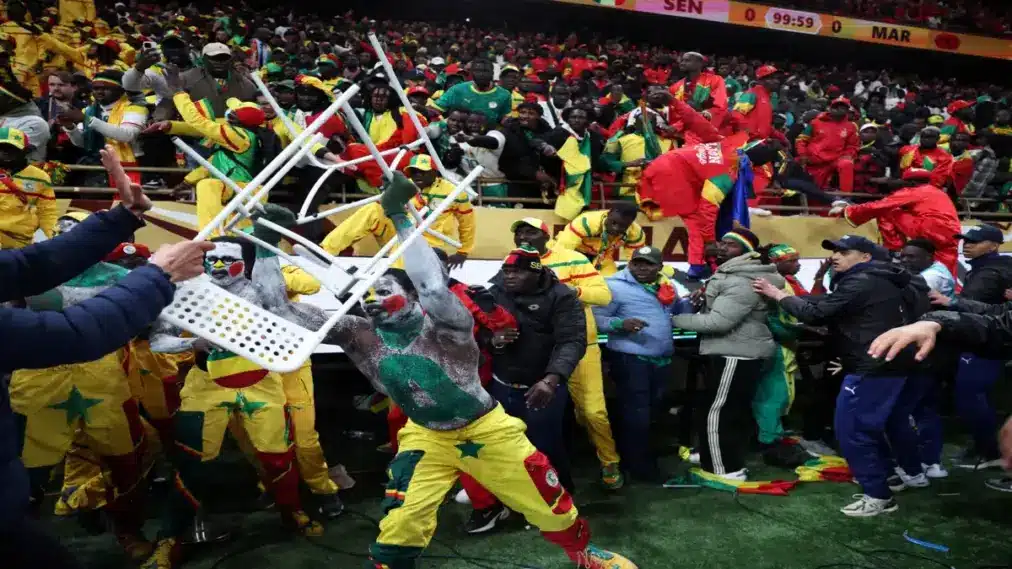
Senegalese authorities and human rights officials have launched a coordinated effort to support the families of 18 supporters detained in Morocco, amid growing concern over their welfare and legal situation.
The group of Senegalese supporters, currently being held in Morocco, has become the focus of intensified action aimed at safeguarding their rights and ensuring close monitoring of ongoing judicial proceedings.
The initiative comes as anxiety mounts among relatives seeking clarity and reassurance.
According to information reported by Wiw Sport, the National Human Rights Commission (CNDH), working closely with the supporters’ lawyer, Patrick Kabou, has begun a series of visits to affected families.
The outreach forms part of a broader plan to provide both legal guidance and emotional support during a period marked by uncertainty.
The visits started in Saint-Louis, where members of the delegation met with relatives of one of the detained supporters.
The meeting provided an opportunity to address concerns directly and offer assistance in what has been described as a particularly difficult environment.
The situation was further compounded by worries surrounding the health of the supporter’s father, adding to the strain on the family.
Officials involved in the initiative say the purpose of these engagements is to ensure that families remain informed about developments in the case.
By maintaining regular communication, the authorities aim to reduce uncertainty while demonstrating a continued commitment to those affected.
In addition to providing updates, the visits are intended to reinforce consular protection for the detained individuals.
Ensuring that the supporters’ fundamental rights are respected remains a central priority, with attention focused on both their conditions in detention and the fairness of the legal process they are undergoing.
Lawyer Patrick Kabou has highlighted the role played by the National Human Rights Commission since the case first emerged.
He pointed to the institution’s involvement in efforts to improve detention conditions and to uphold the guarantees associated with a fair trial.
The commission’s actions have been presented as part of a sustained response designed to address both legal and humanitarian concerns.
Beyond direct engagement with families, the initiative also extends to diplomatic efforts.
The president of the National Human Rights Commission, Amsatou Sow Sidibé, has undertaken a series of high-level discussions aimed at advancing the case.
These talks have involved Moroccan diplomatic representatives as well as Amina Bouayach, who heads Morocco’s National Human Rights Council.
This dual approach reflects an attempt to combine on-the-ground support with institutional advocacy.
By engaging both families and international counterparts, officials hope to create conditions that will allow the case to be handled with transparency and respect for legal standards.
The diplomatic dimension is seen as a key element in ensuring that the rights of the detained supporters are protected beyond national borders.
Through dialogue with Moroccan authorities and human rights institutions, Senegalese officials are seeking to facilitate cooperation and encourage adherence to established legal frameworks.
For the families, the ongoing efforts offer some reassurance during an uncertain period.
The presence of officials and legal representatives has helped to provide a clearer understanding of the situation, even as questions remain about the outcome of the proceedings.
While the legal process continues, attention remains firmly on the welfare of the 18 supporters.
Authorities have indicated that they will continue to monitor developments closely, maintaining both legal oversight and humanitarian support.
The case has underlined the challenges faced when citizens encounter legal difficulties abroad, as well as the importance of coordinated responses involving legal, diplomatic and human rights actors.
For now, the combined efforts of the National Human Rights Commission, legal counsel and diplomatic representatives remain focused on ensuring that the detainees’ rights are upheld and that their families are not left without support.
-
 Lugazi bolster attack with Uganda centre-forward Dickson Mataama Aug 28, 2026
 -
NEC FC add Uganda international defender Musitafa Mujuzi to defensive ranks Aug 28, 2026
-
AC Milan cast eye over Frankfurt winger Jean-Matteo Bahoya Aug 28, 2026
-
Alexandre Zaouai linked with Aris Saloniki move from SC Bastia Aug 28, 2026



-
AFCON 2025: Fixtures, Results, Scores and Standings Jan 18, 2026
-
Leadership and long-term vision key to rescuing Zamalek and inspiring Egyptian football – Hany Abou Rida Nov 5, 2025
-
South African giants Orlando Pirates set to lose influential forward Monnapule Saleng Mar 19, 2025
-
Full schedule for 2025 Africa Cup of Nations in Morocco confirmed Feb 12, 2025