Countries
COSAFA
Côte d’Ivoire
DR Congo
Egypt
FIFA World Cup
Ghana
Latest News
Morocco
Senegal
South Africa
Tunisia
UNAF
UNIFFAC
WAFU A
WAFU B
World Cup 2026 hits 100-day countdown amid political unrest in US and Mexico
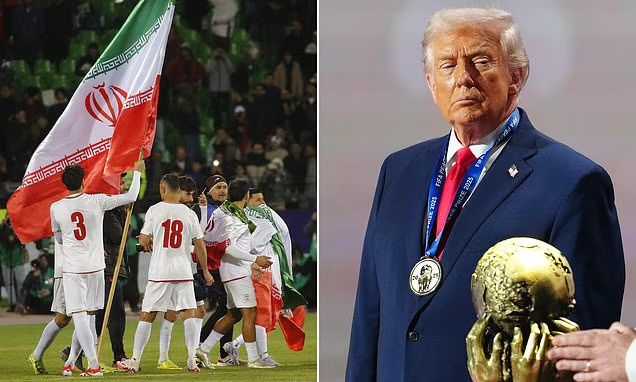
The 2026 FIFA World Cup reached its 100-day countdown on Tuesday, setting the stage for what promises to be the largest and most complex edition in the tournament’s history. Yet the global football celebration is unfolding amid a backdrop of geopolitical tension and domestic uncertainty, with recent US-Israeli strikes on Iran, ongoing violence in Mexico, and controversies surrounding the Trump administration casting a shadow over preparations.
For the first time, the World Cup will be staged across three countries – United States, Canada, and Mexico – expanding the tournament to a record 48 teams from the 32-team format of 2022. Millions of fans are expected to travel across North America, from the high-altitude Estadio Azteca in Mexico City, which will host the opening match on June 11, to MetLife Stadium in New Jersey, set to stage the final on July 19.
A total of 104 matches will take place across 16 venues and four time zones, with the United States hosting 78 games, accounting for the lion’s share of the tournament.
FIFA President Gianni Infantino has consistently highlighted the commercial scale of the event, predicting record revenues of $11 billion, far surpassing the $7 billion generated by the 2022 Qatar World Cup. “The demand is there. Every match is sold out,” Infantino said, citing billions of global television viewers and more than 508 million ticket requests for the seven million available. He has described the tournament’s magnitude as equivalent to “104 Super Bowls,” a nod to both the spectacle and the potential profits.
Despite the economic optimism, the tournament has faced criticism over ticket pricing, which many supporters argue places official matches out of reach for average fans. Fan advocacy groups such as Football Supporters Europe have denounced FIFA for a “monumental betrayal,” prompting the organization to offer a small number of $60 tickets for official supporters’ groups—a gesture widely seen as symbolic rather than substantial.
Political turbulence casts long shadow
Beyond commercial and logistical concerns, political factors have emerged as the tournament’s most unpredictable challenge. The policies of the Trump administration, both domestic and international, have generated questions about the smooth execution of World Cup operations. Trade disputes with co-hosts Canada and Mexico, tensions with European allies over potential territorial claims, and immigration crackdowns have all fueled uncertainty for traveling fans and participating nations.
Iran’s team, for instance, is scheduled to play group-stage matches in Los Angeles and Seattle amid heightened tensions following US-Israeli strikes in the region. FIFA Secretary General Mattias Grafstrom cautioned that the organization is monitoring developments closely but refrained from detailed commentary.
Enhanced visa restrictions have also affected citizens from several World Cup-qualified nations, including Iran, Haiti, Senegal, and Ivory Coast. The White House, however, has insisted that fan tourism should not be affected, emphasizing expedited visa processing for ticket holders.
Mexico, too, has been grappling with domestic unrest. The recent killing of a high-profile drug lord in a military operation triggered violent incidents in Guadalajara, a city hosting four World Cup matches.
Both Infantino and Mexican President Claudia Sheinbaum have publicly reassured fans that the tournament schedule will remain intact. “Very reassured, everything’s good,” Infantino told AFP last week, signaling confidence that security measures are sufficient to prevent disruptions.
Expanded tournament format: opportunities and concerns
On the sporting front, the expanded 48-team format brings both excitement and new challenges. The initial group stage now comprises 12 groups, with the top two from each group plus the eight best third-placed teams advancing to the knockout rounds. While this structure ensures more nations experience the World Cup stage, it also reduces the likelihood of early upsets, meaning the tournament’s traditional powerhouses are unlikely to face elimination in the first round.
Defending champions Argentina are expected to dominate headlines, with Lionel Messi leading the charge in what is almost certainly his final World Cup campaign. Messi will celebrate his 39th birthday on June 24, making this edition a potential swansong for one of football’s all-time greats. The Argentine squad will face stiff competition from 2018 champions France and reigning European champions Spain, while England, under the guidance of Thomas Tuchel, will aim to end a 60-year drought without a major international trophy.
Meanwhile, the tournament will also welcome several debutants, including Cape Verde, Curacao, Jordan, and Uzbekistan, offering a rare chance for emerging football nations to make their mark on the global stage. For these teams, participation alone represents a historic achievement and an opportunity to challenge established powers in the World Cup arena.
Logistical and commercial complexity
Managing an event of this scale requires unprecedented coordination. FIFA must oversee scheduling across multiple time zones, ensure stadium readiness, and maintain security protocols for both fans and players. The United States’ heavy concentration of matches places additional pressure on local authorities, with New York, Los Angeles, and other major cities expecting to accommodate massive international crowds.
Commercially, the tournament represents a historic opportunity. Sponsors, broadcasters, and tourism boards are poised to benefit from increased exposure and spending, while local economies in host cities anticipate a surge in hotel occupancy, restaurant activity, and ancillary services. Infantino has highlighted the global audience as a key driver of revenue, noting that billions are expected to tune in to watch the tournament live.
Ticketing, however, remains a contentious issue. Despite the launch of a limited number of lower-priced tickets for official supporters, many fans fear that the World Cup experience may become increasingly exclusive, catering to wealthier audiences and corporate hospitality packages. FIFA’s challenge will be to balance profitability with accessibility, ensuring the tournament retains its global appeal without alienating grassroots supporters.
Security, diplomacy, and fan experience
Security concerns are not limited to political unrest. With fans traveling from every corner of the globe, authorities must address potential threats ranging from organized crime to civil disturbances. Co-host nations have pledged extensive security deployments, including law enforcement coordination and surveillance measures, to mitigate risks. Diplomatic relations among the US, Mexico, and Canada will also be closely monitored, particularly given the sensitive political climate in the region.
For fans, navigating visas, transportation, and stadium access will require careful planning. Authorities have promised that ticket holders will receive priority processing for visas and other necessary permits, but the effectiveness of these measures remains to be seen. Fans traveling from countries affected by US immigration restrictions may face additional challenges, despite assurances from the White House and FIFA.
Looking ahead
As the countdown reaches 100 days, the 2026 World Cup stands poised at the intersection of sport, politics, and commerce. The tournament promises historic moments on the pitch, from Messi’s farewell campaign to the emergence of new footballing nations, while simultaneously testing the resilience of host nations in managing political unrest, security threats, and logistical complexity.
The eyes of the world will be on North America this June, with billions of viewers anticipating drama, excitement, and unforgettable footballing moments. Whether the tournament can deliver a seamless global celebration amid political uncertainty will be a defining test not only for FIFA but for the co-host nations themselves. If successful, the 2026 World Cup could set a new benchmark for scale, spectacle, and commercial impact, establishing a template for future tournaments while navigating one of the most complex geopolitical landscapes in modern sporting history.
The stage is set, the countdown has begun, and the world will soon turn its attention to stadiums from Mexico City to New Jersey. Amid uncertainty, anticipation, and expectation, the biggest footballing event in history is ready to kick off.
-
 TS Galaxy and Kaizer Chiefs set for cup clash after social media taunt Oct 27, 2026
 -
Jayden Adams remembered at 2026 Ballon d’Or ceremony Oct 27, 2026
-
Kopo reveals how he persuaded Ronwen Williams to return to football Oct 27, 2026
-
Agent expects Sipho Mbule to remain abroad after Zakho contract Oct 27, 2026


-
AFCON 2025: Fixtures, Results, Scores and Standings Jan 18, 2026
-
Match hero Taiwo Awoniyi reflects on team effort after Chelsea triumph May 5, 2026
-
Leadership and long-term vision key to rescuing Zamalek and inspiring Egyptian football – Hany Abou Rida Nov 5, 2025
-
South African giants Orlando Pirates set to lose influential forward Monnapule Saleng Mar 19, 2025




-
Barcelona v Real Madrid: Catalans backed at 1.65 to win October Clasico Oct 23, 2026
-
Barcelona and Real Madrid meet in pivotal 265th Clasico Oct 23, 2026
-
Sevilla FC v Osasuna: probable line-ups for Monday’s La Liga meeting Oct 25, 2026
-
Champions League: PSG beat Barcelona as Liverpool complete comeback against Villarreal Oct 20, 2026