AFCON 2025 final sparks legal debate over refereeing, discipline and responsibility
The Africa Cup of Nations Morocco 2025 final was not merely a football match that ended with one team winning and another losing.
Instead, it unfolded into an extraordinary episode that transcended the usual sporting framework, raising profound legal and organisational questions about respect for the laws of the game, the scope of the referee’s authority, and the responsibilities of teams and supporters at a stage meant to embody discipline and fair play.
In this context, Dr. Khalil Boubhi, a visiting professor at the Institute of Sports Professions in Kenitra has offered a detailed legal analysis of the incidents that marked the final between Morocco and Senegal.
His assessment focused on three key areas: refereeing decisions, the conduct of the technical staff and players, and the actions of supporters, all examined within the legal framework governing continental competitions.
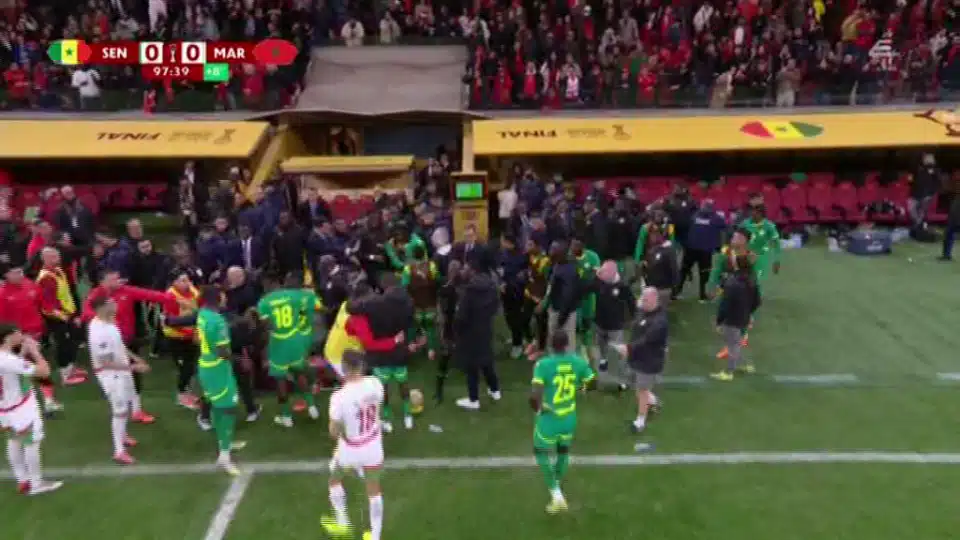
The defining moment came in the 98th minute, when a penalty was awarded to Morocco following a VAR review, a decision later confirmed by experts. This proved to be the most critical turning point of the final. Senegal coach Pape Thiaw stormed onto the pitch to protest, an action that prompted several of his players to leave the field in objection.
A group of both starting and substitute players responded to what was described as incitement, making gestures captured by television cameras.
Meanwhile, Senegal captain Sadio Mane remained on the pitch with two or three teammates, a situation which, from a legal perspective, suggested a calculated attempt to avoid the incident being classified as a full withdrawal from the match.
The legal analysis placed primary responsibility on Congolese referee Jean-Jacques Ndala, citing his failure to impose discipline at a decisive moment despite the wide authority granted to him under Law No. 5 of the Laws of the Game. According to Dr. Khalil Boubhi, once the Senegalese team returned to the field, the coach should have been sent off as a direct disciplinary sanction for entering the pitch and inciting players, in line with the requirements of Law No. “12.” He also noted that players who made provocative gestures should have been cautioned, something that did not occur.
The analysis further raised a sensitive refereeing issue regarding the penalty itself. Television replays indicated that Senegal goalkeeper Edouard Mendy crossed the goal line during the save, a situation that would legally require the penalty to be retaken under Law No. 14. However, the referee brought the match to an end with surprising speed, without intervention from the assistant referee or the VAR team.
Turning to the conduct of the Senegalese technical staff and players, Dr. Khalil Boubhi described the pitch invasion, calls for withdrawal and insinuations affecting the integrity of the refereeing as disciplinary violations rather than regulatory ones. He explained that such actions fall under the CAF Disciplinary Code and could trigger both disciplinary and ethical investigations.
The analysis suggested that severe disciplinary and financial sanctions could be imposed on the Senegal coach, some players, and possibly the Senegalese Football Federation, based on Articles 146 and 147 of the Disciplinary Code. It also emphasised the right of the Royal Moroccan Football Federation to approach the competent bodies to request investigations and tougher penalties.
Addressing the debate over whether Senegal should legally be deemed to have lost the match, the analyst clarified that Article “82” of the competition regulations does not apply in this case. He explained that the application requires the entire team to leave the field without the referee’s permission, which did not occur since the captain and several players remained on the pitch.
In this regard, he recalled the 1999 African Champions League final between Raja Casablanca and Esperance Tunis, when Raja players briefly left the field while captain Abdel Latif Grindo stayed behind. Play eventually resumed, and the Moroccan side went on to be crowned champions, with the incident treated as a disciplinary matter rather than an organisational one.
Regarding events in the stands, Dr. Khalil Boubhi considered the attempts by some Senegalese supporters to storm the pitch, along with acts of violence and vandalism, to be criminal offences under Moroccan law in addition to serious sporting violations.
He held the Senegalese federation partly responsible for inciting supporters and using them as a means of pressure, calling for sanctions that could include banning fans from attending and travelling to matches as a deterrent to protect the integrity of competitions.
The analysis concluded that while the Morocco 2025 edition of the Africa Cup of Nations will stand as a landmark in terms of organisational excellence and Morocco’s international sporting stature, it was marred by a legally troubling sporting episode.
According to Dr. Khalil Boubhi, the final became a moment where actions inside and outside the stadium attempted to divert the match from its natural course, leaving an episode that will remain open to debate within African sports law circles.
-
 Kruger United recruit South African striker Wonderboy Makhubu for Betway Premiership campaign Aug 26, 2026
 -
Sporting secure Morocco Under-17 defender Zekri as Senegal goalkeeper Diaw joins Al Shabab Aug 26, 2026
-
Lions let All Blacks escape after 68-minute battle at Ellis Park Aug 26, 2026
-
Ouaddou explains Maswanganyi tensions after Orlando Pirates exit Aug 26, 2026


-
AFCON 2025: Fixtures, Results, Scores and Standings Jan 18, 2026
-
Leadership and long-term vision key to rescuing Zamalek and inspiring Egyptian football – Hany Abou Rida Nov 5, 2025
-
South African giants Orlando Pirates set to lose influential forward Monnapule Saleng Mar 19, 2025
-
Full schedule for 2025 Africa Cup of Nations in Morocco confirmed Feb 12, 2025




-
Ajax close in on Franco-Guinean youngster Abdoulaye Camara Aug 19, 2026
-
DR Congo star Fiston Mayele joins Al Ahli Tripoli on two-year deal Aug 20, 2026
-
Ibrahim Maza ‘untouchable’ at Bayer Leverkusen unless two conditions are met Aug 19, 2026
-
Manchester United close in on Carlos Baleba agreement Aug 19, 2026