2025 AFCON final descends into controversy after disputed officiating decision
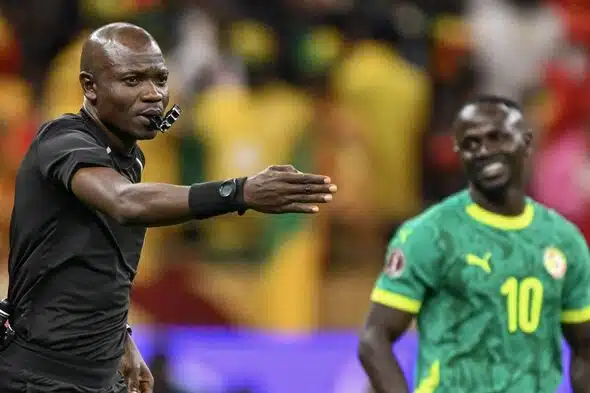
The 2025 Africa Cup of Nations final ended in extraordinary controversy after a series of refereeing decisions triggered protests from Senegal and overshadowed the showpiece match in Morocco.
The final, which had been delicately balanced at 0-0 deep into stoppage time, took a dramatic turn in the sixth minute of added time when Congolese referee Jean-Jacques Ngambo awarded a penalty to the host nation.
The decision immediately sparked outrage among the Senegalese players and technical staff, who strongly disputed the call and questioned the judgment of the match officials.
Tensions had already been high moments earlier. Senegal believed they had taken the lead after finding the back of the net, only for the goal to be ruled out.
The disallowed effort was met with disbelief on the Senegal bench and frustration among the players on the pitch, who felt they had been denied a decisive breakthrough in a tightly contested final.
When the penalty was subsequently given to Morocco, the sense of injustice within the Senegal camp intensified.
With emotions running high and the match nearing its conclusion, the Senegal head coach instructed his players to leave the field in protest.
The unprecedented decision effectively halted proceedings and plunged the stadium into confusion.
Supporters inside the ground and millions watching worldwide were left stunned as officials attempted to manage the unfolding situation.
Moroccan players gathered near the penalty area, awaiting clarity, while Senegal’s players stood firm in their refusal to continue, signalling their anger at what they perceived as biased officiating.
The match, intended to crown the champions of Africa, instead became defined by disorder and dispute.
What should have been a celebration of continental football descended into a prolonged stand-off, with no immediate resolution as officials conferred on the pitch.
The controversy surrounding the final added to a growing list of contentious moments that had already marked the tournament.
Throughout the competition, refereeing decisions had been the subject of debate, with teams and analysts repeatedly questioning consistency and the application of technology.
The dramatic events in the final only amplified those concerns on the biggest stage of all.
For Senegal, the sense of grievance was clear.
Having battled through the tournament and matched the hosts in a tense final, the players felt deprived of a fair sporting conclusion.
Their withdrawal from the pitch was a powerful statement, reflecting both their frustration and the gravity of the situation as they saw it.
For Morocco, the night was meant to be historic, with hopes of lifting the trophy on home soil.
Instead, the focus shifted away from performance and towards the decisions of the officials, leaving celebrations muted and the outcome clouded by uncertainty.
The Confederation of African Football was left facing intense scrutiny as the final drew to a chaotic close.
The incident raised serious questions about officiating standards, the handling of critical decisions in high-pressure moments, and the broader impact of controversy on the credibility of the competition.
Rather than being remembered for moments of brilliance or tactical mastery, the 2025 AFCON final will be recalled for a dramatic and deeply divisive conclusion that sparked global debate and cast a long shadow over African football’s biggest stage.
-
 Al Qanah midfielder Moudi Shalata reveals two major career ambitions after Al Ahly heroics Oct 22, 2026
 -
Mandla Ncikazi leaves Orlando Pirates to become PSL head coach Oct 22, 2026
-
Samkelo Zwane’s Kaizer Chiefs future uncertain after loan spell Oct 22, 2026
-
Siyethemba Sithebe joins Flamingo FC after 18-month spell without professional club Oct 22, 2026




-
AFCON 2025: Fixtures, Results, Scores and Standings Jan 18, 2026
-
Match hero Taiwo Awoniyi reflects on team effort after Chelsea triumph May 5, 2026
-
Leadership and long-term vision key to rescuing Zamalek and inspiring Egyptian football – Hany Abou Rida Nov 5, 2025
-
South African giants Orlando Pirates set to lose influential forward Monnapule Saleng Mar 19, 2025




-
PSG v Barcelona: fiery attacks set up Champions League classic at Parc des Princes Oct 18, 2026
-
Champions League: PSG beat Barcelona as Liverpool complete comeback against Villarreal Oct 20, 2026
-
Real Betis v Barcelona: kick-off time, TV details and match preview Oct 16, 2026
-
PSG beat Barcelona 4-2 in Champions League thriller Oct 21, 2026