AFCON switch to four-year cycle faces legal challenge under CAF statutes
The decision to change the Africa Cup of Nations (AFCON) from a biennial to a four-year tournament may be illegal under the governing statutes of the Confederation of African Football (CAF), according to official CAF documents and provisions of its laws.
The move, which has generated widespread debate across the continent, was never tabled, discussed or approved by the CAF General Assembly – the body recognised in CAF statutes as the organisation’s supreme authority.
Under Article 17 of the CAF Statutes, the General Assembly is explicitly described as “the supreme authority of CAF” and is responsible for defining the organisation’s general policy and approving fundamental decisions. Any major structural change affecting African football must therefore be presented to, debated by, and voted on by the General Assembly.
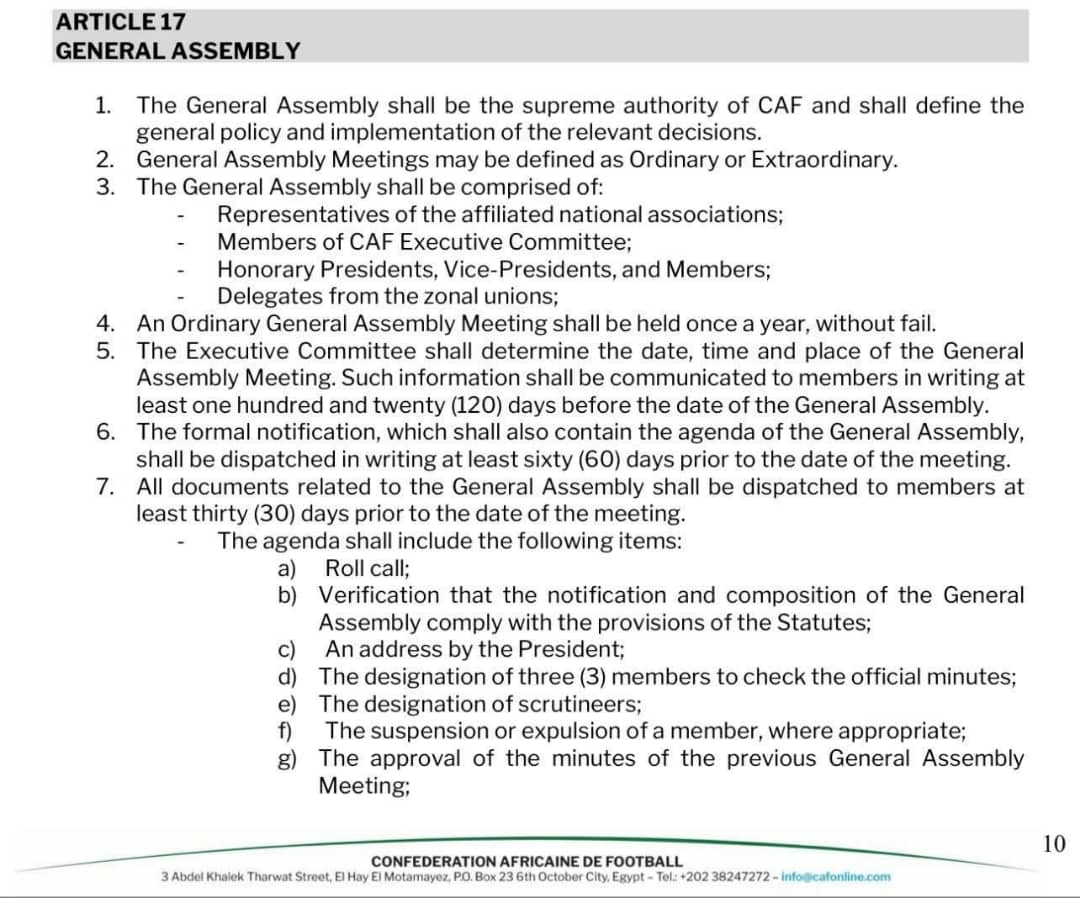
However, documents from CAF statutes show that no such proposal to change AFCON’s frequency was submitted ahead of the most recent General Assembly in Kinshasa.
According to the statutes, National Associations wishing to submit an item for inclusion on the agenda of a General Assembly must do so in writing at least 90 days before the meeting, with a clear explanation of the proposal. There is no record of an agenda item relating to a change in AFCON’s cycle meeting this requirement.
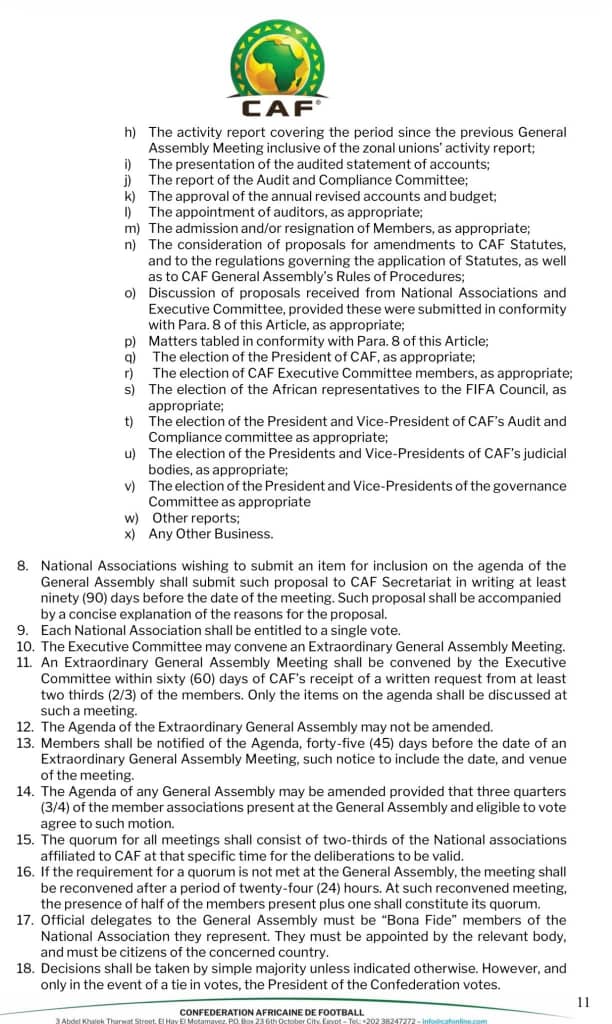
In addition, the statutes state that only matters listed on the official agenda may be discussed, and that the agenda itself can only be amended if three-quarters of member associations present and eligible to vote agree to such a motion.
CAF’s laws further clarify that each National Association has one vote, and decisions are taken by simple majority unless otherwise stated. Crucially, the Executive Committee – including the CAF president – does not have the authority to unilaterally alter the competition calendar in a way that fundamentally reshapes African football without General Assembly approval.
The documents also underline that the Executive Committee may convene an Extraordinary General Assembly, but even in that case, only items explicitly listed on the agenda can be discussed, and the agenda itself cannot be amended.
Legal experts and administrators familiar with CAF governance argue that changing AFCON from a two-year to a four-year cycle represents a fundamental shift in African football policy, comparable to altering statutes or competition regulations – actions that clearly fall within the exclusive remit of the General Assembly.
Critics of the decision say the issue is not whether a four-year AFCON is desirable, but whether due process has been followed.
“The rule of law matters,” one senior football administrator said. “CAF statutes are clear. The General Assembly is above the president, above the Executive Committee, and independent of FIFA. If the General Assembly has not approved this, then it has no legal standing.”
The statutes also make clear that if the General Assembly rejects a proposal, it cannot be implemented, regardless of external pressure or executive preference.
Attention now turns to Africa’s federation presidents, who collectively form the General Assembly. Under CAF law, they carry the responsibility to safeguard governance, ensure statutory compliance, and determine whether such a significant change to AFCON’s structure should stand.
If the matter is formally raised and rejected at a future General Assembly, the proposed four-year cycle would be void under CAF’s own rules.
For now, the controversy highlights ongoing tensions around governance, transparency and decision-making within African football – and raises serious questions about whether one of the continent’s most important competitions can be reshaped without the consent of its highest authority.
-
 Tottenham scouts watch Younes Ebnoutalib score Eintracht Frankfurt winner Oct 20, 2026
 -
Köln consider January move for German-Nigerian attacker Lukas Nmecha Oct 20, 2026
-
Manchester United join Liverpool in race for Borussia Dortmund midfielder Felix Nmecha Oct 20, 2026
-
Mali striker Lassine Sinayoko backs Paris FC to challenge for Ligue top spot Oct 20, 2026


-
AFCON 2025: Fixtures, Results, Scores and Standings Jan 18, 2026
-
Match hero Taiwo Awoniyi reflects on team effort after Chelsea triumph May 5, 2026
-
Leadership and long-term vision key to rescuing Zamalek and inspiring Egyptian football – Hany Abou Rida Nov 5, 2025
-
South African giants Orlando Pirates set to lose influential forward Monnapule Saleng Mar 19, 2025




-
PSG v Barcelona: fiery attacks set up Champions League classic at Parc des Princes Oct 18, 2026
-
Real Betis v Barcelona: kick-off time, TV details and match preview Oct 16, 2026
-
Morocco to face New Zealand as FIFA U-17 Women’s World Cup kicks off in Rabat Oct 16, 2026
-
Klinton Cod leads African journalists, Pundits and Content creators joining José Mourinho on Football.com TV Oct 19, 2026