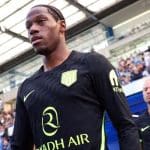
Zamalek vice-president Hisham Nasr says football company offer was worth 5bn Egyptian pounds

Zamalek vice-president Hisham Nasr says he was saddened by supporters’ criticism after the club’s match against Abu Qir Fertilizers in the fourth round of the league.
Nasr, speaking to MBC Masr, said: “I was upset by the attack from Zamalek fans because I had been suffering from a serious health problem over the past two months.”
He acknowledged the supporters’ right to express their views, adding: “The fans have the right to criticise and chant. Everyone knows the important role they played with the team last season, and we are grateful for everything they did.”
Nasr said he had asked why the criticism had occurred and believed supporters had formed an opinion about the proposed football company after hearing only one side of the issue.
“The Zamalek fans have built an idea about the football company,” he said. “My advice to them – they are like my children and friends – is not to form an opinion after listening to only one side. I am ready to sit with the fans, and with anyone who has questions, provided it is done politely and respectfully.”
Financial concerns
Nasr defended the current board’s record in the football department, pointing to winning the league and reaching the CAF Confederation Cup final.
“What we achieved by winning the league and reaching the Confederation Cup final is a miracle,” he said. “Imagine if this club had financial sustainability and stability.”
He said Zamalek had inherited significant commercial and financial difficulties.
“When we took over, there was only one advertisement on the first-team shirt. Now the entire shirt carries advertising, while the value of the television rights has become comparable with those of the leading clubs,” Nasr said.
He added that the club had created a new branch to generate income for sports that do not make money, including the first-team football operation.
“The football team spends one billion pounds, while the football company’s income is 500m pounds. That means there is an annual deficit of 500m pounds,” he said.
Nasr also revealed details of an offer to establish a football company, saying the valuation should be carried out by specialist firms rather than the board. As Zamalek is affiliated with the state, he said the proposal would also have to be submitted to the relevant administrative authority, with the club’s ownership protected.
“Anyone who spoke about selling Zamalek does not understand the offer made to the club,” Nasr said. “The offer we received to establish the football company was worth 1.8bn pounds. The investor would also cover the 500m-pound gap between revenue and expenditure for 10 years. Therefore, the total offer reached 5bn pounds.”
He said the project had been delayed because the board initially focused on the club’s new branch. Work on the football company and potential partnerships began after the crisis involving the withdrawal of the land.
Nasr thanked businessmen and Zamalek supporters who had provided financial assistance during difficult periods, but said the club needed a sustainable financial model to reduce the pressure on them.
Player departures
Regarding Juan Bizzera’s move to Shabab Al Ahli Dubai, Nasr said Zamalek faced a serious financial crisis and would not benefit as a club if it rejected the financial offer.
Asked whether the departure could lead to similar transfers, he replied: “Every situation is different. Zamalek produces stars, and players and coaches shine at Zamalek.”
He also defended the sale of Hossam Abdel Meguid to Bulgarian club Ludogorets during the previous summer transfer window.
“Hossam spent two seasons without renewing his contract and wanted to pursue a European move. Should we have allowed him to see out his contract and leave for free?” he said.
Nasr confirmed that Zamalek players’ outstanding payments had been transferred that day.
On Hossam El-Zanaty potentially becoming sporting director in place of John Edward, he said discussions were continuing over the requests and powers involved, with no decision yet made.
Nasr added that Zamalek would not sell any player in January if not for the land crisis, which forced the club to return money and created further financial problems. He said the club faced substantial debts and was working to resolve them.
-
 Adil Bourabaa faces three-month layoff after ankle surgery Oct 16, 2026
 -
Luis Enrique jokes about Ousmane Dembele’s holiday request Oct 16, 2026
-
Morocco to face New Zealand as FIFA U-17 Women’s World Cup kicks off in Rabat Oct 16, 2026
-
Jules Kounde considers Barcelona exit amid Premier League interest Oct 16, 2026




-
AFCON 2025: Fixtures, Results, Scores and Standings Jan 18, 2026
-
Match hero Taiwo Awoniyi reflects on team effort after Chelsea triumph May 5, 2026
-
Leadership and long-term vision key to rescuing Zamalek and inspiring Egyptian football – Hany Abou Rida Nov 5, 2025
-
South African giants Orlando Pirates set to lose influential forward Monnapule Saleng Mar 19, 2025




-
Real Betis v Barcelona: kick-off time, TV details and match preview Oct 16, 2026
-
Roma v Real Madrid: home side tipped to score first in Champions League clash Oct 12, 2026
-
Atletico Madrid v Manchester United: probable line-ups for Champions League clash Oct 12, 2026
-
Celta Vigo v Juventus: Probable line-ups for Europa League encounter Oct 14, 2026