World Cup 2026: Top Somalia referee Omar Abdulkadir Artan suffer visa setback ahead of tournament
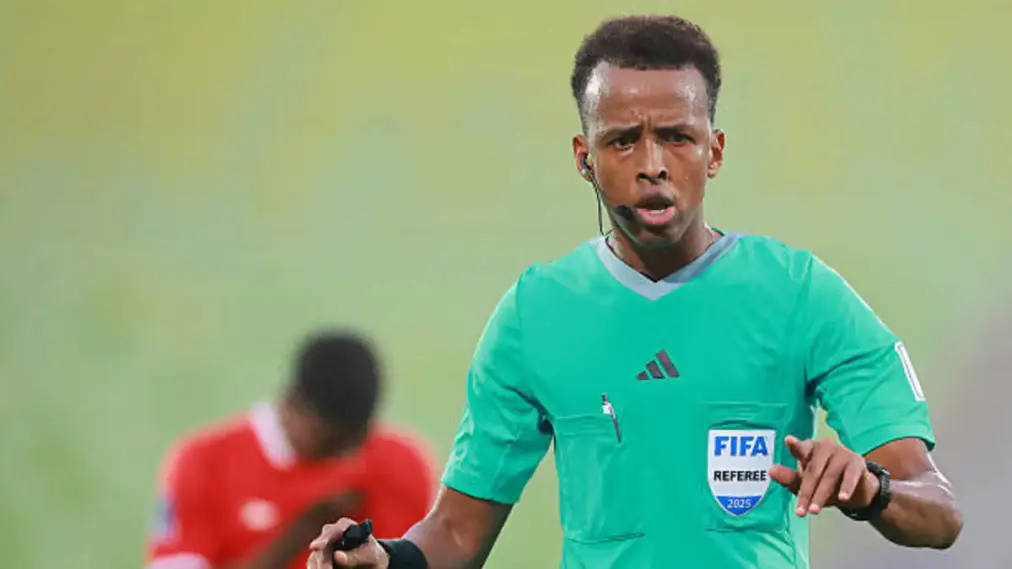
Concerns are growing over the availability of Somali referee Omar Abdulkadir Artan for the 2026 FIFA World Cup after reports emerged that he has yet to travel to the United States due to visa-related complications.
Artan, who was selected by FIFA among the elite group of match officials appointed for the global tournament, remains stranded just days before the competition gets underway. The situation has sparked uncertainty regarding whether the highly regarded Somali referee will be able to take up his duties in time for the start of the World Cup.
The tournament, which is being jointly hosted by the United States, Canada and Mexico, is set to bring together the world’s top football nations and the finest match officials from every confederation. For Artan, the appointment represented one of the biggest achievements of his refereeing career and a significant milestone for Somali football.
However, administrative hurdles now threaten to overshadow what should have been a proud moment for the experienced official.
According to reports, Artan is currently facing difficulties obtaining the necessary visa documentation required to travel to the United States. As a result, he remains unable to join the other referees selected for the tournament, many of whom have already arrived in North America and begun their pre-competition preparations.
The delay has attracted attention across African football circles, particularly given Artan’s reputation as one of the continent’s most respected referees. His absence from the group of officials already assembled in the host nation has inevitably raised questions about whether the issue can be resolved before the opening matches.
FIFA traditionally requires referees to participate in a series of seminars, physical assessments, technical briefings and training sessions ahead of major tournaments. These activities are designed to ensure consistency in decision-making and allow officials to familiarize themselves with the latest guidelines and competition protocols.
Missing part of that preparation period could potentially complicate matters, making a swift resolution increasingly important.
Artan’s selection for the World Cup was widely celebrated throughout Somalia and across East Africa. Over the years, he has built a strong reputation through his performances in continental competitions and international fixtures, earning recognition for his professionalism, composure and understanding of the game.
His appointment was viewed as a reflection of his steady rise through the ranks of African football officiating and a testament to the progress being made by Somali football on the international stage.
For many supporters, seeing a Somali referee chosen for the world’s biggest sporting event was a source of immense national pride. Consequently, the current uncertainty surrounding his participation has become a major talking point among fans and football stakeholders.
While other African referees selected by FIFA have successfully completed their travel arrangements and reported to the tournament’s preparation camps, Artan’s situation remains unresolved. The contrast has only heightened concern about the possibility of a delayed arrival or, in the worst-case scenario, an inability to participate.
Despite the uncertainty, there remains hope that the visa issue can be resolved quickly. Such administrative challenges have occasionally affected players, coaches and officials in international competitions, but many are ultimately settled through expedited procedures when major sporting events are involved.
Neither FIFA nor the relevant authorities have publicly indicated that Artan’s place among the selected referees is under immediate threat. Nevertheless, time is becoming an increasingly important factor as the countdown to the World Cup continues.
The coming days are expected to be crucial in determining whether the Somali official will be able to travel and join his colleagues before the tournament begins.
Should the issue be resolved, Artan would have the opportunity to fulfil a lifelong ambition by officiating on football’s biggest stage. If not, it would represent a disappointing setback for one of Africa’s leading referees and for Somali football, which has proudly followed his journey to the pinnacle of the profession.
For now, football fans across the continent will be hoping that a solution is found quickly, allowing Omar Abdulkadir Artan to take his rightful place among the referees selected for the 2026 FIFA World Cup.
-
 Francis Onyeka faces extended spell on sidelines at Elversberg Oct 19, 2026
 -
Qatar reportedly offers Algeria prospect Yacine Abed lucrative naturalisation package Oct 19, 2026
-
Azzedine Ounahi set to miss Morocco’s November qualifiers against Niger Oct 19, 2026
-
Nikolas Nartey set for Stuttgart return ahead of Atletico clash Oct 19, 2026




-
AFCON 2025: Fixtures, Results, Scores and Standings Jan 18, 2026
-
Match hero Taiwo Awoniyi reflects on team effort after Chelsea triumph May 5, 2026
-
Leadership and long-term vision key to rescuing Zamalek and inspiring Egyptian football – Hany Abou Rida Nov 5, 2025
-
South African giants Orlando Pirates set to lose influential forward Monnapule Saleng Mar 19, 2025




-
PSG v Barcelona: fiery attacks set up Champions League classic at Parc des Princes Oct 18, 2026
-
Real Betis v Barcelona: kick-off time, TV details and match preview Oct 16, 2026
-
Morocco to face New Zealand as FIFA U-17 Women’s World Cup kicks off in Rabat Oct 16, 2026
-
Bryan Mbeumo scores again as Manchester United held by Leeds Oct 18, 2026