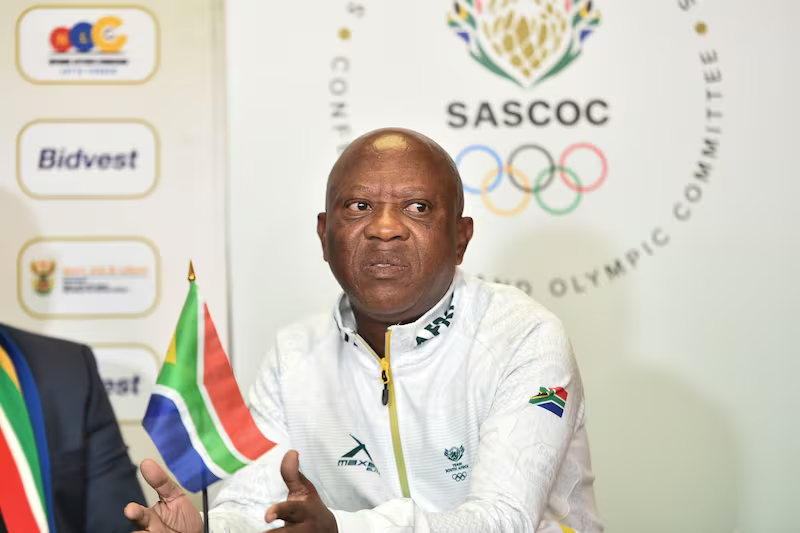
Athletics South Africa (ASA) have been ordered by World Athletics to remove suspended president James Moloi immediately and overhaul their constitution within six months, or risk a global suspension.
The instruction follows an independent disciplinary panel’s finding that Moloi was guilty of two charges involving the misuse of ASA funds. The panel, chaired by retired judge Basheer Waglay, ruled on October 6 2026 that removing Moloi as president and as a member of the executive board was the appropriate sanction.
In a letter signed by World Athletics chief executive Jon Ridgeon and addressed to ASA and its executive board, the governing body said the disciplinary decision must be implemented “without delay”.
World Athletics also issued a deadline for ASA to adopt a revised constitution and then hold fresh elections.
A fact-finding mission led in September by Zakhele Dlamini, president of the Southern African Confederation of Athletics (Saca) and vice-president of the Confederation of African Athletics (CAA), identified wider problems within the organisation.
“The report identifies serious deficiencies in the governance and functioning of ASA, including divisions within the executive board, difficulties in collective decision-making, uncertainty regarding the authority of elected officials and the validity of certain decisions, and conflicts of interest arising from overlapping responsibilities at national and provincial levels,” the letter said.
World Athletics added that the problems had contributed to “institutional instability” and affected ASA’s ability to meet its constitutional responsibilities, including its duties towards athletes.
The governing body said the issues represented “structural weaknesses in ASA’s governance framework, rather than isolated incidents or disagreements between individuals”.
World Athletics and CAA reviewed ASA’s existing constitution and a draft recently prepared by the federation. While acknowledging that the draft contained “several improvements”, they said it did not yet meet key governance standards.
The revised constitution must establish ASA’s council as the supreme decision-making body, with voting rights limited to properly accredited representatives of constituent members. Individuals must not hold multiple votes or represent more than one constituency at the same meeting.
It must also clearly separate the responsibilities of the council, executive board, president, commissions and administration. Electoral, disciplinary, vetting and financial oversight processes must be sufficiently independent, with transparent appointments and safeguards against interference.
The document must include suitable provisions on term limits, gender balance, athlete representation, transparency, financial accountability and the conduct of elected officials. It must also reflect South Africa’s current administrative and territorial organisation.
ASA has one month from the date of World Athletics’ letter to submit a detailed timetable for the revision and adoption process. The revised constitution must be formally adopted within six months, after which fresh elections must take place within a further three months.
Dlamini has been nominated by World Athletics and CAA as an independent observer for both the constitutional adoption process and the elections.
World Athletics said failure to approve a satisfactory constitution within six months, or any deliberate attempt to obstruct the roadmap, would lead to the matter being referred to its council for possible sanctions under article 13 of its constitution.
-
 Enzo Maresca backs Marc Guehi for future Manchester City captaincy Oct 20, 2026
-
Mohamed Salah takes swipe at Besiktas president with cryptic ‘35%’ post Oct 20, 2026
-
Leipzig coach challenges Yan Diomande to fulfil his potential at Real Madrid Oct 20, 2026
-
Liverpool and Manchester United consider moves for Dortmund midfielder Felix Nmecha Oct 20, 2026


-
AFCON 2025: Fixtures, Results, Scores and Standings Jan 18, 2026
-
Match hero Taiwo Awoniyi reflects on team effort after Chelsea triumph May 5, 2026
-
Leadership and long-term vision key to rescuing Zamalek and inspiring Egyptian football – Hany Abou Rida Nov 5, 2025
-
South African giants Orlando Pirates set to lose influential forward Monnapule Saleng Mar 19, 2025




-
PSG v Barcelona: fiery attacks set up Champions League classic at Parc des Princes Oct 18, 2026
-
Real Betis v Barcelona: kick-off time, TV details and match preview Oct 16, 2026
-
Porto v PSV: predicted line-ups for Champions League league-phase clash Oct 19, 2026
-
Bayern Munich host Arsenal in heavyweight Champions League clash Oct 19, 2026