WAFCON 2026: Historic final awaits as Cameroon face Malawi
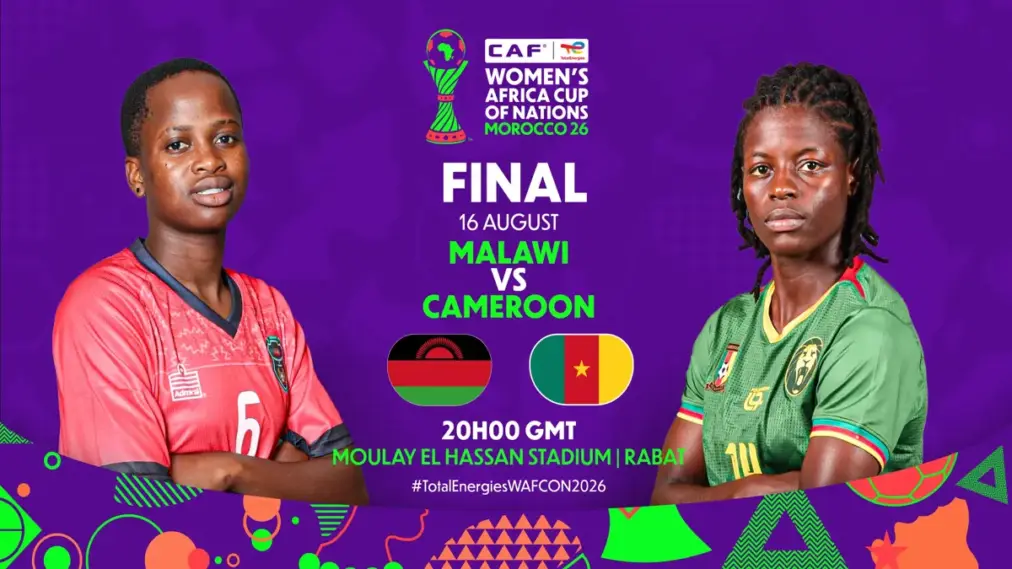
Cameroon and Malawi will meet in Rabat on Sunday in a historic Women’s Africa Cup of Nations final, with neither side having previously won the continental title.
The final at the Moulay-El-Hassan Stadium is scheduled for 20:00 GMT (21:00 local time), with both teams chasing a first Women’s AFCON crown.
Since the 2022 edition, this will be the first final contested by two nations yet to lift the trophy.
The winner will become only the fourth nation to claim the Women’s Africa Cup of Nations, joining record champions Nigeria, who have won 10 titles, Equatorial Guinea with two and South Africa with one.
The occasion represents a significant moment for both teams, although their routes to the final have been very different.
Malawi reach final for first time
Malawi’s appearance in the final is already a landmark achievement, with the Scorchers becoming only the seventh nation in the history of the competition to reach the title match.
Their presence also gives the final a distinctly historic feel.
A victory would deliver Malawi their first continental women’s football title and add a new name to the list of champions.
For Cameroon, the opportunity is equally significant.
The Indomitable Lionesses are seeking to turn their appearance in the final into a title-winning campaign and could achieve another distinction if they overcome Malawi.
A victory would make Cameroon the third African nation to win both the men’s and women’s Africa Cup of Nations. Only Nigeria and South Africa have previously achieved that feat.
This is also only the third Women’s AFCON final in which neither finalist has previously won the competition. The other two occasions came in 1998 and 2022.
A final with a history of drama
Previous Women’s Africa Cup of Nations finals have produced both high-scoring contests and closely fought encounters.
The record for the most goals scored in a final came in 2010, when Nigeria defeated Equatorial Guinea 4-2.
The biggest winning margin was recorded in 2004, when Nigeria beat Cameroon 5-0.
Equatorial Guinea also recorded a four-goal victory over South Africa in 2012, winning 4-0.
Of the 13 finals played before Sunday’s match, seven have ended with a winning margin of at least two goals.
There have also been occasions when the final has been decided by the smallest possible margin. In 2018, the match finished goalless before the winner was determined by a penalty shootout.
Defending will be crucial
The statistics from previous finals underline the importance of keeping a clean sheet.
Nine of the 13 previous finals were won by teams that did not concede.
The same figures show how unusual it is for both finalists to score, with that happening only four times.
Scoring first has also generally proved decisive. The 2024 final was the only exception in which a team that established a two-goal advantage went on to lose.
Morocco led Nigeria 2-0 in that match, but the Nigerians produced a comeback to win 3-2.
That history could make the opening goal particularly important when Cameroon and Malawi meet in Rabat.
A chance to create a new record
The final also provides an opportunity for individual history to be rewritten.
Nigeria’s Perpetua Nkwocha remains the only player to score both a hat-trick and four goals in a Women’s Africa Cup of Nations final. She achieved the feat against Cameroon in 2004.
This time, the focus will be on two teams attempting to create their own place in the competition’s history.
Cameroon arrive with the ambition of finally adding the women’s continental title to their achievements, while Malawi will seek to complete an extraordinary first appearance in the final by lifting the trophy.
With neither nation having previously been crowned African women’s champions, Sunday’s match guarantees a new winner.
For Cameroon and Malawi, the opportunity is more than simply a final.
It is a chance to establish a new chapter in the history of the Women’s Africa Cup of Nations, with one captain set to lift a trophy that has never before belonged to either nation.
-
 Tottenham scouts watch Younes Ebnoutalib score Eintracht Frankfurt winner Oct 20, 2026
 -
Köln consider January move for German-Nigerian attacker Lukas Nmecha Oct 20, 2026
-
Manchester United join Liverpool in race for Borussia Dortmund midfielder Felix Nmecha Oct 20, 2026
-
Mali striker Lassine Sinayoko backs Paris FC to challenge for Ligue top spot Oct 20, 2026


-
AFCON 2025: Fixtures, Results, Scores and Standings Jan 18, 2026
-
Match hero Taiwo Awoniyi reflects on team effort after Chelsea triumph May 5, 2026
-
Leadership and long-term vision key to rescuing Zamalek and inspiring Egyptian football – Hany Abou Rida Nov 5, 2025
-
South African giants Orlando Pirates set to lose influential forward Monnapule Saleng Mar 19, 2025




-
PSG v Barcelona: fiery attacks set up Champions League classic at Parc des Princes Oct 18, 2026
-
Real Betis v Barcelona: kick-off time, TV details and match preview Oct 16, 2026
-
Morocco to face New Zealand as FIFA U-17 Women’s World Cup kicks off in Rabat Oct 16, 2026
-
Klinton Cod leads African journalists, Pundits and Content creators joining José Mourinho on Football.com TV Oct 19, 2026