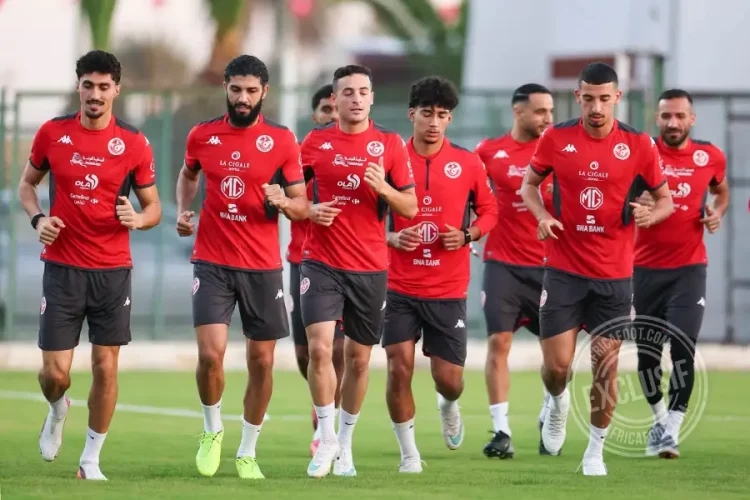
Tunisia’s search for stability will be tested when they face Libya on 13 and 17 November in a decisive double-header in the race to qualify for CAN 2027.
The Aigles of Carthage have taken only two points from their opening two matches, drawing 1-1 with Uganda and 2-2 with Botswana in October. With no victories so far, the results have increased scrutiny on a new coaching staff still trying to establish the team’s identity.
Uganda, co-hosts of the next CAN, are already guaranteed a place in the finals. That leaves one qualifying spot for Tunisia, Libya and Botswana, meaning Tunisia cannot afford another setback before the final two matchdays in March 2027.
For Nader Daoud, a former assistant with the national team, the current difficulties reflect more than poor results or tactical problems. He believes Tunisia are struggling to balance a generational change that has removed several long-standing figures from the squad.
The departures of Wahbi Khazri, Ellyes Skhiri, Naim Sliti and Youssef Msakni have created a significant gap in both technical quality and dressing-room authority. Their influence extended beyond performances: they were established figures who could take responsibility and provide direction when matches became difficult.
Tunisia have yet to identify players capable of filling that leadership role. The task is not simply to replace four individuals with four new players, but to rebuild the team’s hierarchy and develop a group able to carry the squad and pass on a winning mentality to a generation with fewer international references.
That lack of authority has been apparent when Tunisia have had to protect a lead or recover from a difficult position. They have sometimes lacked the character, control and rhythm required to impose themselves on opponents.
Creativity is another concern. Although Tunisia still have promising players, they do not currently possess the same depth of individuals able to decide matches with a piece of skill, a change of pace or an attacking run in a tight area.
The absence of Hannibal Mejbri is particularly significant. His energy, aggression in challenges, ability to break lines and capacity to accelerate play could have added a different dimension to the midfield. Tunisia must find other ways to give their attacking play personality and unpredictability, especially against opponents prepared to defend deep.
The new staff must deliver results while rebuilding the side’s foundations. The first two matches exposed problems in managing games and maintaining a coherent shape for 90 minutes, although Daoud’s assessment suggests responsibility cannot rest solely with the coaches.
Tunisia need a style suited to the players available, with clearer midfield roles, greater understanding in wide areas and more developed attacking combinations. They must also improve their efficiency at both ends of the pitch: October showed they can score, but not always control matches or protect an advantage.
Libya, known as the Knights of the Mediterranean, are under pressure too, having collected one point from their first two games. The fixtures offer them a chance to revive their campaign, and Tunisia would be unwise to judge them solely by their position or FIFA ranking.
In a derby, discipline, intensity and the handling of decisive moments can outweigh theoretical differences in ability. These matches are therefore an early test of Tunisia’s new cycle, with the immediate aim of taking maximum points and the wider challenge of showing that reconstruction has begun.
-
 Tunisia face Libya in crucial ‘six-point’ CAN 2027 qualifying derby Nov 10, 2026
-
Strasbourg track Gabriel Wesseh as African transfer news gathers pace Nov 10, 2026
-
Senegal v Sudan: Vieira’s side named favourites for key 2027 Africa Cup of Nations qualifier Nov 10, 2026
-
Bitegeko injury leaves Chiefs with just one player on international duty Nov 10, 2026


-
AFCON 2025: Fixtures, Results, Scores and Standings Jan 18, 2026
-
Match hero Taiwo Awoniyi reflects on team effort after Chelsea triumph May 5, 2026
-
Leadership and long-term vision key to rescuing Zamalek and inspiring Egyptian football – Hany Abou Rida Nov 5, 2025
-
South African giants Orlando Pirates set to lose influential forward Monnapule Saleng Mar 19, 2025




-
Manchester United host Aston Villa as both sides seek a Premier League lift Nov 6, 2026
-
Real Sociedad and Lyon name probable line-ups for Europa League meeting Nov 3, 2026
-
Atletico Madrid host Barcelona in Liga summit clash with history at stake Nov 6, 2026
-
Nottingham Forest v Manchester City: City Ground hosts clash at opposite ends of the table Nov 6, 2026