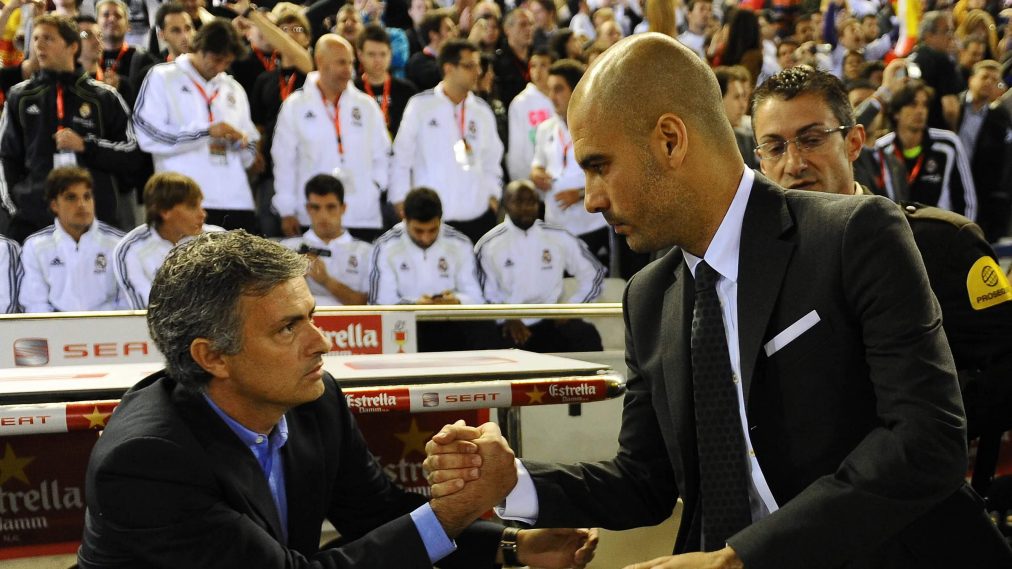
Eighteen years after a pivotal meeting in Lisbon, Marc Ingla still keeps the USB memory stick handed to him by Jose Mourinho in a desk drawer.
The device contained a 27-page presentation setting out Mourinho’s vision for Barcelona, where he was one of the leading candidates to replace Frank Rijkaard as head coach in the spring of 2008. According to Spanish newspaper Mundo Deportivo, the meeting took place as the club struggled with a growing sense of complacency and prepared for what was expected to be a second successive season without a trophy.
Mourinho was without a club after his unexpected departure from Chelsea at the start of the season, although he had already built a strong reputation through his work with Porto and Chelsea. His influential agent, Jorge Mendes, was aware that Mourinho and his family wanted to return to Barcelona, where the Portuguese had spent four satisfactory years as an assistant to Bobby Robson and Louis van Gaal.
Mendes arranged the meeting at the offices of Gestifute in the Portuguese capital. Ingla, then Barcelona’s vice-president for sporting affairs, attended alone after sporting director Txiki Begiristain withdrew the day before because of an unavoidable personal commitment.
Ingla, however, was not especially enthusiastic about Mourinho’s candidacy. He preferred Pep Guardiola, who had only just begun his coaching career with Barcelona B.
After the initial greetings, Mourinho produced a white USB stick from one of his pockets. His presentation insisted that Barcelona should retain the 4-3-3 formation, along with its tactical variations, as a non-negotiable foundation. The approach appeared to acknowledge Johan Cruyff, despite Mourinho’s poor relationship with the former Barcelona figure.
Mourinho also argued that the ball should be used in every training session, including physical-conditioning work, in a method associated with Cruyff’s football philosophy.
The presentation contained a detailed assessment of the squad. Mourinho questioned whether Ronaldinho should remain, while indicating that he wanted to keep Samuel Eto’o and Deco. Sylvinho, Lilian Thuram and Javier Ezquerro were listed as possible departures, while Mourinho also raised doubts about the roles of Edmilson, Oleguer and Zambrotta.
He did not discuss potential signings, but suggested recruiting former Barcelona players for his coaching staff. The names mentioned included Luis Enrique, Xavi Ferrer and Sergi Barjuan, all of whom had worked with Mourinho during his previous period at the club.
The most difficult discussion concerned his relationship with the media. Mourinho was told he needed to improve relations with journalists after a series of confrontations during Chelsea’s Champions League knockout meetings with Barcelona, in which he had displayed what was described as the worst side of his personality.
Rijkaard’s fate was ultimately sealed by Barcelona’s poor finish. He had delivered two La Liga titles and one Champions League trophy, but his side ended the campaign well behind Bernd Schuster’s Real Madrid, forming a guard of honour for them at Santiago Bernabeu. Barcelona were also eliminated by Manchester United in the Champions League semi-finals.
When the time came to appoint a successor, president Joan Laporta again followed Cruyff’s advice and backed Begiristain’s choice of Guardiola. As Barcelona’s greatest team began to take shape and Lionel Messi emerged, Mourinho felt snubbed and became the Catalan club’s foremost enemy.
-
 Jeremie Obounet Moussangova joins Union Sportive d’Oyem in Gabon Oct 25, 2026
-
Football betting tips for 25 October: Mbappe backed to score in El Clasico Oct 25, 2026
-
Cardoso refuses excuses as Sundowns suffer early CAF Champions League exit Oct 25, 2026
-
Makua questions whether some Kaizer Chiefs players are good enough for the club Oct 25, 2026



-
AFCON 2025: Fixtures, Results, Scores and Standings Jan 18, 2026
-
Match hero Taiwo Awoniyi reflects on team effort after Chelsea triumph May 5, 2026
-
Leadership and long-term vision key to rescuing Zamalek and inspiring Egyptian football – Hany Abou Rida Nov 5, 2025
-
South African giants Orlando Pirates set to lose influential forward Monnapule Saleng Mar 19, 2025




-
Barcelona v Real Madrid: Catalans backed at 1.65 to win October Clasico Oct 23, 2026
-
Barcelona and Real Madrid meet in pivotal 265th Clasico Oct 23, 2026
-
PSG v Barcelona: fiery attacks set up Champions League classic at Parc des Princes Oct 18, 2026
-
Champions League: PSG beat Barcelona as Liverpool complete comeback against Villarreal Oct 20, 2026