
Ramy Bensebaini: The Algerian recounts his beginnings at Paradou AC

Ramy Bensebaini’s rise to prominence in European football is closely tied to the foundation he built at Paradou AC, one of Algeria’s most respected football academies. Before making his mark at Stade Rennais and later establishing himself in Germany with Borussia Mönchengladbach, the Algerian international developed his skills through a unique and demanding training program that shaped both his technique and mentality.
Paradou AC has long been recognized as a model academy in Algeria and across Africa, known for its structured development system and emphasis on technical excellence. For Bensebaini, the institution played a decisive role in transforming a young, ambitious boy from Constantine into a professional footballer capable of competing at the highest level in Europe.
In an interview with Gladbach Live, Ramy Bensebaini reflected on his early journey. He revealed that he first played for his hometown club in Constantine, where he even wore the captain’s armband despite his young age. His talent quickly drew attention when Paradou AC organized nationwide trials to identify promising prospects. Initially selected to join a club in Algiers, Bensebaini faced an unexpected obstacle: his mother was reluctant to let him move so far away at just ten or eleven years old.
The setback proved difficult. Upon returning to Constantine, his former club no longer welcomed him, leaving him without a team for an entire year. Yet persistence paid off. The following season, he earned another opportunity through Paradou’s trial system and was finally admitted into the academy. That second chance would ultimately change his life.
Bensebaini spent six formative years at Paradou AC, undergoing an unconventional but highly effective training program. He described how, during the early stages, players trained and competed barefoot and without goalkeepers. Friendly matches were often played against older teams equipped with boots and full squads. The unusual methods were designed to sharpen technique, improve ball control, and develop intelligence on the pitch. When the young players eventually began wearing boots, it felt strange at first—proof of how deeply they had adapted to the academy’s philosophy.
For many of those boys, football represented more than a sport; it was a pathway to broader opportunities. Bensebaini acknowledged that it offered a rare chance to leave Algeria and pursue something greater. The discipline, resilience, and technical grounding instilled at Paradou became the bedrock of his professional career.
Now an African champion and a versatile defender recognized for his consistency and tactical awareness, Bensebaini openly credits the academy for his achievements. He emphasized that Paradou contributed to his development in every aspect, not only technically but also mentally and personally.
His heartfelt acknowledgment is likely to resonate with the coaches and staff at Paradou AC, who continue to nurture young talents with the same philosophy. As Bensebaini’s career continues to evolve in Europe, his story stands as a powerful testament to the academy’s influence and its status as a benchmark for football development in Algeria and beyond.
Popular News


-
Gianni Infantino joins Donald Trump’s inaugural ‘Peace Council’ as sole Sports representative
Feb 19, 2026 -

Young Mali midfielder Nouhoum Kamissoko targets breakthrough at Marseille
Feb 19, 2026 -
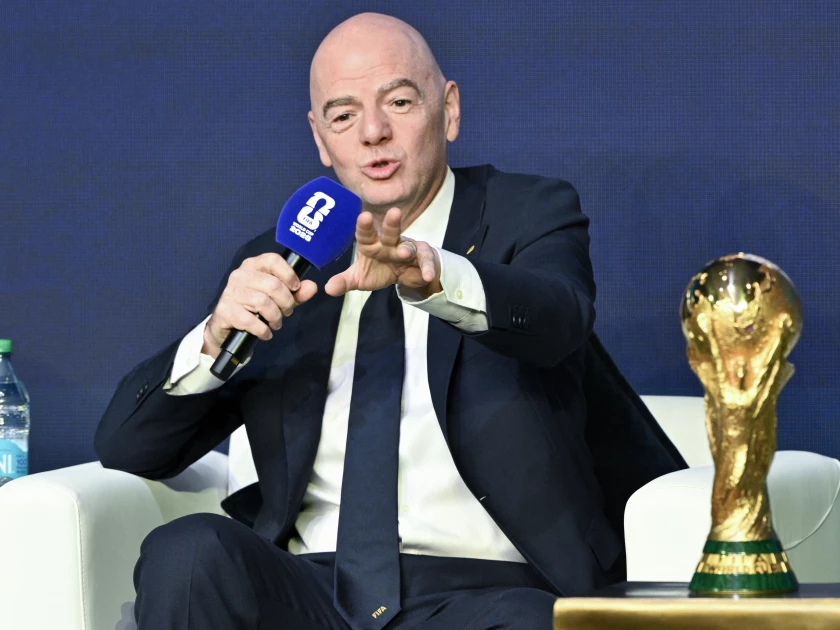
“Every match is SOLD OUT,” says Gianni Infantino as 2026 World Cup draws 508 million ticket requests
Feb 19, 2026 -

CAF EXCO member Samir Sabha calls for immediate resignation of General Secretary Veron Mosengo-Omba over ‘illegal’ mandate
Feb 19, 2026
-
BREAKING: FIFA World Cup 2026 final draw confirmed for December 5 in Washington, D.C.
Aug 22, 2025 -

Gabon legend Pierre-Emerick Aubameyang re-joins Olympique Marseille
Jul 31, 2025 -

FC St. Pauli eye move to sign Malian forward Lassine Sinayoko
Jul 31, 2025 -

Liverpool plotting to bid £120 million to sign Swedish-Eritrean striker Alexander Isak
Jul 31, 2025