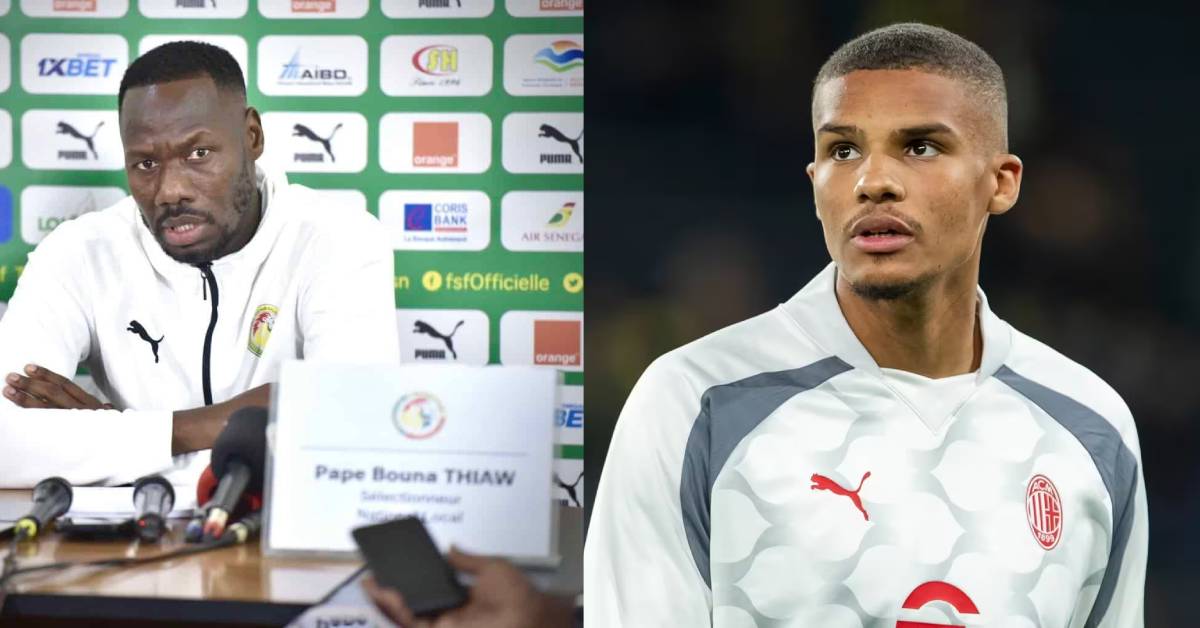
Pape Thiaw faced the most expected question in Dakar on Thursday.
The Senegal head coach spoke openly about Malick Thiaw and his possible future with the national team, addressing growing calls from supporters who want clarity on the German-born defender’s international plans.
For months, Senegal fans have revived the same debate every international window.
Many believe Malick Thiaw has both the talent and identity to strengthen the Lions of Teranga.
But the process, as Pape Thiaw explained, carries more depth than emotion alone.
The coach confirmed two direct meetings with the AC Milan defender.
The first came during Malick’s club spell in Italy. The second occurred recently after the Champions League meeting between Newcastle and Barcelona.
Both talks, Thiaw said, delivered honesty but also revealed the complications behind a national switch.
“We met twice,” Pape Thiaw told reporters. “The first was when he played for AC Milan, and the second was after the Newcastle-Barcelona game.
We talked. But some situations carry more layers than others. This one does.”
Unlike normal eligibility discussions, Malick Thiaw’s case sits in a legally sensitive category.
The 22-year-old has already represented Germany at senior level.
That anchors his sporting status to a federation filled with binding agreements beyond the pitch.
“When a player plays for Germany, it involves bonuses, contracts, image rights, and administrative agreements tied to sporting nationality,” Pape Thiaw explained.
“This isn’t just changing a shirt. This means reopening legal frameworks, financial clauses, and personal commitments. That takes time.”
The Senegal coach spoke with a calm tone but without hiding the reality.
His words suggested that national pride, although significant, does not override the documentation and personal obligations behind the switch.
Senegalese supporters, especially across social media, have shown frustration. Many argue that other dual-nationality players reached agreements faster.
Others believe Malick Thiaw’s delay signals hesitation. Pape Thiaw strongly disagreed.
“He loves Senegal, no doubt,” the coach said. “He shows it. He tells me. And I feel it every time we speak.
To us, he is family. He has a bond with this country that football alone cannot explain.”
Thiaw expanded on that emotional link, reminding audiences that the defender travels to Senegal regularly outside professional obligations.
“He spends his holidays here. He comes because he wants to, not because anyone pushes him. That matters.”
Despite frustration among supporters, the coach refused to force the situation or publicly pressure the player.
Instead, he urged patience and understanding.
“As the coach, I did what I had to do,” he said firmly. “I opened the door. I held the conversations.
I made our intentions clear. Now the decision belongs to him.”
His message carried not resignation, but respect. In his view, Malick Thiaw does not owe an overnight resolution to the public.
The defender deserves space to organise a career-changing final move that affects legal, professional and emotional dimensions at once.
“It’s not a matter of loyalty. It’s a matter of timing and process,” Thiaw said. “If this was a simple declaration, we would not sit here discussing it.
But it is not simple. It involves contracts, federations, lawyers and official signatures. That carries weight.”
Thiaw closed the topic by lowering the temperature, rejecting tension and appeals for impatience.
“We will not rush him,” he said. “We will not push him. We trust him.
We give him time. When he is ready, we will know. Until then, we continue to respect his journey.”
In a world of instant decisions and fast reactions, Pape Thiaw offered a slower message. Not a story of rejection.
Not a story of hesitation. A story of complexity, identity and choice.
For now, Senegal waits with hope, not hostility. And the door, the coach made clear, stays open.