
Mosengo-Omba targets DR Congo FA presidency as CAF exit nears
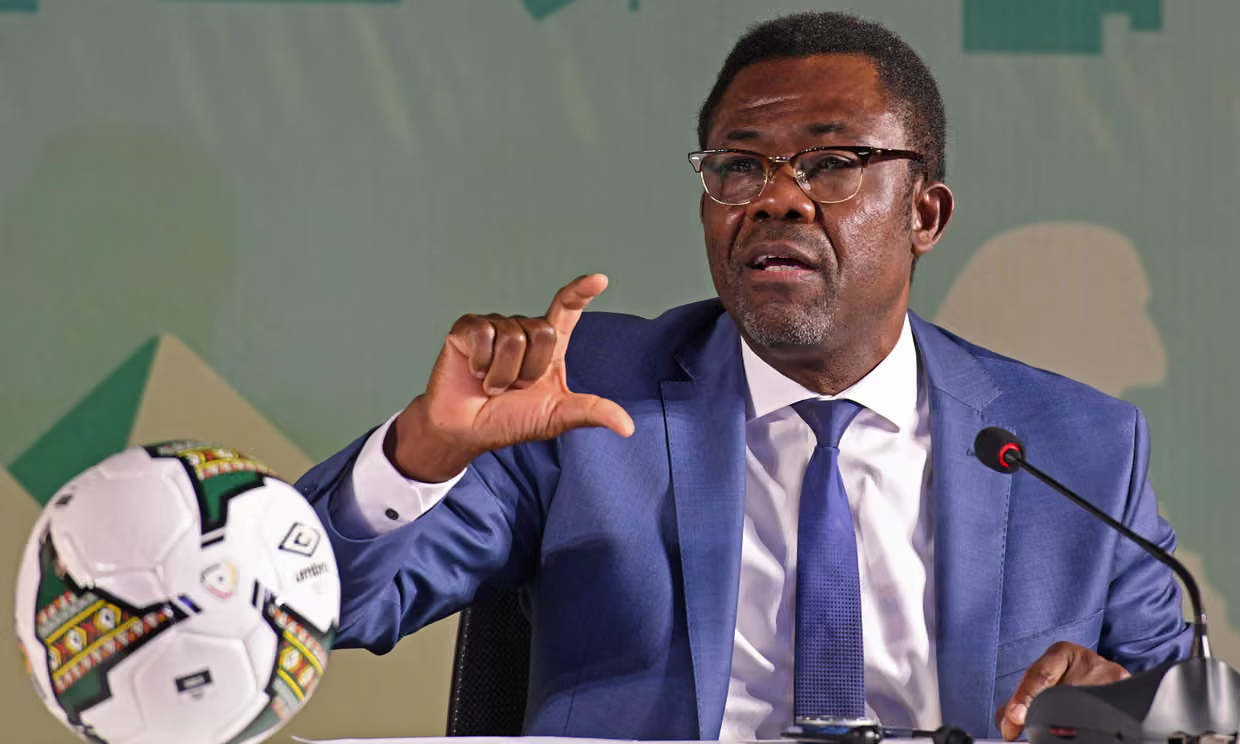
Véron Mosengo-Omba is set to contest for the presidency of the Democratic Republic of Congo’s football federation (FECOFA), as he prepares to step down from his role as general secretary of CAF.
Although the Congolese official has not publicly confirmed his candidacy or his departure from CAF, details of his proposed vision for Congolese football have emerged through respected French business outlet Financial Afrik, pointing to an imminent shift in his career.
His expected exit from CAF comes amid mounting pressure over his continued stay in office beyond the organisation’s mandatory retirement age, a situation that has exposed deep governance tensions within African football’s governing body.
CAF departure amid growing scrutiny
Mosengo-Omba is widely expected to leave his position when CAF’s Executive Committee meets in Cairo, following weeks of internal pressure and criticism.
Appointed in 2021, he exceeded CAF’s retirement limit in October 2025 after a three-year extension granted by president Patrice Motsepe expired. His decision to remain in office beyond that period drew sharp criticism from sections of CAF leadership, with some members reportedly prepared to push for his removal.
Sources close to the situation suggest he has opted to step aside voluntarily to avoid further confrontation, in what insiders have described as an increasingly “toxic” environment.
His tenure leaves a mixed legacy — marked by commercial growth and expansion of competitions, but also by persistent concerns over governance, transparency and controversial administrative decisions.
A return home with a reform agenda
Mosengo-Omba’s anticipated move to FECOFA signals a return to national football administration, where he is expected to position himself as a reform candidate with a comprehensive development plan.
According to Financial Afrik, his vision is built on four pillars: professionalisation, transparency, sustainable performance and economic development.
At the heart of his programme is a commitment to restructuring domestic competitions. He advocates for well-organised, regular and commercially attractive leagues capable of showcasing local talent and attracting both domestic and international investment.
For Mosengo-Omba, football in DR Congo should evolve into a fully-fledged economic ecosystem — one that generates employment, drives revenue and contributes to national development.
Focus on youth and grassroots development
A key component of his strategy is grassroots football.
He places strong emphasis on youth development, proposing the creation of academies and the strengthening of existing training centres across the country. Talent identification at an early age, he believes, is essential to building a sustainable pipeline for the national teams.
This approach aims to address long-standing structural weaknesses in Congolese football, where inconsistent development pathways have often hindered the transition of young talent to the elite level.
Governance and modernisation at the core
Mosengo-Omba’s experience within FIFA and CAF is central to his pitch.
Having operated at the highest levels of global football administration, he is positioning himself as a candidate capable of aligning FECOFA with international governance standards.
His plans include the digitalisation of administrative processes, improved financial management and strict adherence to regulatory frameworks. Transparency and accountability are also highlighted as key priorities, with a focus on eliminating opaque practices that have historically undermined trust in football institutions.
He is expected to present himself as a leader who can restore credibility with sponsors, partners and international bodies.
Inclusive vision for Congolese football
Beyond structural reforms, Mosengo-Omba is also advocating for a more inclusive football ecosystem.
His programme includes the promotion of women’s football, expansion of competitions across all provinces and equal opportunities for talent regardless of geographical or social background.
This nationwide approach is designed to ensure that football development is not concentrated in a few urban centres but benefits the entire country.
A defining moment for Congolese football
Mosengo-Omba’s potential candidacy comes at a critical juncture for both CAF and Congolese football.
While CAF faces uncertainty over its administrative future following his departure, FECOFA could be entering a transformative phase if his bid materialises.
However, questions remain.
His close ties to FIFA and the controversies surrounding his CAF tenure may influence how his candidacy is received domestically. Whether he is seen as a reformer with global experience or a figure linked to contentious governance debates could shape the outcome of the race.
For now, his plans — though not yet officially declared — offer the clearest indication yet of his next move.
If confirmed, Mosengo-Omba’s bid would mark a significant shift from continental administration to national leadership — and potentially redefine the future of football in the Democratic Republic of Congo.
Popular News


-
AFCON 2025: Fixtures, Results, Scores and Standings
Jan 18, 2026 -

Leadership and long-term vision key to rescuing Zamalek and inspiring Egyptian football – Hany Abou Rida
Nov 5, 2025 -

South African giants Orlando Pirates set to lose influential forward Monnapule Saleng
Mar 19, 2025 -

Full schedule for 2025 Africa Cup of Nations in Morocco confirmed
Feb 12, 2025
-
Morocco vs Ecuador Friendly: Where and How to Watch
Mar 26, 2026 -

Morocco vs. Ecuador: Match details, key talking points and where to watch
Mar 27, 2026 -
Chile overturn deficit to defeat Cape Verde in FIFA Series clash
Mar 27, 2026 -
Where and how to watch Saudi Arabia vs Egypt friendly ahead of 2026 World Cup
Mar 26, 2026


