Morocco’s Mehdi Benatia breaks silence after Marseille exit, blasts club culture and takes responsibility for failures
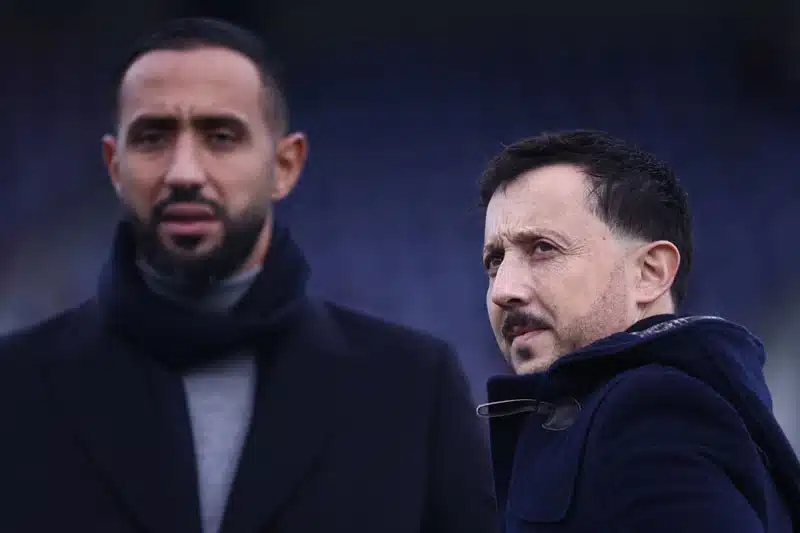
Former Marseille football director Mehdi Benatia has opened up about his turbulent two-and-a-half-year spell at the French club, revealing his frustrations with the way his tenure ended while also taking responsibility for some of the decisions that contributed to the club’s difficulties.
Benatia, who left Marseille after a period marked by intense pressure, internal disagreements and sporting challenges, reflected extensively on his time at the club in an exclusive interview with France Football.
The former Morocco international admitted that he was left feeling “a little sad” following his departure, particularly because he had hoped to leave Marseille on a high by helping the club secure qualification for the UEFA Champions League.
Instead, his time at the club ended amid considerable turmoil, with Benatia making it clear that the experience had taken a significant emotional and professional toll.
“I’m not complaining about anything; we are lucky people, but this experience was exhausting. It was a constant battle.”
Benatia explained that he deliberately chose to remain true to his personality throughout his time in Marseille rather than ignore problems or simply accept the status quo.
According to the former sporting director, he arrived at the club determined to confront issues that he believed had become deeply rooted within the organisation.
He described what he saw as an “unfortunately entrenched mediocrity” at Marseille and insisted that he attempted to challenge that culture rather than turn a blind eye to problems.
For Benatia, taking that approach inevitably created tensions because he was unwilling to remain silent when he believed something was wrong.
Despite his criticism of the club and several individuals, Benatia did not attempt to distance himself completely from Marseille’s shortcomings during his tenure.
The former defender acknowledged that he carries responsibility for certain failures, particularly decisions concerning the sporting project.
He admitted that the departure of the coach after the team struggled to maintain the same level of intensity over consecutive matches was also partly his responsibility because of his position within the club.
Benatia suggested that, as football director, he had to accept accountability when sporting decisions failed to produce the desired results.
His comments underline his belief that holding a senior position at a club such as Marseille comes with responsibility not only for successes but also for failures.
However, he strongly rejected the idea that he should be held responsible for all of Marseille’s financial and squad-management problems.
One of the areas in which Benatia sought to defend himself was the club’s financial situation and the perception that he left Marseille with a squad containing a large number of players the club wanted to sell.
Reports suggested that as many as 15 of the club’s 23 players were considered available for departure, but Benatia insisted that this situation could not simply be attributed to his management.
He argued that the frequent changes to Marseille’s squad during transfer windows had been happening long before his arrival.
According to the former director, the club already had a pattern of repeatedly rebuilding its squad, meaning that he should not be made the sole scapegoat for a situation that predated his tenure.
Benatia therefore pushed back against the narrative that his decisions were responsible for leaving Marseille with an unmanageable squad or worsening the club’s financial position.
Benatia was also highly critical of the attitude and professionalism of some players during his time at Marseille.
The former Morocco international accused certain members of the squad of selectively deciding which matches they wanted to perform in, suggesting that their commitment and intensity were not consistent from one game to another.
For someone who spent much of his playing career at the highest level, Benatia appeared particularly frustrated by what he perceived as a lack of consistency.
He insisted that players should be held accountable when their performances fall below expectations and argued that criticism of footballers should not be treated as something forbidden within a professional environment.
Benatia’s comments reflect a broader concern about the mentality within the Marseille squad, particularly when the team was expected to compete at the highest level.
The former Marseille football director also recalled an incident involving the club’s players during a training camp in Ivory Coast.
Benatia said he had seen videos showing Marseille players dancing and singing during the camp.
While such activities can often be considered harmless team-building exercises, Benatia appeared to question whether the players were displaying the appropriate mentality given the demands facing the club.
He then made a pointed reference to Marseille owner Frank McCourt.
The remark appeared to underline Benatia’s frustration with what he considered a mismatch between the seriousness expected at a major European club and the behaviour he witnessed from some players.
Benatia also revealed that there was a particular moment during his Marseille tenure when he felt “betrayed.”
The incident occurred before the Champions Trophy meeting with Paris Saint-Germain in Kuwait.
The match ended 2-2 after an entertaining encounter, with PSG eventually prevailing on penalties.
Although Benatia did not reveal every detail surrounding the episode, his decision to highlight the feeling of betrayal indicates the extent of the internal tensions he experienced during his final period at Marseille.
The former sporting director’s comments suggest that his departure was not simply the result of sporting disagreements but was also influenced by deeper issues concerning trust and relationships within the club.
Perhaps the strongest statement from Benatia came at the end of his interview, when he addressed the circumstances surrounding his departure.
The former Marseille sporting director insisted that he did not receive financial compensation in exchange for remaining silent about what happened during his time at the club.
He also stated that he did not sign a confidentiality agreement when leaving Marseille.
“When I left Marseille, I asked for nothing and I didn’t sign anything related to confidentiality. There’s no need to buy my silence. What I have to say is…”
The statement leaves the door open for Benatia to reveal further details about his experiences at the club.
His comments could therefore fuel further discussion around the internal workings of Marseille, particularly regarding the relationship between the sporting department, club executives, coaching staff and players.
Benatia’s two-and-a-half-year spell at Marseille ultimately ended without the stability he had hoped to establish.
He arrived with the reputation of a former top-level defender and Morocco international who understood the demands of elite football. His objective was to contribute to the construction of a competitive Marseille side capable of challenging domestically and returning to the highest level of European competition.
However, the period was characterised by managerial changes, squad turnover, disagreements and intense pressure.
While Benatia accepts that he made mistakes and that some sporting decisions during his tenure did not work, he clearly believes that many of the problems at Marseille were structural and existed before he arrived.
His interview with France Football therefore represents both an admission of responsibility and a strong defence of his record.
Benatia’s willingness to speak openly about his time at Marseille also demonstrates that his departure has not brought an end to the questions surrounding his relationship with the club.
Instead, his revelations have offered a rare insight into the internal tensions that accompanied his tenure, with the former sporting director making it clear that he remains prepared.
-
 Ghana’s Mohammed Salisu starts for Monaco for the first time in 285 days in win over CSKA Sofia Oct 16, 2026
 -
Burkina Faso v Ghana: How to watch the UFOA-B U17 clash live Oct 16, 2026
-
CAF Champions League: Pyramids FC take narrow first-leg lead over El Merriekh Bentiu Oct 16, 2026
-
Pyramids FC hold half-time lead over El Merriekh Bentiu in CAF Champions League Oct 16, 2026



-
AFCON 2025: Fixtures, Results, Scores and Standings Jan 18, 2026
-
Match hero Taiwo Awoniyi reflects on team effort after Chelsea triumph May 5, 2026
-
Leadership and long-term vision key to rescuing Zamalek and inspiring Egyptian football – Hany Abou Rida Nov 5, 2025
-
South African giants Orlando Pirates set to lose influential forward Monnapule Saleng Mar 19, 2025




-
Roma v Real Madrid: home side tipped to score first in Champions League clash Oct 12, 2026
-
Atletico Madrid v Manchester United: probable line-ups for Champions League clash Oct 12, 2026
-
Celta Vigo v Juventus: Probable line-ups for Europa League encounter Oct 14, 2026
-
Real Betis v Barcelona: kick-off time, TV details and match preview Oct 16, 2026