
Morocco FA president Fouzi Lekjaa hails King Mohammed VI’s vision for success
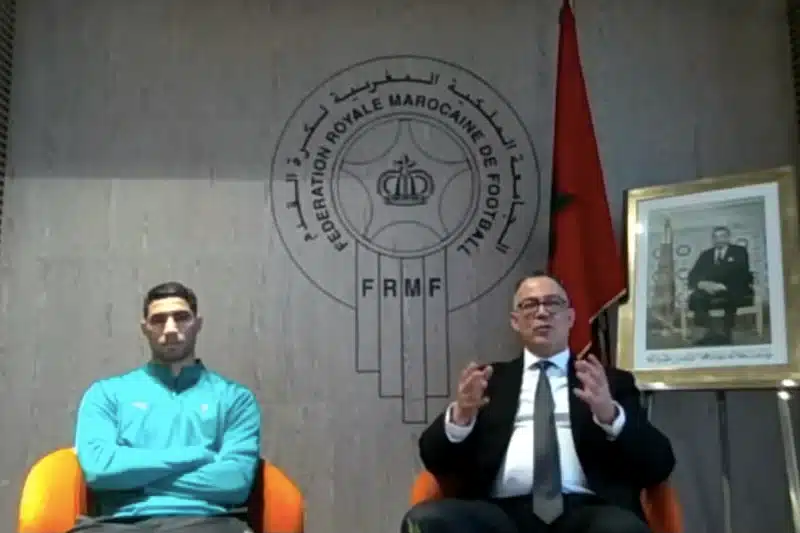
President of the Royal Moroccan Football Federation, Fouzi Lekjaa has credited King Mohammed VI for the series of successes achieved.
His comment stem from the sides FIFA Arab Cup triumph, where the Moroccan reserve team defeated Jordan to annex the title last week.
And according to Fouzi Lekjaa, the numerous achievement is a direct result of King Mohammed VI’s vision, stressing the King’s message to the National Sports Conference served as a roadmap.
He affirmed that there is no cause for concern regarding the future performance of the national teams, given the accumulation of generations of footballing talent.
Speaking alongside Moroccan international Achraf Hakimi as a guest on the “Passport Guest” program, broadcast on the “Youth Passport” platform, Lekjaa said that King Mohammed VI’s message to the National Sports Conference constitutes a clear, precise, and comprehensive roadmap for developing the sports sector in Morocco.
He added that the King proceeded to implement this vision on the ground, inaugurating the Mohammed VI Football Academy a year after the conference, followed by the Mohammed VI Football Complex in 2019.
He considered this complex to be a true space for developing skills using a professional methodology that is in no way different from the standards applied in developed countries in this field.
He stated that this integrated formula of Moroccan training and development, which has resulted in the success of a number of national coaches, including Sektioui, Regragui, Wahbi, and others, “can only produce elite young people who have made their mark in various age groups, both male and female, and in all types of football.”
Lekjaa believes that “this is the beginning of a path that will place Morocco among the leading countries in the field of football,” adding that “football cannot be separated from the development path led by” King Mohammed VI.
He emphasized that “footballing talent exists in the national championship,” citing as evidence the results of the African Nations Championship (CHAN) and the participation of Moroccan players in Qatar, where they competed against teams that had played in the World Cup, such as Jordan, Saudi Arabia, and the UAE.
“When we add the development of the institutional and marketing aspects, the championship will evolve to reach the pace of the national teams.”
The sports official reassured everyone that “football at the national team level is not in danger in the future,” pointing out that Hakimi, for example, “is still capable of participating in the 2026 World Cup, as well as the 2030 edition.”
“He will be joined by the generation that won the Under-20 World Cup and performed well in the Under-17 category,” as well as “a group of players who are emerging today but have not yet joined the national team.”
Popular News



-
AFCON 2025: Fixtures, Results, Scores and Standings
Jan 18, 2026 -

Leadership and long-term vision key to rescuing Zamalek and inspiring Egyptian football – Hany Abou Rida
Nov 5, 2025 -

South African giants Orlando Pirates set to lose influential forward Monnapule Saleng
Mar 19, 2025 -

Full schedule for 2025 Africa Cup of Nations in Morocco confirmed
Feb 12, 2025
-
DR Congo declares national holiday after 2026 World Cup qualification
Apr 1, 2026 -
Nigeria star Victor Boniface happy to return after three months injury absence
Apr 1, 2026 -

South African trainer Pitso Mosimane applies for vacant Ghana coaching job
Apr 1, 2026 -
Real Madrid set sights on Franco-Cameroonian star Hugo Ekitike
Apr 1, 2026