Morocco deserves to host 2030 World Cup final – FA chief Fouzi Lekjaa reiterates
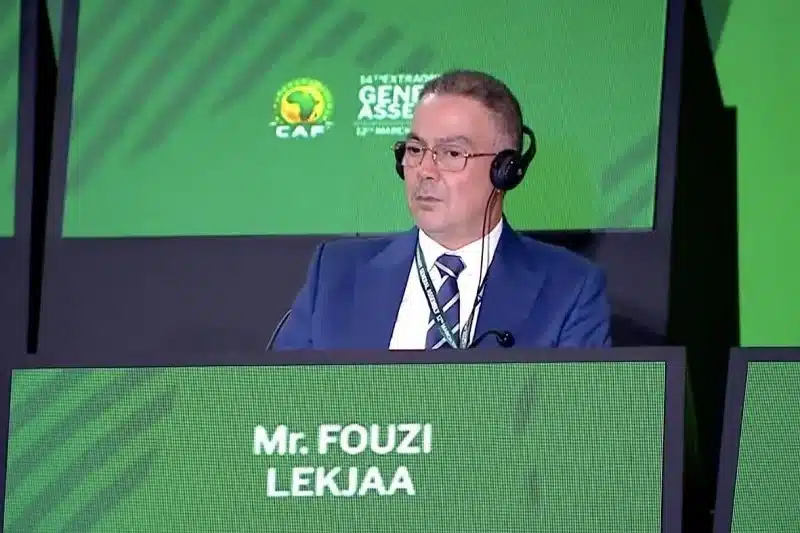
The Royal Moroccan Football Federation (FRMF) president Fouzi Lekjaa has reaffirmed Morocco’s determination to push for the right to host the 2030 FIFA World Cup final, insisting that the country’s ambition is also linked to Africa’s desire to stage the showpiece match.
Morocco will co-host the 2030 World Cup alongside Spain and Portugal, with the tournament designed as a joint project involving two continents. The three football federations have repeatedly stressed the importance of working together on the organisation of the tournament.
Speaking to Jeune Afrique, Lekjaa described Morocco as Africa’s representative in the joint hosting arrangement and stressed that the three countries should not approach the tournament as competitors.
“Morocco is Africa’s representative,” Lekjaa said. “We are not three countries operating in a spirit of competition, but rather one of complementarity, situated at the crossroads of civilizations and cultures.”
The FRMF president also made it clear that Morocco will continue to defend its ambition to host the final, which the country hopes could be staged at the planned Hassan II Stadium in Benslimane.
“We will always stand up for the rights of the Kingdom of Morocco and Africa—a continent that, in my view, deserves to host a World Cup final for the second time in a century,” he said.
Morocco’s position reflects the broader significance attached to the 2030 tournament, which will mark 100 years since the first World Cup. The joint bid was presented as a project connecting Africa and Europe, with the three federations highlighting its transcontinental character.
FIFA assessment underway
Lekjaa also addressed the process of determining the venues for the tournament’s biggest matches, explaining that FIFA task forces have visited Morocco, Spain and Portugal to assess proposed cities and infrastructure.
“Like our Spanish and Portuguese friends, we welcomed the FIFA task force, which visited all the proposed cities and infrastructure facilities,” he said.
“Decisions will follow in due course, in accordance with the established timelines.”
The Moroccan FA has continued preparations for the tournament, with Lekjaa calling for close coordination between Morocco, Spain and Portugal. In July 2026, he stressed that the three countries would be under FIFA’s spotlight and that preparations required continuous work and coordination.
World Cup to accelerate development
Lekjaa also linked Morocco’s preparations for 2030 to the country’s wider infrastructure and economic development.
He said preparations would require the acceleration of major mobility projects, including high-speed rail, highways and airports, to ensure Morocco is ready for the tournament.
“We will need to fast-track the completion of certain mobility projects—including high-speed rail, highways, and airports—to ensure we are ready for the crucial 2030 deadline,” he said.
Beyond infrastructure, Lekjaa believes the World Cup can create opportunities for young people through training, skills development and entrepreneurship.
“Hundreds of thousands of Moroccan and African youths—for this is an African World Cup—will have opportunities for training, skills development, and business growth; a startup will evolve into a small or medium-sized enterprise, and a medium-sized enterprise will grow into a large one,” he added.
The economic and business dimension has already featured in Morocco’s preparations. In February 2026, the FRMF hosted a Morocco-Spain-Portugal business forum focused on investment opportunities connected to the 2030 World Cup, including infrastructure, transport, tourism, hospitality, innovation, services and logistics.
Lekjaa also highlighted the Mediterranean identity of the joint tournament, describing the region as a meeting point of different cultures, religions and languages.
“We are situated on both shores of the Mediterranean, a region renowned for its history, civilization, and the coexistence of religions and languages,” he said.
For Morocco, the 2030 World Cup therefore represents more than a football tournament, with Lekjaa presenting the event as an opportunity to strengthen links between Africa and Europe while showcasing the country’s infrastructure, culture and growing role in international football.
Morocco, Spain and Portugal formally committed to their joint bid in 2023, with the three federations describing the project as an opportunity to create a tournament connecting Africa and Europe.
-
 Villarreal fight back to beat Napoli as Pape Gueye helps secure first Champions League win Oct 14, 2026
 -
Inter Milan beaten by Club Bruges in seven-goal UEFA Champions League thriller Oct 14, 2026
-
Burkina Faso and Togo level at half-time in UFOA-B Under-17 clash Oct 14, 2026
-
CAN 2027: CAF considers winter switch as host preparations fall behind Oct 14, 2026



-
AFCON 2025: Fixtures, Results, Scores and Standings Jan 18, 2026
-
Match hero Taiwo Awoniyi reflects on team effort after Chelsea triumph May 5, 2026
-
Leadership and long-term vision key to rescuing Zamalek and inspiring Egyptian football – Hany Abou Rida Nov 5, 2025
-
South African giants Orlando Pirates set to lose influential forward Monnapule Saleng Mar 19, 2025




-
Atletico Madrid v Manchester United: probable line-ups for Champions League clash Oct 12, 2026
-
Manchester United host winless Tottenham in Premier League clash Oct 7, 2026
-
Roma v Real Madrid: home side tipped to score first in Champions League clash Oct 12, 2026
-
Real Madrid fitness update: Valverde a doubt for Villarreal as Kylian Mbappe returns Oct 8, 2026