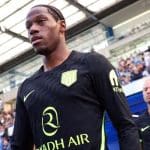
Three days before Trabzonspor announced the signing of Mohamed Salah, control of his four British companies changed hands, with his wife, Magi Mohamed Sadiq, appointed as a director of all four on the same day Salah stepped down from their boards.
The changes were made on 3 August 2026. In three of the companies, Sadiq was joined by chartered accountant and tax adviser Frederick William Huxtable, who had already been a director of the main trading company since May 2024.
Three days later, on 6 August, Trabzonspor announced a two-year contract for Salah.
The timing points to a significant reorganisation of the Liverpool forward’s business and asset structure, although the sequence of events does not prove why the changes were made. Tax considerations are one possible explanation, against a backdrop of simultaneous developments in the United Kingdom and Abu Dhabi.
Sadiq takes a larger formal role
Sadiq has generally remained out of the spotlight during her husband’s rise to European football prominence, but company records show she had already been involved in the family’s business structure before Salah’s move to Turkey.
She was previously an owner or shareholder in two of the family’s companies, while their daughter, Makka Salah, jointly owns a third company with her father.
The important change on 3 August was her appointment as a registered director of all four companies, at the same time as Salah left their boards.
The four companies’ latest accounts show combined accounting assets of more than £54m and net positions approaching £34.8m. The figures cover different accounting periods and are presented in different ways. They do not represent the companies’ market value or an estimate of Salah’s personal wealth.
Salah owns all the shares in his principal trading company, SALAH UK COMMERCIAL LIMITED. He and Sadiq own MOS REAL ESTATE equally.
He also owns half of TRINITY KENSINGTON with Makka Salah, while retaining the right to appoint or remove its directors. Sadiq owns all the shares in MOS INVESTORS and is recorded as the person with control of that company.
Under the new arrangements, Salah has moved his working life to Turkey without remaining a registered director of any of his four British companies. Sadiq and Huxtable are now their only registered directors.
Huxtable was previously a partner at the international accounting and tax advisory network RSM and has written about the taxation of image rights.
The new structure may separate Salah’s professional life in Turkey from the management of his British assets, but it does not automatically exempt him from UK tax. His UK tax residence would depend on other factors, including the number of days he spends in Britain, where he works and lives, and his family connections.
SALAH UK COMMERCIAL and image rights
SALAH UK COMMERCIAL LIMITED began operating around the time Salah moved to Chelsea and remains active.
Its importance was highlighted in an Amsterdam court ruling concerning a dispute with Adidas. The judgment said Salah’s UK image rights were owned and managed by SALAH UK COMMERCIAL, while IMAGECORP HOLDINGS LIMITED owned and managed those rights elsewhere in the world.
The two companies had separate sponsorship agreements with Adidas, both of which ended on 31 July 2026. SALAH UK COMMERCIAL therefore provides a structure through which the use of Salah’s name and image in the UK can be licensed in return for payments made to the company.
Its latest available accounts, filed in February 2026 for the year ending June 2025, showed total assets of about £46m and liabilities of roughly £10.5m. Net assets stood at £35.5m, compared with about £29.3m a year earlier, an increase of approximately £6.2m.
Net assets are not Salah’s annual income or an amount he received in cash during the year. They represent the accumulated value held by the company after liabilities are deducted. The published accounts do not separately identify annual sales or show how much Liverpool paid in comparison with sponsorship income.
HM Revenue and Customs says a company’s profits are subject to corporation tax. Money taken by its shareholder is then governed by separate rules depending on whether it is paid as a salary or dividend. The accounts show that the company accumulated net assets worth tens of millions of pounds during Salah’s time in the Premier League.
UK tax changes due in 2027
In November 2025, the UK government announced plans for a tax change to take effect on 6 April 2027. It will target image-rights payments connected to a player’s contract with his club.
Under the current system, a player’s company can receive payments from his club for exploiting his image without those payments automatically being treated as salary. However, the rights must have genuine commercial value and the club must have a real plan to exploit them.
A case involving Hull City established an important boundary. Payments equivalent to about 25% of one player’s income were treated as wages after authorities concluded the club did not have a genuine commercial plan for using his image rights.
Once the new rule takes effect, any image-rights payment linked to a player’s employment will be treated as part of his earnings, even when it is paid to his company. It will therefore be subject to income tax and National Insurance contributions.
The change does not automatically cover separate sponsorship contracts, such as agreements with Adidas or Pepsi.
Salah’s Liverpool contract had been due to run until 2027 before the parties agreed to end it early. Had it continued, the new rule would have taken effect during its final weeks, meaning any image-rights payments connected with that contract could have been treated as employment income, even if they were received by his British company.
Salah announced on 24 March 2026, about four months after the tax change was revealed, that he would leave Liverpool at the end of the season. The timing makes the reform a possible factor, but it does not establish that it influenced the decision. No document links the two events.
IMAGECORP leaves Abu Dhabi
IMAGECORP HOLDINGS LIMITED is described in the Dutch judgment as the company that owned and managed Salah’s image rights outside the UK.
Public records from Abu Dhabi Global Market (ADGM) show that it was incorporated in the Cayman Islands on 24 January 2014 under the number GC-284598. In January 2021, it legally moved to ADGM, where it was registered under entity number 000005015.
Rami Abbas Issa, Salah’s lawyer and adviser, appeared as one of its directors. On 4 April 2025, Salah ceased to appear as a direct shareholder, and an entity called JUPITER INVESTMENTS LIMITED subsequently appeared as the direct shareholder.
A change in the name of the direct shareholder does not reveal the ultimate beneficial owner. The public register does not identify who benefits from Jupiter, so it is not possible to establish whether it is a holding company within a structure used by Salah or an independent entity.
On 29 April 2026, around five weeks after Salah announced his departure from Liverpool, ImageCorp applied to move from ADGM to another jurisdiction. ADGM approved the process on 17 June, and the transfer was finally recorded on 22 June.
The wording “continued outside Abu Dhabi Global Market” means ImageCorp was not dissolved. Instead, it moved its legal domicile to another jurisdiction while retaining its legal identity.
On the same day, Rami Abbas ended his time as a director in the ADGM records. Abbas had appeared in the structure of Salah’s international image rights since 2018. Jupiter also ceased to appear as a direct shareholder.
The available public record ends at that point. It does not disclose the new jurisdiction, or the names of the directors and shareholders following the transfer.
When ImageCorp moved to Abu Dhabi in 2021, the United Arab Emirates did not operate the current federal corporation tax system. Corporation tax began applying to financial years starting on or after 1 June 2023, requiring companies to register, file returns and pay any tax due.
Being based in a free zone does not guarantee a zero tax rate. That treatment applies only to “qualifying income”, while non-qualifying income is subject to a 9% rate. The Federal Tax Authority’s guidance says brands and other marketing-related intellectual property do not fall within the category of qualifying intellectual property for the zero rate.
Tax is therefore one possible explanation for ImageCorp’s departure from Abu Dhabi. Its application was filed in April 2026, after the new system had come into effect. But it coincided with other commercial and sporting changes involving Salah.
Both Adidas agreements referred to in the Dutch judgment ended on 31 July 2026. Three days later, Salah left the boards of his four British companies. Three days after that, he signed for Trabzonspor.
The tax theory carries some weight, but it cannot explain the decision on its own. Salah was also ending one sporting and commercial phase and beginning another, creating a possible reason to reorganise his image rights, contracts and companies.
The Trabzonspor deal
Trabzonspor’s contract adds another element to the structure.
According to the club’s disclosure to Turkey’s Public Disclosure Platform, KAP, Salah will receive a €10m salary and a €7m signing fee in each of the two seasons covered by the agreement. That represents guaranteed annual payments of €17m, excluding performance-related bonuses whose value has not been disclosed.
The announcement also includes an agent-service fee worth 5% of the player’s total remuneration. That is a separate cost of the deal and is not additional money paid to Salah.
A separate agreement gives him 20% of sales of products bearing his name through the club’s retail company. It does not give him 20% of all Trabzonspor sales, or 20% of all income from his image rights in Turkey.
Trabzonspor’s disclosure does not say whether the 20% share will be paid directly to Salah or through one of his companies. Either way, transferring the money to a company outside Turkey would not automatically remove it from Turkish tax rules. Payments sourced in Turkey could face local withholding or other tax treatment, depending on the nature of the rights, the company’s location and the relevant double-tax treaty.
If the income is received by Salah’s British company, its profits would fall under the UK corporation tax system, whose main rate is 25%. Had ImageCorp remained in Abu Dhabi, a zero rate would still not have been guaranteed because marketing-related income from a name and image could have been taxed at 9%.
ImageCorp left Abu Dhabi less than two months before Salah signed for Trabzonspor. The key unanswered question is therefore not simply whether the Turkish income will flow to Britain or the UAE, but where the company that previously managed his non-UK image rights is now based, and whether it will receive the 20% share of sales linked to his name in Turkey.
Salah has entered the Turkish stage with responsibilities redistributed across his business interests: he retains control of his main British company, its registered management has moved to his wife and a professional accountant, and the company handling his international rights has left Abu Dhabi for an undisclosed jurisdiction. At the same time, the Trabzonspor contract creates a separate stream of commercial income connected to his name.
Those steps do not, by themselves, prove a tax plan. Taken together, however, they show a restructuring of Salah’s commercial affairs shortly before his sporting and business move from Britain to Turkey.
-
 Maghreb de Fes and ASEC Mimosas reveal probable line-ups for CAF Champions League tie Oct 17, 2026
 -
Maghreb de Fes face a l’ASEC Mimosas in first-ever CAF Champions League meeting Oct 17, 2026
-
Leeds v Manchester United: Mbeumo backed at 3.4 as sides meet in Premier League derby Oct 17, 2026
-
Abongile Tom backed despite two contentious MTN8 final penalty decisions Oct 17, 2026



-
AFCON 2025: Fixtures, Results, Scores and Standings Jan 18, 2026
-
Match hero Taiwo Awoniyi reflects on team effort after Chelsea triumph May 5, 2026
-
Leadership and long-term vision key to rescuing Zamalek and inspiring Egyptian football – Hany Abou Rida Nov 5, 2025
-
South African giants Orlando Pirates set to lose influential forward Monnapule Saleng Mar 19, 2025




-
Real Betis v Barcelona: kick-off time, TV details and match preview Oct 16, 2026
-
Roma v Real Madrid: home side tipped to score first in Champions League clash Oct 12, 2026
-
Atletico Madrid v Manchester United: probable line-ups for Champions League clash Oct 12, 2026
-
Celta Vigo v Juventus: Probable line-ups for Europa League encounter Oct 14, 2026