Marriage won’t end our careers: Ngozi Okobi’s fight to change Nigeria’s women’s football mindset
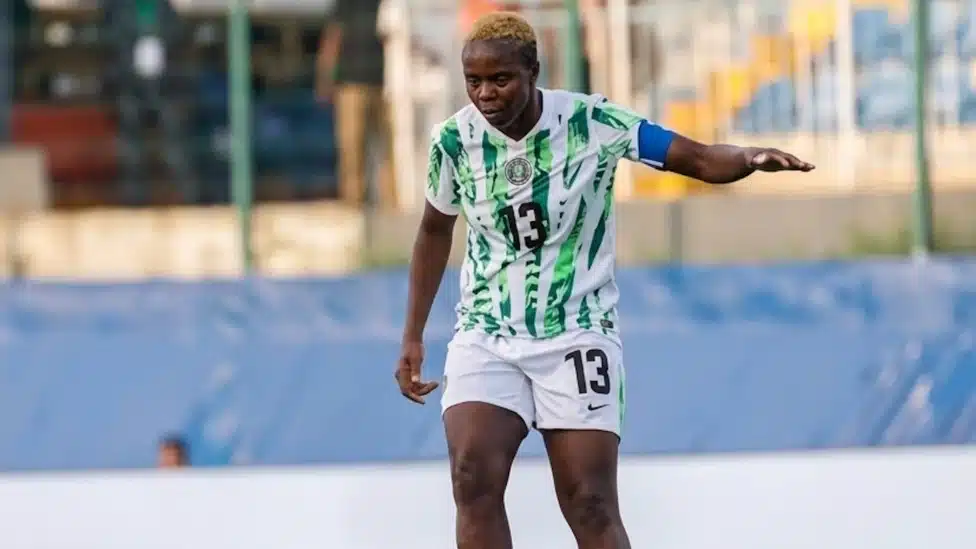
For years, a quiet belief has followed women’s football in Nigeria – that marriage and motherhood could signal the end of a player’s international career.
Former Super Falcons midfielder Ngozi Okobi-Okeoghene is determined to challenge that narrative.
As Nigeria prepare for the 2026 Women’s Africa Cup of Nations (WAFCON) in Morocco, the four-time African champion has opened up on the pressure many female footballers face when considering marriage and starting families.
According to Okobi, several Super Falcons players have delayed marriage because they fear losing their place in the national team.
The 32-year-old, who earned 75 caps for Nigeria and won four WAFCON titles, believes social attitudes towards married women and mothers have created unnecessary anxiety among female athletes.
“Nigerians, most of the fans out there, feel when a woman is married, she’s old,” Okobi said. “When a woman gives birth, she’s old, she doesn’t have the strength to do whatever she’s doing.”
A personal journey that changed the conversation
Okobi’s argument is built on personal experience. She married Okeoghene Ahmed in 2017 and continued playing for Nigeria after tying the knot, proving that family commitments and elite football could coexist.
However, her career later took an unexpected turn when she stepped away from the game due to a high-risk pregnancy, forcing her to miss major international tournaments, including the 2023 FIFA Women’s World Cup and the Paris 2024 Olympic Games.
After seven years of marriage, Okobi welcomed her first child, a baby boy named Nathan, in September 2024 in Canada.
Rather than allowing motherhood to close the door on football, she began the difficult process of rebuilding her career. Five months after giving birth, she started an intense fitness programme designed to regain her strength and match readiness.
Her hard work paid off when she returned to competitive action in June 2025, coming off the bench in the 83rd minute for Ottawa Rapid FC in Canada’s Northern Super League — just eight months after becoming a mother.
‘Motherhood should not be the end of anyone’s story’
Okobi’s comeback eventually earned her another opportunity with the Super Falcons. Head coach Justin Madugu recalled the midfielder for friendly matches against Cameroon and Senegal in early 2026, before including her in Nigeria’s squad for the WAFCON tournament in Morocco.
Nigeria, the record 10-time African champions, have been drawn in Group C alongside Malawi, Zambia and Egypt.
For Okobi, her return is proof that motherhood should not be viewed as a barrier to success.
“They keep making us feel bad about ourselves,” she said. “Most of the girls are so scared to get married. They feel by the time they get married, they won’t be called to the national team anymore.”
The former Levante and Washington Spirit player believes football authorities and supporters must do more to encourage female athletes to pursue both sporting and personal ambitions.
“Being a soccer player doesn’t stop me from being a wife. It doesn’t stop me from being a career woman, an athlete,” she added. “We need to encourage our women. We need to make them understand that of course they can do more.”
A champion returns for another WAFCON challenge
Okobi’s career remains one of the most decorated in Nigerian women’s football history.
She played a key role in Super Falcons triumphs at the WAFCON in 2010, 2014, 2016 and 2018, while also scoring against Sweden at the 2015 FIFA Women’s World Cup in Canada, where she was named Player of the Match.
At the 2019 FIFA Women’s World Cup in France, she featured every minute of Nigeria’s campaign as the team reached the knockout stage for the first time in two decades.
Now, after overcoming pregnancy, motherhood and doubts about her future, Okobi is preparing for another continental challenge with Nigeria.
The Super Falcons will begin their 2026 WAFCON campaign against Malawi on July 28, before facing Zambia on August 1 and Egypt on August 5.
Her journey from childbirth back to the national team has become more than a personal comeback story — it is a statement against one of the biggest misconceptions surrounding women’s football in Nigeria.
-
 Rangers coach Derek McInnes welcomes Tochi Chukwuani’s impact in St Johnstone win Oct 24, 2026
 -
Bayer Leverkusen chief sends clear message to Victor Boniface amid January exit rumours Oct 24, 2026
-
2026 U-17 Women’s World Cup: Ghana’s Black Maidens stun Canada to book Round of 16 spot Oct 24, 2026
-
Eric Chelle eyes Liverpool’s Wellity Lucky and Noah Adekoya for Nigeria’s Olympic Eagles Oct 24, 2026


-
AFCON 2025: Fixtures, Results, Scores and Standings Jan 18, 2026
-
Match hero Taiwo Awoniyi reflects on team effort after Chelsea triumph May 5, 2026
-
Leadership and long-term vision key to rescuing Zamalek and inspiring Egyptian football – Hany Abou Rida Nov 5, 2025
-
South African giants Orlando Pirates set to lose influential forward Monnapule Saleng Mar 19, 2025




-
Barcelona v Real Madrid: Catalans backed at 1.65 to win October Clasico Oct 23, 2026
-
Barcelona and Real Madrid meet in pivotal 265th Clasico Oct 23, 2026
-
PSG v Barcelona: fiery attacks set up Champions League classic at Parc des Princes Oct 18, 2026
-
Champions League: PSG beat Barcelona as Liverpool complete comeback against Villarreal Oct 20, 2026