Lionel Messi’s international career began with tears and a red card, passed through a succession of painful defeats and nearly ended in retirement, before becoming one of the greatest stories in Argentina’s football history.
Messi was sent off within minutes of his debut against Hungary in 2005 after an altercation with Vilmos Vanczak. He left the pitch in tears, according to Spanish newspaper AS.
A year later, he made his mark at the World Cup in Germany, helping Argentina beat Serbia and Montenegro 6-0. Their campaign ended in the quarter-finals against Germany, however, with the hosts progressing on penalties after Messi remained on the bench during extra time.
Argentina reached the Copa America final in 2007, but lost 3-0 to Brazil. It was Messi’s first major final defeat with the national team, coming as he began to establish himself among Argentina’s leading players.
The pressure intensified at the 2010 World Cup. With Diego Maradona in charge, Argentina were beaten 4-0 by Germany in the quarter-finals. Messi failed to score during the tournament and faced fierce criticism, as comparisons with Maradona became increasingly difficult to avoid.
Argentina’s struggles continued at the 2011 Copa America on home soil. They were eliminated by Uruguay on penalties, deepening the criticism directed at Messi and creating one of the most strained periods between the forward and the supporters.
In 2014, Messi came closer than ever to fulfilling his country’s greatest ambition. He led Argentina to the World Cup final, but Germany won in extra time. The defeat left Messi unable to match Maradona’s achievement of taking Argentina to the world title.
Another final followed in 2015, when Chile defeated Argentina on penalties in the Copa America final. Calls for Messi to leave the national team grew louder after the loss.
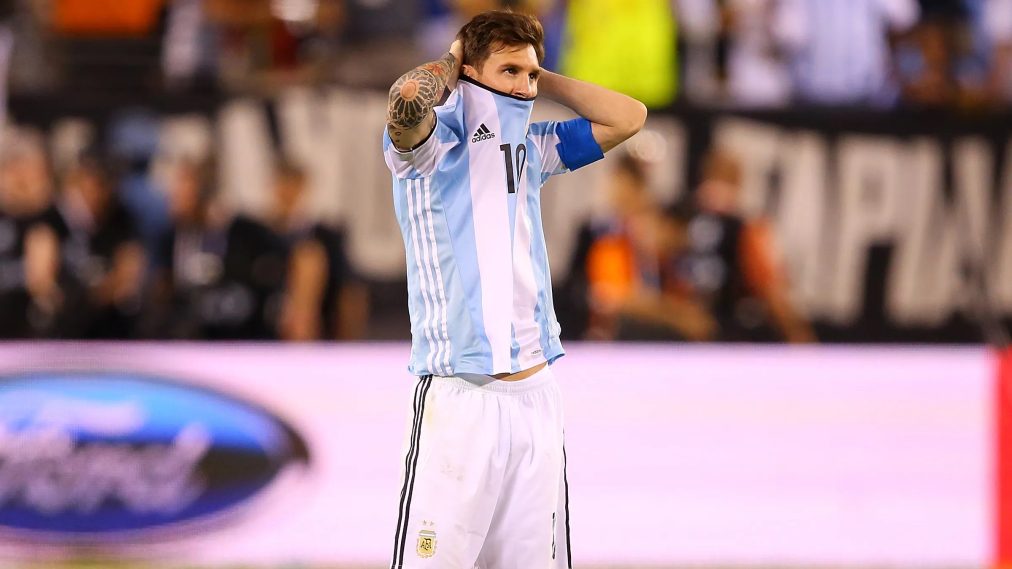
The breaking point came in 2016. Chile again prevailed on penalties, this time in the Copa America Centenario final, with Messi missing Argentina’s attempt. He subsequently announced his retirement from international football, saying: “It is over.”
Messi returned in 2018, but Argentina’s wait for a major trophy continued. They went out to France in the last 16 of the World Cup, with Kylian Mbappe starring as the title remained beyond Messi’s reach. In 2019, Argentina were beaten by Brazil in the Copa America semi-final, despite Messi contributing one goal and one assist during the tournament.
The turning point arrived in 2021. Lionel Scaloni built a team capable of sharing the responsibility around Messi, and Argentina finally ended their long wait by beating Brazil at the Maracana to win the Copa America. It was Messi’s first major international title with Argentina. Months later, they defeated Italy at Wembley to claim another trophy.
In 2022, the story reached its defining chapter. Messi guided Argentina to the World Cup in Qatar, winning one of the most memorable finals in the tournament’s history and achieving the dream that had pursued him throughout his career.
Argentina added another Copa America title in 2024 by beating Colombia in the final. Then, in 2026, Messi, aged 39, played Spain in a celebrated final and took Argentina into extra time during his last international journey before ending his career with an enduring legacy.
-
 Rayan Cherki hits back at critics after France victory over Belgium Oct 6, 2026
 -
Ibrahim Traore vows action to ‘cure’ Burkina Faso’s ailing football Oct 6, 2026
-
Lionel Messi set for final Argentina appearance as farewell tribute planned Oct 6, 2026
-
REVEALED: FIFA allowed ineligible DR Congo goalkeeper to play at 2026 World Cup Oct 6, 2026



-
AFCON 2025: Fixtures, Results, Scores and Standings Jan 18, 2026
-
Match hero Taiwo Awoniyi reflects on team effort after Chelsea triumph May 5, 2026
-
Leadership and long-term vision key to rescuing Zamalek and inspiring Egyptian football – Hany Abou Rida Nov 5, 2025
-
South African giants Orlando Pirates set to lose influential forward Monnapule Saleng Mar 19, 2025




-
AFCON 2027 Qualifiers: McCarthy warns South Africa to expect tough test against Eritrea Sep 29, 2026
-
Denmark v Portugal: Nations League kick-off time, TV channel and match prediction Sep 29, 2026
-
France v Belgium: Probable line-ups for Nations League clash Oct 3, 2026
-
AFCON 2027 qualifiers: Manchester United injury crisis deepens as Noussair Mazraoui hobbles off in Morocco win Sep 30, 2026