Jesús de Miguel: Prosecutor doubts criminal charges against goalkeeper Jesús Owono over Tenerife striker’s death
Jesús de Miguel: Prosecutor doubts criminal charges against goalkeeper Jesús Owono over Tenerife striker’s death
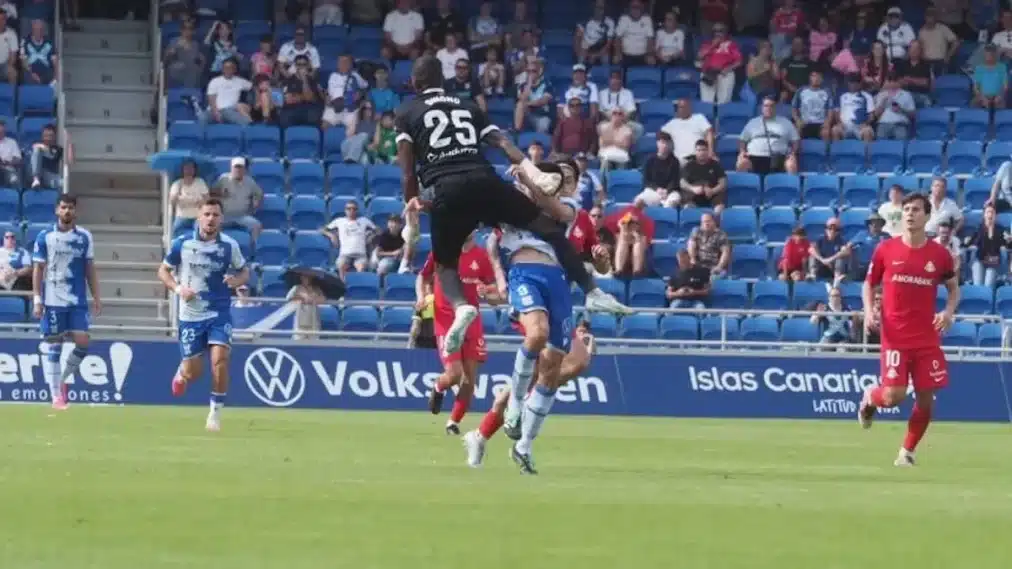
The chief prosecutor of Santa Cruz de Tenerife, José Luis Sánchez-Jáuregui, believes it is highly unlikely that criminal proceedings will be initiated against Andorra goalkeeper Jesús Owono following the death of Tenerife striker Jesús de Miguel after a collision during a match.
Sánchez-Jáuregui explained that the incident occurred in the course of play, making it difficult to establish grounds for criminal prosecution unless evidence suggests the challenge went beyond the limits of acceptable sporting conduct.
The 30-year-old striker died on Tuesday after suffering a cardiac arrest following a collision with Owono during a Spanish second-tier fixture. His death sent shockwaves through Spanish football, with tributes pouring in from clubs, players and football authorities.
Speaking about the potential legal consequences of the incident, the prosecutor stressed that the next steps would depend largely on the referee’s report and the findings of the Spanish Football Federation’s (RFEF) Sports Disciplinary Committee.
He believes those findings will be crucial in determining whether the goalkeeper’s challenge could attract further legal scrutiny.
Disciplinary ruling could determine legal direction
Sánchez-Jáuregui said investigators would first need to establish how the incident was documented by the match officials before considering whether criminal proceedings were justified.
A key consideration will be whether the Sports Disciplinary Committee determines that Owono’s challenge constituted dangerous or extremely dangerous play.
The committee will also have to consider whether there was any intention on the goalkeeper’s part to cause harm to De Miguel during the incident.
According to the prosecutor, those findings will provide an important basis for assessing the nature of the challenge and whether it warrants consequences beyond the sporting disciplinary framework.
“If the deceased player’s family disagrees with the conclusions, they can file a complaint alleging assault resulting in death, which would trigger an investigation,” the prosecutor explained.
However, Sánchez-Jáuregui maintained that the possibility of the matter progressing into a serious criminal case remained remote.
He indicated that, even if proceedings were initiated, the most likely legal classification would be manslaughter through less serious negligence rather than an intentional killing.
Prosecutor explains possible manslaughter classification
The chief prosecutor further explained the distinction between an intentional act and a death resulting from an unintended consequence.
He described a situation in which an individual is pushed, falls and breaks their neck, without the person responsible having any intention to cause death.
In such circumstances, the death could potentially be treated as manslaughter through negligence, depending on the circumstances and the evidence established.
That distinction is particularly relevant to De Miguel’s case because the fatal collision happened during a competitive football match, where physical challenges are part of the game.
Nevertheless, the prosecutor’s comments do not rule out the possibility of an investigation should the family challenge the disciplinary findings or submit a formal complaint.
Owono could face sporting suspension
While criminal proceedings appear unlikely, Owono could still face sporting sanctions if the RFEF Competition Committee determines that his challenge violated disciplinary regulations.
Article 102 of the federation’s disciplinary code could be applied if the incident is classified as violent conduct against an opponent resulting in serious harmful or injurious consequences.
The provision allows for a suspension of between four and 12 matches, depending on the severity of the offence and its consequences.
The relevant section of Article 102 states:
“Acting violently towards an opponent during the course of play, resulting in harmful or injurious consequences considered serious, either because of their nature or the period of inactivity they may cause, and provided the offence does not constitute a more serious violation, shall be punished with a suspension of four to twelve matches.”
The eventual decision will therefore depend on the referee’s account and the assessment of the disciplinary authorities.
While De Miguel’s death has raised questions about the circumstances surrounding the collision, Sánchez-Jáuregui believes the fact that it happened during normal play makes criminal prosecution particularly difficult.
-
 Jesús de Miguel: Prosecutor doubts criminal charges against goalkeeper Jesús Owono over Tenerife striker’s death Nov 3, 2026
-
Orlando Pirates expected to extend Nkosinathi Sibisi’s contract Nov 3, 2026
-
Orlando Pirates target back-to-back Betway Premiership titles after flying start Nov 3, 2026
-
Rayners urges Sundowns to score early against Golden Arrows Nov 3, 2026


-
AFCON 2025: Fixtures, Results, Scores and Standings Jan 18, 2026
-
Match hero Taiwo Awoniyi reflects on team effort after Chelsea triumph May 5, 2026
-
Leadership and long-term vision key to rescuing Zamalek and inspiring Egyptian football – Hany Abou Rida Nov 5, 2025
-
South African giants Orlando Pirates set to lose influential forward Monnapule Saleng Mar 19, 2025




-
Barcelona host Aston Villa in Champions League meeting at Spotify Camp Nou Nov 2, 2026
-
AEK Athens v Real Madrid: Champions League date, kick-off time and viewing details Nov 2, 2026
-
Villarreal host unbeaten PSG in first European meeting Nov 2, 2026
-
Le Havre AC host Paris Saint-Germain as Ligue 1 leaders seek another win Oct 28, 2026