‘It belongs to the people, not executives’ – Sepp Blatter launches fierce attack on FIFA’s $20bn World Cup plan
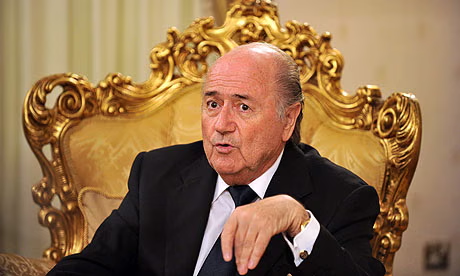
Former FIFA President Sepp Blatter has strongly criticised the organisation’s proposal to create a $20 billion subsidiary to oversee the World Cup and other major events, arguing that football’s flagship competition should not be treated as a commercial asset controlled by a select group of executives.
Blatter, who led FIFA for 17 years before stepping down in 2015, said the World Cup represents the cultural heritage of the sport and should remain connected to supporters around the world rather than becoming an investment opportunity for private equity firms.
“Football belongs to no individual and to no institution. It belongs to the people,” Blatter told Reuters.
“If FIFA were transferred into a profit-oriented corporate structure, it would lose its soul,” he added.
FIFA’s investment strategy sparks backlash
FIFA announced plans on Tuesday to establish the new subsidiary, which would manage the World Cup and other international competitions while allowing external investors to acquire up to a 20% stake.
The move has triggered opposition from several figures within European football, with UEFA among those expressing concerns over the direction of the global game. European football’s governing body accused FIFA of effectively putting football’s most prestigious tournament up for sale.
Blatter joined the growing criticism, insisting that the World Cup should not be transformed into a financial product designed to generate returns for investors.
“The FIFA World Cup is not a commercial asset that belongs to a handful of executives,” he said. “It is part of the cultural heritage of world football.”
“FIFA is the guardian of the World Cup, not its owner.”
Blatter questions influence of private investors
The former FIFA president said he was stunned by the proposal and insisted such a move would never have been considered during his time in charge of the organisation.
According to Blatter, allowing investors to pursue financial gains and greater influence could undermine the principles that have guided football associations for more than a century.
He argued that football’s strength comes from its connection to fans, clubs and communities rather than corporate interests.
“Modern football has survived for more than a century because it belongs to the people,” Blatter said. “That principle should never change.”
The controversy adds to ongoing debates over FIFA’s commercial expansion and the future management of the World Cup, which remains the most valuable and influential competition in international football.
-
 Napoli name Kevin De Bruyne and Frank Anguissa in starting XI against Bodø/Glimt Oct 20, 2026
 -
S. Guirassy double earns Borussia Dortmund narrow Champions League win at Sabah Oct 20, 2026
-
Roma make six changes as Suleiman Camara starts for Slovan Bratislava Oct 20, 2026
-
Liverpool name starting XI for UEFA Champions League clash with Villarreal Oct 20, 2026



-
AFCON 2025: Fixtures, Results, Scores and Standings Jan 18, 2026
-
Match hero Taiwo Awoniyi reflects on team effort after Chelsea triumph May 5, 2026
-
Leadership and long-term vision key to rescuing Zamalek and inspiring Egyptian football – Hany Abou Rida Nov 5, 2025
-
South African giants Orlando Pirates set to lose influential forward Monnapule Saleng Mar 19, 2025




-
PSG v Barcelona: fiery attacks set up Champions League classic at Parc des Princes Oct 18, 2026
-
Real Betis v Barcelona: kick-off time, TV details and match preview Oct 16, 2026
-
Porto v PSV: predicted line-ups for Champions League league-phase clash Oct 19, 2026
-
Morocco face Germany with top spot in Women’s Under-17 World Cup Group A at stake Oct 20, 2026