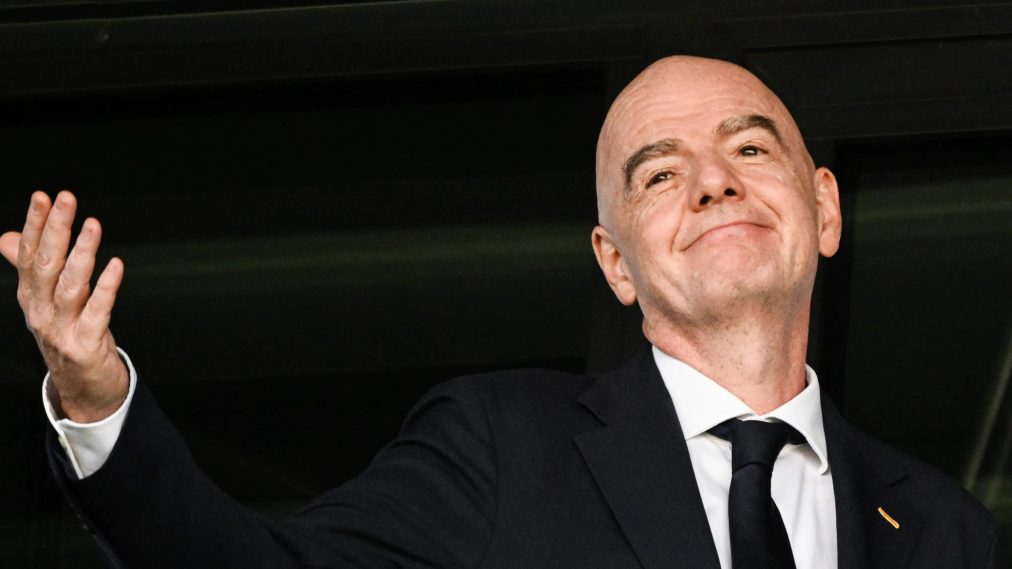
Gianni Infantino says he retains the support of the “vast majority” of football’s governing community and has no intention of stepping aside as criticism grows over a proposed FIFA commercial rights deal.
In a rare interview with the BBC, the FIFA president rejected questions about whether he remained suitable for the role or had considered resigning. He pointed to the backing he says he continues to receive from member associations around the world.
The controversy centres on the FIFA Football Enterprises (FFE) initiative, which included a proposal to sell part of FIFA’s commercial rights to a private investment company. Infantino cancelled the project only a few days after it was announced.
The plan prompted widespread anger. The presidents of UEFA, the Asian Football Confederation and the Confederation of North, Central America and Caribbean Association Football signed a letter accusing Infantino of breaking trust through “deception”.
UEFA has also demanded the release of key documents relating to the initiative by 2 November, saying FIFA has failed to answer several fundamental questions.
At an earlier FIFA Council meeting, Infantino faced strong criticism over the handling of the matter. He was told his position could be questioned if he did not provide the requested documents, including the reasoning behind the initiative.
Infantino did not give a specific date for their delivery, saying the process was subject to legal procedures and that his administration was working on the required responses.
“We will certainly answer all the questions that have been raised, within the limits of the process being followed and as much as we can,” he said.
The FIFA president acknowledged that the organisation had made some mistakes, saying communication and consultation with member associations needed to improve. He also said he was willing to hold more regular discussions with UEFA as tensions between the two organisations continue.
Asked whether he was still qualified to lead FIFA and whether he had thought about resigning, Infantino laughed before replying: “I was elected by 211 member associations from all over the world.”
He said differences of opinion were normal but argued that the will of the majority had to be respected. The member associations, he added, had the final say over who leads FIFA and how it is run.
Infantino cited support he said he received from the Asian Football Confederation during a visit to Tokyo, as well as backing from African associations. He said he remained in contact with federations across the world and recognised that bringing differing views together was difficult, while insisting that every opinion should be respected.
His international activity has increased during the dispute, with visits to Morocco, the Dominican Republic, Cape Verde and Japan. Those trips have strengthened his position ahead of the FIFA presidential election scheduled for March.
He has also proposed increasing funding for football development programmes worldwide by about $3.4bn. The deadline for challengers to submit nominations is 18 November, and no announced candidate has yet emerged to oppose him, raising the prospect of an uncontested election and a fourth term.
Infantino has since travelled to Baku, Azerbaijan, for the inaugural FIFA Under-15 tournament and festival. Teams from 189 member associations are taking part, including England, Spain, France, Argentina and Brazil.
A Russian team is also competing, marking its first appearance in a FIFA-sanctioned tournament since Russian teams were suspended from international competitions in February 2022.
This year’s event is for boys, with the 2027 edition planned for girls. FIFA intends to hold the tournament annually for both sexes from 2028. Matches feature eight players per side, on smaller pitches, with two 20-minute halves.
“It is a fantastic opportunity to bring young people together from all over the world,” Infantino said, adding that he hoped players would one day remember that their first global tournament had been held in Azerbaijan.
-
 FIFA U15 Festival Baku 2026: Burkina Faso beat Antigua and Barbuda in opening match Oct 24, 2026
-
Al Ahly Tripoli take 4-0 lead into Welwalo Adigrat return Oct 24, 2026
-
CAF Confederation Cup: CS Sfaxien face AFAD Plateau in decisive second leg Oct 24, 2026
-
Azam FC v ZED FC: How to follow CAF Confederation Cup tie Oct 24, 2026


-
AFCON 2025: Fixtures, Results, Scores and Standings Jan 18, 2026
-
Match hero Taiwo Awoniyi reflects on team effort after Chelsea triumph May 5, 2026
-
Leadership and long-term vision key to rescuing Zamalek and inspiring Egyptian football – Hany Abou Rida Nov 5, 2025
-
South African giants Orlando Pirates set to lose influential forward Monnapule Saleng Mar 19, 2025




-
Barcelona v Real Madrid: Catalans backed at 1.65 to win October Clasico Oct 23, 2026
-
Barcelona and Real Madrid meet in pivotal 265th Clasico Oct 23, 2026
-
PSG v Barcelona: fiery attacks set up Champions League classic at Parc des Princes Oct 18, 2026
-
Champions League: PSG beat Barcelona as Liverpool complete comeback against Villarreal Oct 20, 2026