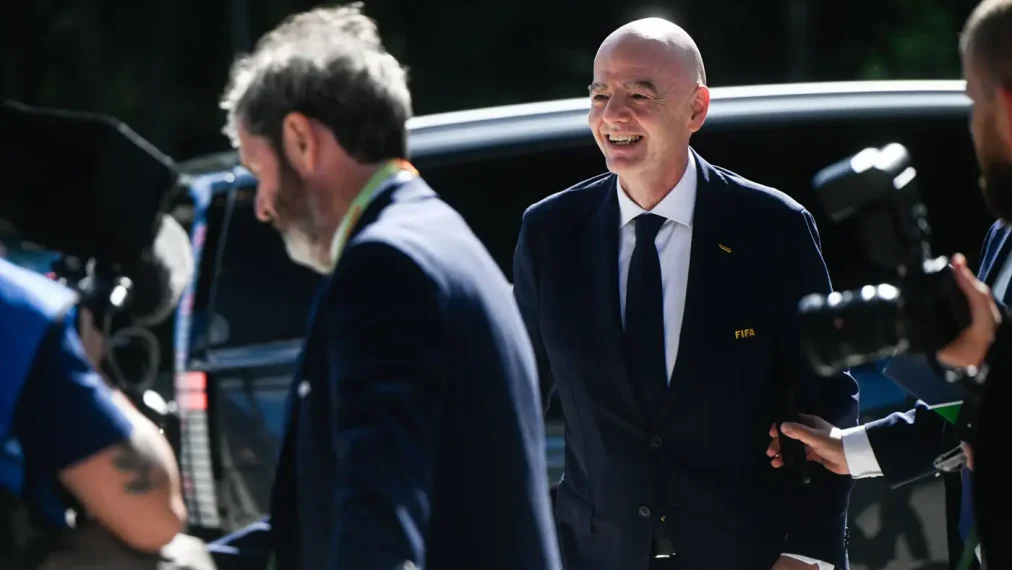
Three weeks ago, Gianni Infantino’s removal as FIFA president appeared increasingly likely. But discussions behind closed doors in Rabat and Nyon have changed the calculations, with the 56-year-old now believed to have enough support to remain in office after a decade spent building an international network of alliances.
The shift has forced his European opponents to rethink their campaign. Rather than trying to defeat Infantino outright, some are now considering changes to FIFA’s governing structure that would reduce the concentration of authority in the presidency.
A source familiar with confidential discussions among senior football officials told Reuters: “Three weeks ago, I thought he was finished. What I did not appreciate was the strength of the relationships he has built after 10 years in power, which are almost impossible to break.”
Infantino faced the biggest challenge of his career this year after his controversial proposal to sell a 20% stake in FIFA competitions, including the World Cup, to private investors collapsed.
The plan provoked widespread anger. UEFA, the Asian Football Confederation and Concacaf led calls for a change in FIFA’s leadership, while several European associations withdrew their backing for Infantino’s re-election. France became the latest to do so last Thursday.
FIFA secretary general Matthias Grafstrom described the episode as “an unfortunate and shameful series of events”, but gave Infantino his full support after an emergency meeting in Rabat, suggesting the immediate crisis had begun to recede.
Infantino’s main advantage lies in FIFA’s electoral system. At the FIFA Congress, each of the 211 national associations has one equal vote, meaning a successful challenge would require a global coalition extending well beyond UEFA’s 55 members.
That calculation carries risks for the opposition. Losing a contest against Infantino could strengthen his position rather than weaken it.
“I think the course of events has changed,” one source said. “It is now very dangerous for UEFA to go into a vote and not win.”
No candidate has yet emerged with the worldwide support needed to challenge Infantino before the election in March. The deadline for nominations is 18 November.
Nasser Al-Khelaifi, president of Paris Saint-Germain, is regarded by prominent figures in football as one of the few people capable of building the continental coalition required to defeat Infantino. However, a spokesperson said he “has no ambition, intention or desire to become FIFA president”.
Another name under discussion is Concacaf president Victor Montagliani, who has said he would not stand without sufficient guarantees of victory. A surprise candidate from Africa or Asia remains possible.
Infantino continues to enjoy firm backing outside Europe. Steeve Laigle, president of the New Caledonia Football Federation, said: “Most presidents of the Oceania associations have declared their support for Mr Infantino, and we will support him until the end. When we make a promise and are loyal to someone, we remain loyal to them until the end.”
Support is also strong in Africa, where many associations believe continued backing could bring increased development funding. Morocco, one of the continent’s most influential associations, is among Infantino’s public supporters. Reports that FIFA promised Casablanca the 2030 World Cup final in return for African backing have been denied by FIFA, while the Moroccan federation has not commented.
With the leadership challenge stalled, some opponents are examining a plan to redistribute presidential powers to the general secretariat and impose tighter oversight of major strategic and commercial decisions.
French Football Federation president Philippe Diallo, who withdrew his support for Infantino, said: “The trust placed in the FIFA president has been broken.”
He added: “The project cannot be purely European; it must bring together all continents. Our task now is to ensure that a programme and a candidate emerge, and then work to secure their victory.”
The FIFA presidential election will be held in Rabat, Morocco, on 18 March 2027.
-
 Elyaz Zidane opens up on pressure of living in father Zinédine’s shadow Oct 17, 2026
 -
Algeria reach historic Futsal AFCON semi-finals as Morocco maintain perfect record Oct 17, 2026
-
Morocco’s Gessime Yassine reportedly close to Chelsea move from Strasbourg Oct 17, 2026
-
Wydad turn to goalkeeper Rachid Ghanimi ahead of Amal Tiznit clash Oct 17, 2026



-
AFCON 2025: Fixtures, Results, Scores and Standings Jan 18, 2026
-
Match hero Taiwo Awoniyi reflects on team effort after Chelsea triumph May 5, 2026
-
Leadership and long-term vision key to rescuing Zamalek and inspiring Egyptian football – Hany Abou Rida Nov 5, 2025
-
South African giants Orlando Pirates set to lose influential forward Monnapule Saleng Mar 19, 2025




-
Real Betis v Barcelona: kick-off time, TV details and match preview Oct 16, 2026
-
Roma v Real Madrid: home side tipped to score first in Champions League clash Oct 12, 2026
-
Atletico Madrid v Manchester United: probable line-ups for Champions League clash Oct 12, 2026
-
Celta Vigo v Juventus: Probable line-ups for Europa League encounter Oct 14, 2026