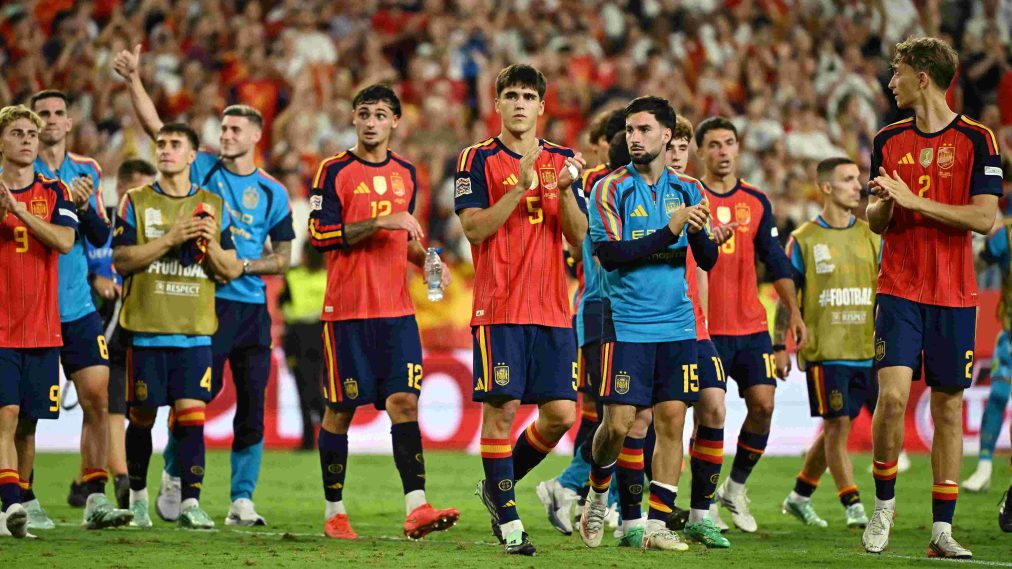
Spain have transformed themselves from a nation with one major international honour into the dominant force in world football, with their success rooted in a long-term development system built around youth academies and a shared style of play.
Until the end of the 20th century, Spain had won only one European Championship, in 1964. Their best World Cup finish was fourth place in 1950, a record that remained untouched until 2010. A quarter of a century later, La Roja sit at the summit of the global game and continue to thrive in Europe, including in the Nations League, after winning their second World Cup this summer.
The foundation of that rise was laid in club academies, led by Barcelona’s La Masia. Its building became accommodation for young players from outside the city on 20 October 1979, and it now houses more than 300 youngsters.
Barcelona invested heavily in the academy. Its annual budget reached 30m euros, according to a 2015 Harvard Business School report, which also found that half of the club’s 18- and 19-year-old players were studying at university – the highest proportion among Europe’s leading clubs.
The approach was not confined to Barcelona. Real Madrid’s La Fabrica has about 300 players, who stay there for an average of three years, while Athletic Club, Villarreal, Valencia and Sevilla also developed extensive academy structures.
Spain’s distinctive feature was the priority given to tactical intelligence and technical ability rather than physical size. That helped players such as Xavi and Andres Iniesta emerge – footballers who might have been overlooked elsewhere. La Masia’s influence reached its peak in 2010, when graduates Lionel Messi, Iniesta and Xavi occupied the top three places in the Ballon d’Or voting, the first academy to achieve that feat.
One philosophy from youth teams to the senior side
The Spanish Football Federation connected its age-group teams through a common footballing philosophy and retained coaching staff who moved between different levels.
The results came quickly. Spain won the European Under-19 Championship in 2002, 2004, 2006 and 2007, and matched Italy’s record of five European Under-21 titles, including successive victories in 2011 and 2013.
That structure was supported by a central base. The federation opened Ciudad del Futbol in Las Rozas on 12 May 2003, at a cost of about 46m euros, making it the permanent training centre for all national teams.
Coach education was another part of the system. In 2017, Spain had 15,089 coaches holding a Uefa Pro or A licence, compared with 1,796 in England, according to The Guardian. The Spanish A licence cost £960, while the equivalent in England cost £3,645. As a result, Spanish children could receive professional coaching from the earliest stages.
The system produced a senior side in which 20 of the 23 players in Spain’s Euro 2008-winning squad had come through the national youth teams, with most also winning honours at junior level.
At the 2010 World Cup final, seven Barcelona players started for Spain, while Barcelona players scored all of the team’s goals during the tournament. The same generation then completed an unprecedented sequence by winning Euro 2012, making Spain the first nation to claim three successive major international titles.
Success beyond one golden generation
Spain’s progress did not end when Xavi and Iniesta retired. Current manager Luis de la Fuente had coached the youth national teams since 2013, leading the Under-19 side to the European title in 2015 and the Under-21 team to victory in 2019 before being promoted to the senior job.
Under De la Fuente, Spain won Euro 2024 to become the most successful team in the competition’s history, with four titles.
Their biggest triumph came last July, when Ferran Torres scored in the 106th minute to secure a 1-0 win over Argentina in the 2026 World Cup final at MetLife Stadium in New Jersey. At 65, De la Fuente became the oldest manager to win the World Cup.
Since 2008, Spain have won two World Cups, in 2010 and 2026, and three European Championships, in 2008, 2012 and 2024. Germany have won one World Cup, in 2014, but no European title in that period; Italy’s only trophy was Euro 2021, while England still have only their 1966 World Cup.
Spain have therefore turned success into a repeatable structure: academies teaching one philosophy, youth teams following the same principles, a large pool of qualified coaches and a senior manager produced by the system itself.
They are also the first national team to hold the men’s and women’s World Cup titles at the same time, and the first to win the men’s World Cup more than once in the 21st century, while historic powers including Germany, Italy and Brazil continue searching for a route back to the top.
-
 Achraf Hakimi returns from injury for Morocco Sep 30, 2026
 -
‘Stronger and more entertaining’ – Algeria’s Djamel Belamri praises Morocco Sep 30, 2026
-
Togo held by Libya in frustrating U23 Africa Cup of Nations qualifier Sep 30, 2026
-
Chelsea could cash in again as Liverpool deal ties payout to Rio Ngumoha Sep 30, 2026


-
AFCON 2025: Fixtures, Results, Scores and Standings Jan 18, 2026
-
Match hero Taiwo Awoniyi reflects on team effort after Chelsea triumph May 5, 2026
-
Leadership and long-term vision key to rescuing Zamalek and inspiring Egyptian football – Hany Abou Rida Nov 5, 2025
-
South African giants Orlando Pirates set to lose influential forward Monnapule Saleng Mar 19, 2025




-
AFCON 2027 Qualifiers: McCarthy warns South Africa to expect tough test against Eritrea Sep 29, 2026
-
AFCON 2027 qualifiers: Algeria, Morocco and Nigeria among winners on opening matchday Sep 26, 2026
-
AFCON 2027 qualifiers: Burkina Faso held by Benin in Group F Sep 25, 2026
-
South Sudan vs Egypt: Where to watch AFCON 2027 qualifier Sep 29, 2026