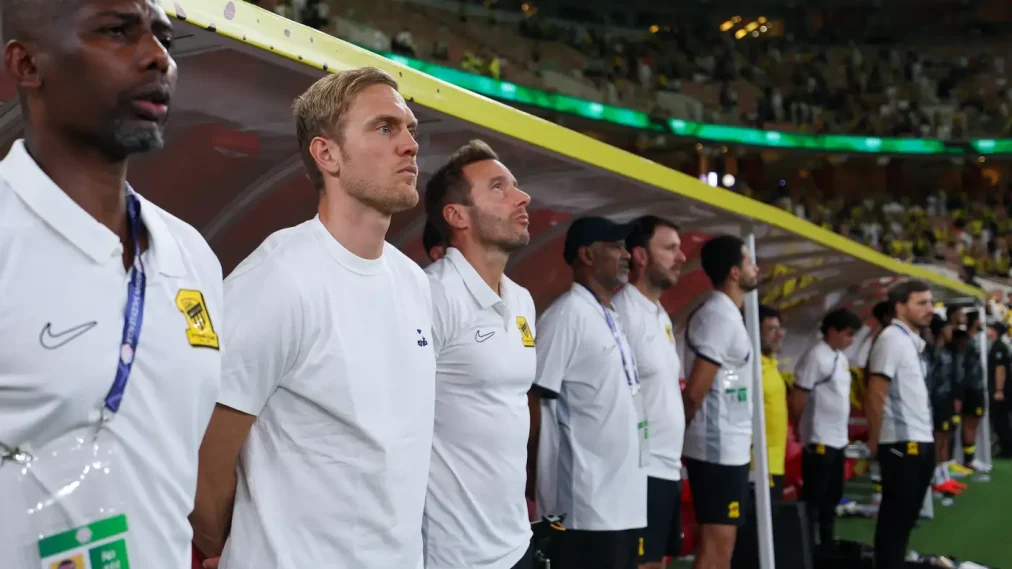
Jens Vising has given Al-Ittihad a clear tactical identity within two months of taking charge, reshaping the team into a collective built on coordinated movement, pressing and rapid transitions rather than individual brilliance.
The young German coach was appointed on 10 July and has gradually reorganised the side. Al-Ittihad now show a recognisable approach in possession, immediately after losing the ball, during attacking transitions and in the defensive responsibilities carried out by their forwards.
Vising’s influence has emerged quickly. Rather than needing years to impose his ideas, he has helped create a team that appears to have played together for much longer. The players now understand what is expected of them and how their movements should support one another, even when the ball is far from the most dangerous areas.
Al-Ittihad do not rely on one player to provide the decisive moment. Their attacks are built around collective movement, with quick passing and constant efforts to create space for team-mates. When they win possession, the objective is not simply to keep the ball but to attack the space behind the opposition defence.
That can come through direct passes that break defensive lines or longer balls used to launch swift attacks. The pace of those transitions allows Al-Ittihad to threaten before their opponents can regain their shape, particularly with players capable of running beyond the back line.
The movement is not limited to the final pass. A forward may run in behind, a winger move inside, a full-back advance and a midfielder cover the space left behind. Together, those actions create several attacking options instead of leaving the team dependent on an individual solution.
Vising’s principles are also clear when possession is lost. Al-Ittihad generally try to recover the ball quickly rather than retreating towards their penalty area. Players close down the ball carrier as a unit, targeting the spaces around him and attempting to force a rushed decision.
For that pressure to work, the lines must move together. A midfielder advances as the winger closes in, the full-back narrows the available space and the forward presses the defenders. Winning the ball high up the pitch then allows Al-Ittihad to attack the goal immediately instead of starting another move from deep.
The full-backs play an important role in providing width while the wingers move into central areas. This creates greater numbers near the opposition penalty area and presents defenders with several problems at once. Vising also seeks one-on-one situations for his wingers, supported by the team’s movement around them.
Youssef En-Nesyri illustrates the change. The Morocco forward is no longer limited to waiting inside the box. At times he drops into advanced defensive positions to close spaces and monitor threats, before quickly turning into a striker searching for room behind the defence.
That willingness to contribute in every phase reflects Vising’s central idea: players must serve the system whether Al-Ittihad have the ball or their opponents do. After 60 days, the team’s identity is already evident through direct transitions, aggressive pressing, advancing full-backs, inside-moving wingers and collective defensive work.
-
 Burkina Faso U17 reach UFOA-B semi-finals after Ghana draw Oct 16, 2026
 -
CAF Confederation Cup: Al Ahli Tripoli take commanding lead with 4-0 win at Welwalo Oct 16, 2026
-
TP Mazembe v Club Africain: kick-off time and TV details for CAF Champions League tie Oct 16, 2026
-
Fouzi Lekjaa to remain at FRMF despite promotion to Moroccan finance minister Oct 16, 2026




-
AFCON 2025: Fixtures, Results, Scores and Standings Jan 18, 2026
-
Match hero Taiwo Awoniyi reflects on team effort after Chelsea triumph May 5, 2026
-
Leadership and long-term vision key to rescuing Zamalek and inspiring Egyptian football – Hany Abou Rida Nov 5, 2025
-
South African giants Orlando Pirates set to lose influential forward Monnapule Saleng Mar 19, 2025




-
Real Betis v Barcelona: kick-off time, TV details and match preview Oct 16, 2026
-
Roma v Real Madrid: home side tipped to score first in Champions League clash Oct 12, 2026
-
Atletico Madrid v Manchester United: probable line-ups for Champions League clash Oct 12, 2026
-
Celta Vigo v Juventus: Probable line-ups for Europa League encounter Oct 14, 2026