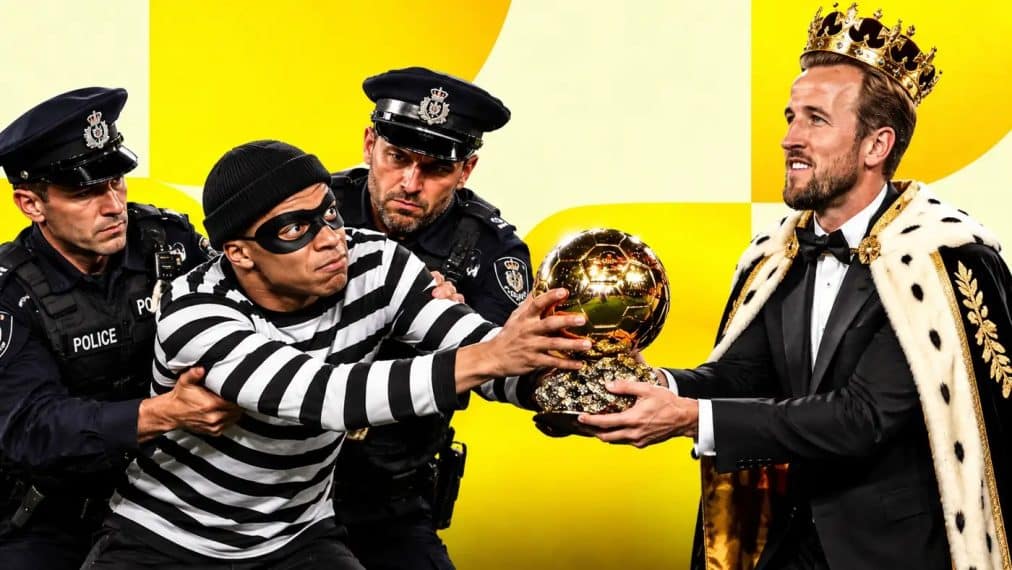
Harry Kane won the 2026 Ballon d’Or after narrowly holding off Kylian Mbappe, in a result that raised wider questions about whether the award should remain a reward for performances on the pitch or become a contest in which the best self-promoter gains an advantage.
The final race was between Kane, whose exceptional season was defined by his work for the team as well as his individual quality, and Mbappe, who paired his performances with a sustained public case for why he deserved to win.
According to Vincent Garcia, editor-in-chief of France Football, Mbappe led the voting for a significant period before Kane moved ahead at the decisive stage. Garcia said the final margin was smaller than the 41-point gap between Rodri and Vinicius Junior in the 2024 edition.
That meant Mbappe was not a distant runner-up. He came very close to winning the award, making the outcome more significant than simply deciding which player finished first.
The concern is not that Mbappe believed he could win, or that he spoke about his ambitions. Every player has the right to regard themselves as a Ballon d’Or contender. The issue is whether persistent public campaigning could become an accepted part of the route to the prize.
Lamine Yamal was also described as having followed a similar path. If Mbappe had won, it might have encouraged future candidates to begin organised campaigns weeks or months before the ceremony, with interviews and statements designed to influence voters. Silence could even become a disadvantage if the most vocal player succeeded in dominating the public debate.
Kane, by contrast, largely allowed his football to make the argument. After winning, he posted the message: “Work hard in silence, let success be your noise.”
The words reflected a career in which Kane has not always been the most prominent figure in global discussions, but has continued to improve until reaching the summit of the game. He did not need to turn every interview into a defence of his candidacy or repeatedly insist that he was capable of winning.
His season at Bayern Munich and with England offered more than outstanding scoring figures. Kane combined goals with creativity, link-up play, the ability to connect his team’s lines and movement that created space for his team-mates. He also made important contributions for his country and helped his teams win trophies.
Those elements formed the basis of his case when the result was announced, and the Ballon d’Or ultimately went to him.
Had Kane lost to Mbappe, it would have represented a serious blow to the principle that the award should be decided by footballing performance rather than a player’s ability to market himself. The Ballon d’Or should not reward the strongest personal campaign or the most persuasive public speaker.
Mbappe and Yamal remain entitled to discuss their ambitions. But the award must continue to recognise the best footballer, not the candidate who manages the debate most effectively. This time, Kane’s quieter approach prevailed, and he left London with the trophy.


-
 AFCON 2025: Fixtures, Results, Scores and Standings Jan 18, 2026
-
Match hero Taiwo Awoniyi reflects on team effort after Chelsea triumph May 5, 2026
-
Leadership and long-term vision key to rescuing Zamalek and inspiring Egyptian football – Hany Abou Rida Nov 5, 2025
-
South African giants Orlando Pirates set to lose influential forward Monnapule Saleng Mar 19, 2025




-
Barcelona v Real Madrid: Catalans backed at 1.65 to win October Clasico Oct 23, 2026
-
Barcelona and Real Madrid meet in pivotal 265th Clasico Oct 23, 2026
-
Sevilla FC v Osasuna: probable line-ups for Monday’s La Liga meeting Oct 25, 2026
-
Inter Milan v Fiorentina: probable line-ups for San Siro clash Oct 24, 2026