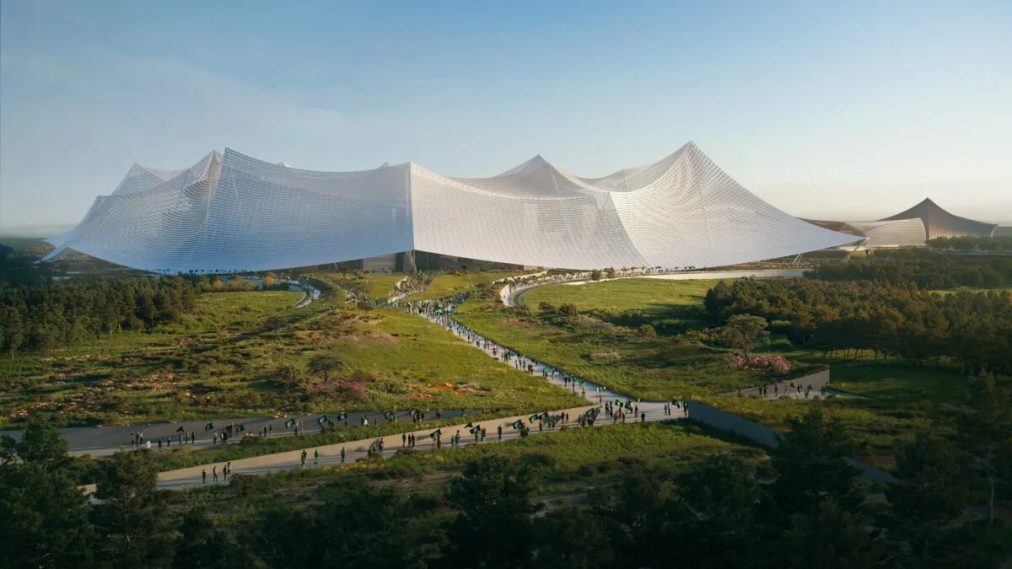
The cost of Morocco’s Grand Stade Hassan II has risen to 13.6bn dirhams (£1.24bn), according to an assessment of public contracts, more than 2.7 times the original budget of about 5bn dirhams.
The stadium in Benslimane, which is being built for the 2030 World Cup, is planned to hold 115,000 spectators and is intended to become one of the largest football venues in the world.
When the project was first presented, construction was expected to cost approximately 5bn dirhams. That figure remains listed in the official presentation of the Casablanca-Settat Regional Investment Centre.
However, a review by Le Desk found that contracts already awarded or put out to tender now amount to 13.6bn dirhams. The figure includes a series of separate packages covering the main construction work, the roof and facades, technical installations, seating and external development.
The total cost may still rise because the final bill has not yet been established. The external works alone account for around 2.7bn dirhams.
A contract for the approximately 115,000 seats, valued at 277.5m dirhams, also recently ended without an appointed supplier after both bids received were rejected.
The scale of the increase is attracting scrutiny while construction remains under way. Progress was estimated at about 40% in spring 2026, with approximately 5,000 workers involved at the site. Completion is still scheduled for the end of 2027.
The venue is a central part of Morocco’s plans for the 2030 World Cup, which will be jointly hosted by Morocco, Spain and Portugal. Its architecture is inspired by the traditional tent used at a moussem, while its exceptional capacity has added to the technical demands of the project.
The rise from an announced budget of 5bn dirhams to 13.6bn dirhams in identified contracts has prompted debate in Morocco, including on social media. Some users have questioned how the additional spending will be funded and how such a large sum is being used, with one question repeatedly raised: “Who pays?”
The discussion extends beyond football. Morocco is investing heavily in infrastructure ahead of the 2030 World Cup, and some support the spending as a long-term investment that could contribute to economic and tourism development.
Others, however, have questioned the country’s budgetary priorities and the eventual cost of major projects.
With several contracts still to be finalised, the 13.6bn-dirham figure may not be the final cost of the Grand Stade Hassan II. Its scale is set to be reflected not only in its capacity, but also in its budget.
-
 Grand Stade Hassan II costs soar to 13.6bn dirhams ahead of 2030 World Cup Oct 1, 2026
 -
Ghana consider five candidates to replace Carlos Queiroz after disastrous CAN 2027 start Oct 1, 2026
-
Spanish FA challenges Morocco’s 2030 final ambition Oct 1, 2026
-
Cote d’Ivoire v Cameroon: all you need to know about the Stade Olympique Alassane Ouattara friendly Oct 1, 2026



-
AFCON 2025: Fixtures, Results, Scores and Standings Jan 18, 2026
-
Match hero Taiwo Awoniyi reflects on team effort after Chelsea triumph May 5, 2026
-
Leadership and long-term vision key to rescuing Zamalek and inspiring Egyptian football – Hany Abou Rida Nov 5, 2025
-
South African giants Orlando Pirates set to lose influential forward Monnapule Saleng Mar 19, 2025




-
AFCON 2027 Qualifiers: McCarthy warns South Africa to expect tough test against Eritrea Sep 29, 2026
-
AFCON 2027 qualifiers: Algeria, Morocco and Nigeria among winners on opening matchday Sep 26, 2026
-
AFCON 2027 qualifiers: Burkina Faso held by Benin in Group F Sep 25, 2026
-
South Sudan vs Egypt: Where to watch AFCON 2027 qualifier Sep 29, 2026