
Former referee attacks handling of VAR in Senegal–Morocco final
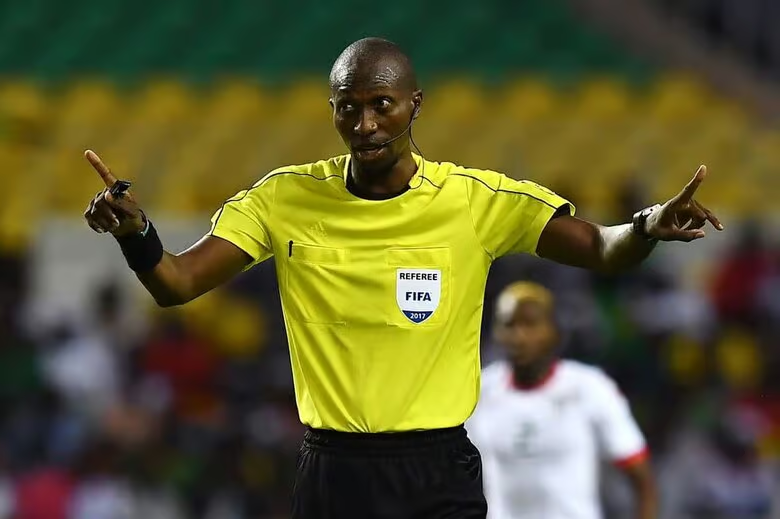
Refereeing decisions in the Senegal–Morocco final have been branded “scandalous” by former international referee Malang Diédhiou, who has questioned both the process and application of the Laws of the Game during the match.
Diédhiou, who has officiated at several Africa Cup of Nations tournaments and World Cups, was speaking to RTS1 as debate continued to rage over a series of contentious moments in the final.
Without hesitation, he described the officiating as a scandal, arguing that the controversy stemmed less from individual calls than from how they were handled.
“Law 5 is clear: the referee’s decisions must be respected. I agree with that principle. But I also agree with what Pape Thiaw did. It’s not the decision itself that’s scandalous, it’s the process,” he said.
According to Diédhiou, the most serious issue related to the referee’s management of key situations, particularly the timing of the whistle. “When I saw the first image, I wrote ‘scandalous refereeing.’
The referee is human; he can make mistakes, but in this type of situation, he can’t ignore the fact that he has to delay blowing his whistle.”
He argued that a fundamental error was made when play was stopped too early, effectively removing the possibility of intervention by video assistant referee (VAR). “By stopping play, he prevented any intervention from VAR.
Even if the ball had gone into the goal, it couldn’t have been awarded. If it had been a young referee, we would have understood. But not someone with that level of experience,” he added, noting that the official had been accustomed to VAR since 2018.
Diédhiou also highlighted an offside decision that resulted in a corner being awarded to Morocco. In his view, the presence of an offside player had a clear influence on the Senegalese defender.
“Even if the ball didn’t come directly towards the player in the offside position, his presence influenced the Senegalese defender. The Laws of the Game are clear. By awarding a corner, VAR could no longer intervene. These are details, but it’s these details that become scandalous at this level,” he emphasized.
On Senegal’s disallowed goal, the former referee was unequivocal. “The Moroccan player wasn’t playing the ball; he was trying to block the opponent with his hands. The goal should have stood,” he declared.
He was equally firm when addressing Morocco’s penalty appeal. “Referees will always be divided. My personal opinion is that Brahim Diaz initiated the play. The Senegalese defender was trying to gain space. There was contact, but it had no real impact. For me, there was no foul,” he said.
Diédhiou concluded by restating what he believes to be the proper role of VAR. “It’s not the player who asks the referee to consult VAR. The referee communicates his decision, and VAR analyzes the footage.
In this match, after all the previous errors, wanting to intervene again in this play seemed outrageous to me,” he insisted, before adding: “Senegal should never have been penalized for either of these incidents.”
Popular News



-

AFCON 2025: Fixtures, Results, Scores and Standings
Jan 18, 2026 -

South African giants Orlando Pirates set to lose influential forward Monnapule Saleng
Mar 19, 2025 -

Leadership and long-term vision key to rescuing Zamalek and inspiring Egyptian football – Hany Abou Rida
Nov 5, 2025 -

Full schedule for 2025 Africa Cup of Nations in Morocco confirmed
Feb 12, 2025
-

FECOFOOT president Jean-Guy Blaise Mayolas slapped with life prison sentence over money laundering, embezzlement, and forgery
Mar 10, 2026 -

Kaizer Chiefs weigh Fernando da Cruz return as head coach talks emerge
Mar 11, 2026 -

Welayta Dicha vs Sidama Bunna 3:1, 2026-03-08, Ethiopia Premier League Match Report and Result
Mar 8, 2026 -

Kaizer Chiefs sporting director refuses to comment on Benni McCarthy speculation
Mar 7, 2026