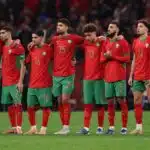
FEATURE: CAF’s lenient sanctions on Senegal spark fears of walk-offs becoming a tactical tool in future AFCON tournaments
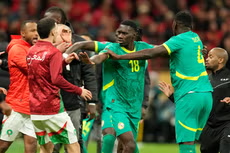
CAF’s disciplinary ruling following the chaotic Africa Cup of Nations 2025 final has ignited widespread anger in Morocco, not only because of the sanctions imposed, but because of what many believe the decision could encourage in future African tournaments.
Across Moroccan media, a common concern has emerged that the punishment did not fit the scale of the incident, raising fears that disorder could gradually be normalised as a pressure tactic in African football.
The Confederation of African Football announced sanctions against both Senegal and Morocco in the aftermath of the disorderly final in Rabat. Senegal head coach Pape Bouna Thiaw was handed a five-match suspension and fined $100,000, while players Iliman Ndiaye and Ismaïla Sarr each received two-match bans.
CAF also imposed financial penalties of $615,000 on the Senegalese federation and $315,000 on Morocco’s federation for multiple violations related to supporter conduct and the actions of team officials and players. At the same time, CAF rejected Morocco’s protest by citing Articles 82 and 84 of the AFCON regulations.
CAF strikes at Morocco and Senegal, issuing fines and suspensions over #AFCON2025 final chaos.
Full breakdown here as Morocco’s appeal to strip Senegal of the AFCON title is also rejected. #SportyFM pic.twitter.com/VcdTMURRrf
— SportyFM Ghana (@SportyFM_) January 29, 2026
For many Moroccans, this rejection lies at the centre of the controversy. Articles 82 and 84 are widely understood to apply to situations where a team refuses to play, withdraws, or leaves the pitch without authorisation.
Morocco’s federation argued that Senegal breached these rules during the final, but CAF dismissed the protest without offering a detailed public explanation, a silence that has only deepened frustration.
The strongest reaction in Morocco has focused less on the fines and more on the message sent by the ruling. Many commentators fear that CAF has effectively shown that walking off the pitch in a final can be punished without affecting the result.
In a competition often defined by pressure, emotion, and fine margins, this is seen as a dangerous precedent. From Morocco’s perspective, the walk-off was not a minor protest but a turning point that disrupted the natural flow of the match. Leaving the pitch in a final challenges both the referee’s authority and the principle that matches must be played to their conclusion under the rules of the game.
African football analyst Jalal Bounouar, speaking to Morocco World News, said the reaction stems from what fans witnessed live. “We all saw what happened during the final,” he said, while describing the sanctions imposed on Senegal’s coach and players as “very lenient.”
He warned that the penalties fall short of expectations and risk sending the wrong signal to teams across the continent. According to Bounouar, stopping a final watched by millions and then returning to apply pressure on officials cannot be treated lightly, cautioning that weak punishment could lead to “more serious problems” in future matches.
Despite the controversy, he noted that Moroccans can still take pride in AFCON 2025 as a tournament, highlighting the organisation, facilities and security, as well as the positive image projected by Moroccan supporters.
Moroccan sports analyst Abderrahim Ouchrif echoed similar concerns in comments to Morocco World News, saying the ruling left many stunned because they had expected firmer sanctions. He explained that public anger is driven by a sense that “the trophy was taken” and Morocco was treated unfairly, leading many to anticipate punishment that matched the scale of the chaos.
Instead, he argued, CAF focused narrowly on the 120 minutes of play, referee and delegate reports, and video evidence, rather than the wider context that Moroccans believe shaped the outcome. Ouchrif described the decision as a harsh lesson, suggesting that successful hosting and hospitality do not guarantee justice in African football, where titles are decided not only by tactics and technique but also by psychological battles and the ability to withstand disruption. He claimed Senegal exploited that reality at a decisive moment, breaking Morocco’s rhythm and focus.
Sports analyst Toufik Senhaji also raised alarms about the long-term implications, warning that CAF’s ruling risks becoming a precedent. Speaking to Morocco World News, he argued that the decision sends a troubling message to future teams, implying that leaving the pitch can be treated as a manageable protest rather than a red line that threatens the integrity of the competition.
Moroccan anger has also been fuelled by the broader context of the final, particularly the scenes in the stands that added to the tension. Widely circulated footage showed Senegal supporters attempting to invade the pitch and clashing with security after a penalty decision, turning the stadium into a volatile environment at a moment when calm was essential. Critics argue that CAF treated these incidents largely as issues punishable by fines, rather than as serious threats to match integrity.
Comparisons have been drawn with club-level precedents, including a late-2025 CAF decision to sanction AS FAR with two matches behind closed doors and a $100,000 fine after lasers and objects were thrown during a Champions League fixture. To many fans, the contrast is stark, with questions raised over why a club can lose home support for crowd misconduct while a national team can walk off in a final without a sporting consequence that alters the result.
Historical context has further intensified the debate. In 2012, CAF adopted a far tougher stance after Senegal’s AFCON qualifier against Côte d’Ivoire was abandoned due to crowd violence. On that occasion, CAF awarded Côte d’Ivoire a 2-0 victory and disqualified Senegal from the 2013 Africa Cup of Nations, a decision widely viewed as a strong deterrent. Outside Africa, Moroccan observers have pointed to European precedents, noting that governing bodies such as UEFA often treat walk-offs as forfeits.
In the Kosovo versus Romania Nations League case last November, Romania were awarded a 3-0 win after Kosovo’s players left the pitch. These examples reinforce the belief that while fines and suspensions can address misconduct, altering the sporting outcome is often seen as essential when a match cannot continue normally.
For many critics, the issue extends beyond legal interpretation to concerns about the future of African football. Finals dominated by stoppages, walk-offs and disorder risk damaging the sport’s image and credibility. In Morocco, the sense of injustice is also tied to national pride, with frustration that a well-organised tournament ended in controversy rather than celebration. Many see CAF’s ruling as a missed opportunity to set a firm standard and protect the competition’s integrity.
If Morocco chooses to appeal, attention will likely shift to how CAF interpreted its own regulations and whether consistency was applied. Analysts such as Ouchrif have suggested the Court of Arbitration for Sport as a possible route, pointing to Morocco’s successful 2015 appeal that overturned CAF sanctions after the country withdrew from hosting AFCON over Ebola concerns. That case remains a powerful reminder that CAF decisions can be challenged when legal reasoning is found wanting.
Even if the ruling stands, pressure remains on CAF to clarify its stance. To prevent walk-offs from becoming a tactical option, critics argue that the confederation must draw a clear and credible line, supported by consistent enforcement and transparent explanations. Without that clarity, the fear persists that chaos, rather than football, could shape future African finals.
Popular News




-

AFCON 2025: Fixtures, Results, Scores and Standings
Jan 18, 2026 -

Leadership and long-term vision key to rescuing Zamalek and inspiring Egyptian football – Hany Abou Rida
Nov 5, 2025 -

South African giants Orlando Pirates set to lose influential forward Monnapule Saleng
Mar 19, 2025 -

Full schedule for 2025 Africa Cup of Nations in Morocco confirmed
Feb 12, 2025

-

Africa’s 2026 World Cup Teams: Fixtures and Results for March friendly games
Apr 1, 2026 -
DR Congo declares national holiday after 2026 World Cup qualification
Apr 1, 2026 -

Emotional return: DR Congo back on world stage after 52 years
Apr 1, 2026 -
Confident response: Morocco overcome Paraguay in crucial friendly win
Mar 31, 2026