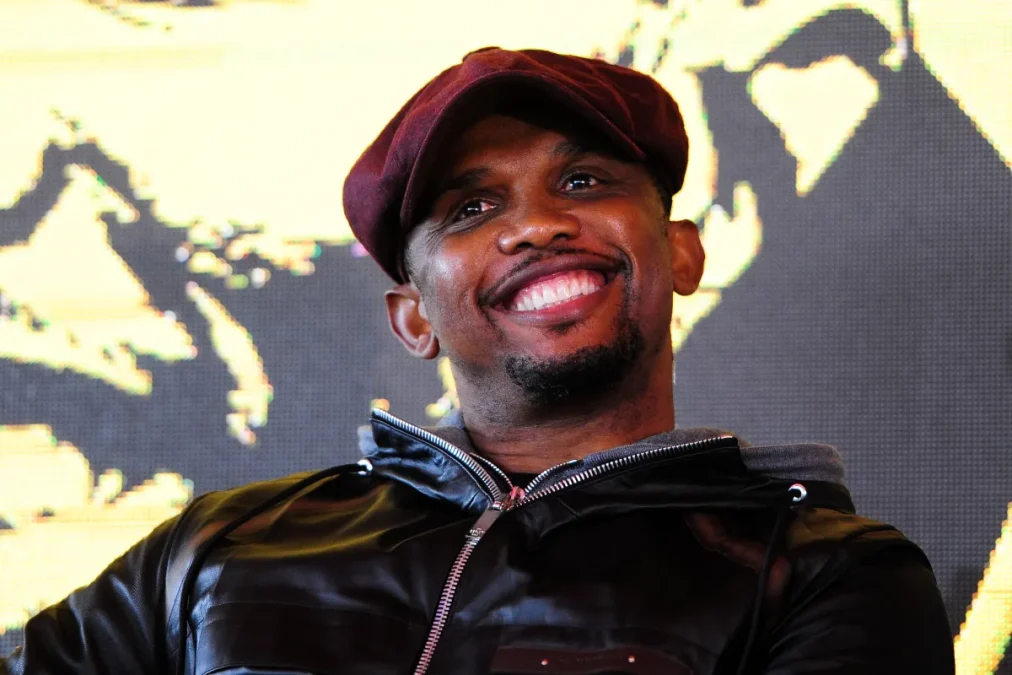
Samuel Eto’o’s plan to strengthen Cameroon’s Under-17 side with dual-national players based in Europe could be blocked by a 2014 presidential decree.
The Cameroon Football Federation president has been in England in recent days trying to persuade young players developed in European academies to join the national team ahead of the Under-17 World Cup, which will be held in Qatar from 19 November to 13 December 2026.
Eto’o is understood to have stepped up discussions with several eligible players as Cameroon prepares for the tournament. He met Manchester United players Bassirou Nkoto and Douka Nkoto, Manchester City’s William Gueke and Nottingham Forest’s Tomak Jaxon David.
Most of those players have already been called up by Cameroon’s youth teams.
The approach mirrors a strategy previously used with the senior national side. Eto’o has sought to meet players’ families, explain Cameroon’s sporting plans and make contact early enough to prevent promising youngsters from committing themselves permanently to the countries where they were born or developed.
However, the federation may face a significant legal problem before any of the players can be selected.
Article 7, paragraph 3, of a presidential decree dated 26 September 2014 states that only players registered in competitions organised by Fecafoot can represent Cameroon at Under-15 and Under-17 level.
The same provision previously prevented Etienne Eto’o, who was living in Spain at the time, from playing for Cameroon at the Under-17 World Cup.
If the rule is applied strictly, young footballers registered with European clubs would be excluded from the Cameroon youth teams, even if they hold Cameroonian nationality and satisfy FIFA’s sporting eligibility requirements.
Fecafoot would therefore need to secure an amendment, clarification or possible exemption before selecting the dual nationals without risking a formal challenge.
The regulation was presumably introduced to protect local development and create opportunities for youngsters playing in Cameroon. Its original purpose may be understandable, but its application appears increasingly difficult to reconcile with the modern game.
The African diaspora represents a substantial pool of talent for the continent’s leading football nations, particularly at youth level. Automatically ruling out players trained in high-quality European academies could mean Cameroon misses out on footballers capable of improving the team immediately.
Eto’o’s active involvement comes after Cameroon failed to qualify for the 2026 World Cup. The former striker is exploring different ways to restore the reputation of the men’s national team.
His methods have often divided opinion, but his personal commitment to Cameroon’s football is difficult to question. The former forward has not remained passive as he attempts to find solutions for the national setup.
There has been more positive news for Cameroon elsewhere. The Indomitable Lionesses recently won the first Women’s Africa Cup of Nations in their history in Morocco, completing an impressive campaign with a 3-0 victory over Malawi.
The question now is whether recruiting players from Europe is the best route for rebuilding the Indomitable Lions. Dual-national footballers could add quality, but Fecafoot will also need to continue strengthening its domestic competitions and youth development centres.
The legal restriction means Eto’o’s efforts in England may not be enough on their own. Before the players can help Cameroon at the Under-17 World Cup, the federation must first determine whether the country’s existing regulations can accommodate a generation increasingly developed outside its borders.
-
 Amad Diallo reveals Bruno Fernandes is his trusted adviser at Manchester United Oct 17, 2026
 -
CAF Champions League: CFFA face Young Africans in crucial second-round first leg Oct 17, 2026
-
CAF Champions League: RS Berkane face Star Sport Academy test in Liberia Oct 17, 2026
-
CR Belouizdad’s CAF Confederation Cup tie postponed after CAS ruling Oct 17, 2026




-
AFCON 2025: Fixtures, Results, Scores and Standings Jan 18, 2026
-
Match hero Taiwo Awoniyi reflects on team effort after Chelsea triumph May 5, 2026
-
Leadership and long-term vision key to rescuing Zamalek and inspiring Egyptian football – Hany Abou Rida Nov 5, 2025
-
South African giants Orlando Pirates set to lose influential forward Monnapule Saleng Mar 19, 2025




-
Real Betis v Barcelona: kick-off time, TV details and match preview Oct 16, 2026
-
Roma v Real Madrid: home side tipped to score first in Champions League clash Oct 12, 2026
-
Atletico Madrid v Manchester United: probable line-ups for Champions League clash Oct 12, 2026
-
Celta Vigo v Juventus: Probable line-ups for Europa League encounter Oct 14, 2026