CAF meeting in Dar es Salaam proceeds as Fouzi Lekjaa joins by videoconference
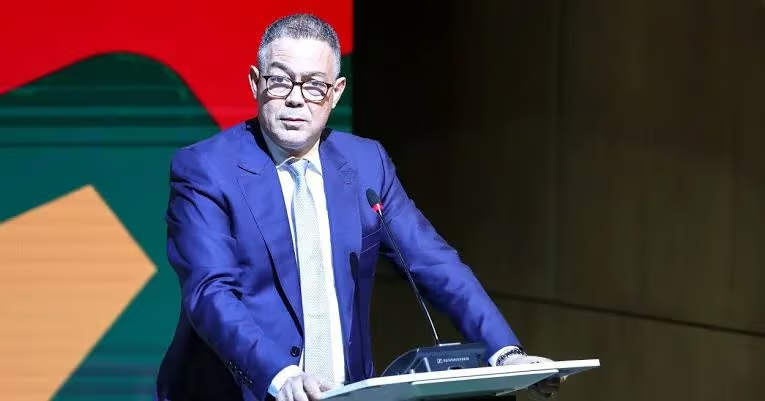
A meeting of the Confederation of African Football’s Executive Committee in Dar es Salaam is taking place under heightened scrutiny after reports suggested that Fouzi Lekjaa would not attend in person, opting instead to participate remotely.
Lekjaa, president of the Royal Moroccan Football Federation and CAF’s first vice-president, is expected to join the session by videoconference in his role as chairman of the finance committee.
Reports circulating ahead of the meeting described his absence from Tanzania as a boycott, set against a backdrop of disagreements over several sensitive issues within the organisation.
Among the points drawing attention are criticisms linked to disciplinary decisions following the final of the last Africa Cup of Nations, including views that sanctions handed down after the match against Senegal national football team were too lenient.
Wider concerns about governance, internal communication and decision-making processes at CAF have also been raised in recent discussions surrounding the Executive Committee.
The meeting is chaired by CAF president Patrice Motsepe and features a broad agenda covering sporting and commercial matters.
Members are set to review the financial performance of the most recent Africa Cup of Nations, including presentations on commercial and audiovisual revenues generated by the competition.
Planning for upcoming editions of the continental tournament is also expected to be discussed, with organisational readiness and scheduling forming part of the deliberations.
Officials will additionally examine reports relating to incidents during the tournament final, along with findings from the disciplinary committee.
Refereeing standards and the use of video assistant refereeing will be assessed as CAF looks to evaluate officiating during the competition.
The women’s football calendar is also on the agenda, including a Moroccan proposal concerning scheduling for the Women’s Africa Cup of Nations.
Further discussions are due to cover continental futsal competitions and broader planning across CAF tournaments.
With multiple governance and operational issues under consideration, the Executive Committee session is seen as a significant moment for the organisation’s ongoing direction.
Popular News


-

AFCON 2025: Fixtures, Results, Scores and Standings
Jan 18, 2026 -

Leadership and long-term vision key to rescuing Zamalek and inspiring Egyptian football – Hany Abou Rida
Nov 5, 2025 -

South African giants Orlando Pirates set to lose influential forward Monnapule Saleng
Mar 19, 2025 -

Full schedule for 2025 Africa Cup of Nations in Morocco confirmed
Feb 12, 2025

-

LIVE UPDATES: D.R Congo 1-0 Jamaica – 2026 FIFA World Cup Playoffs
Mar 31, 2026 -
Cameroon defeat China 2-0 in FIFA Series clash
Mar 31, 2026 -

Africa’s 2026 World Cup Teams: Fixtures and Results for March friendly games
Apr 1, 2026 -

Zimbabwe defender Teenage Hadebe dropped after code of conduct breach
Mar 30, 2026