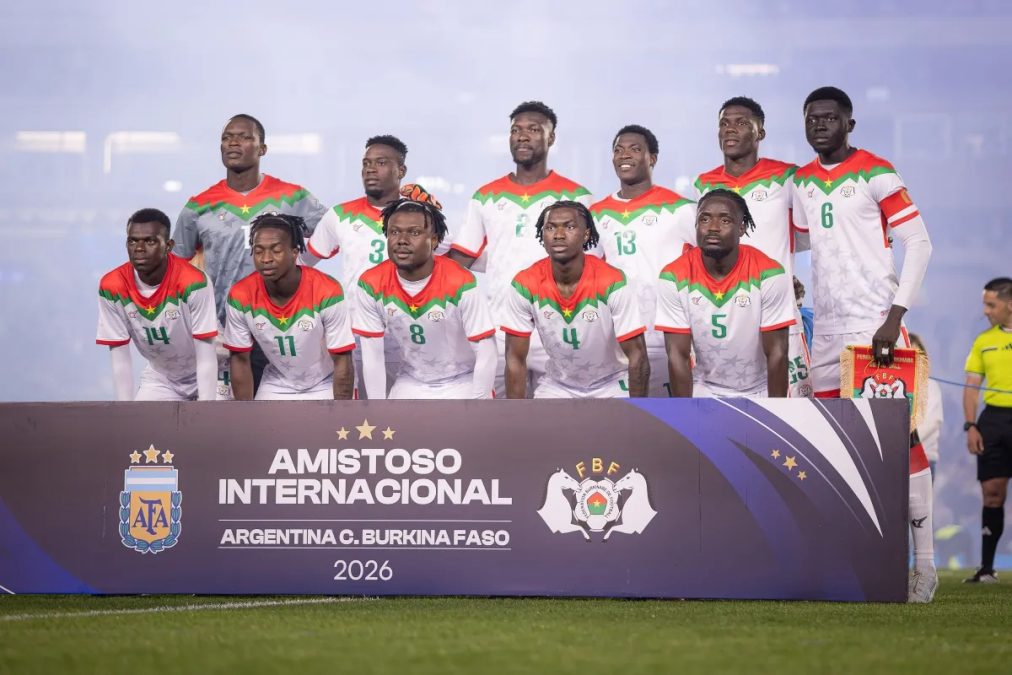
Burkina Faso president Ibrahim Traore has promised immediate measures to overhaul the country’s football system after the national team’s 7-0 defeat by Argentina, a result that could lead to a confrontation with FIFA.
Speaking on Monday while receiving the Burkina Faso U15 women’s team, runners-up in the African school championship, Traore said “new things” would be announced this week to restore order to the national game.
Any direct intervention by the state in the running or appointments of the Federation Burkinabe de Football could have serious consequences. FIFA statutes require member associations to manage their affairs independently and without improper interference from governments or other third parties.
If Burkina Faso’s authorities take control of the federation’s operations, the country could face sanctions, potentially including suspension from FIFA.
It remains unclear what measures Traore intends to introduce. The 7-0 defeat in Argentina, however, cannot be attributed entirely to the country’s football administrators.
Burkina Faso’s journey to Buenos Aires had descended into confusion, forcing the country to call up its U23 side at short notice. The team arrived in Argentina only a few hours before kick-off and then travelled to the Monumental to face the world champions without anything resembling a normal preparation.
Argentina manager Lionel Scaloni publicly acknowledged the efforts made by the Burkinabe players despite the heavy loss.
The problems facing Burkina Faso pre-date the trip to Argentina. The Etalons were runners-up at the 2013 Africa Cup of Nations, finished third in 2017 and fourth in 2021. They also took the race for qualification for the 2022 World Cup to the final round, ending only two points behind Algeria after drawing both matches against the Fennecs.
Since then, their progress has gone into reverse. Burkina Faso were eliminated in the last 16 of the 2025 Africa Cup of Nations, a disappointing result that cost Brama Traore his position as manager. They also failed to qualify for the 2026 World Cup despite the tournament’s expansion.
The decline has several possible causes, including the quality of the current generation, the ageing of established players such as Bertrand Traore, problems within the domestic game and the management of the federation.
Restoring stability, increasing investment and improving player development are therefore understandable aims. The outcome will depend heavily on how the changes are carried out.
The government could support a rebuilding programme without taking control of the federation. A FIFA suspension would prevent Burkina Faso’s national teams and clubs from competing internationally.
The proposed reform therefore carries a significant risk: an attempt to protect and revive national football could instead leave players and teams dealing with the consequences of an institutional dispute.
-
 Burkina Faso football: Ibrahim Traore promises reform after Argentina rout Oct 6, 2026
 -
African football news: Rehmi on trial at Beerschot as Diakite joins Roc Nation Sports Oct 6, 2026
-
Sundowns’ CAF Champions League trip set for R18 tickets in Angola Oct 6, 2026
-
Pitso Mosimane warns Benni McCarthy will be determined to deny South Africa Oct 6, 2026




-
AFCON 2025: Fixtures, Results, Scores and Standings Jan 18, 2026
-
Match hero Taiwo Awoniyi reflects on team effort after Chelsea triumph May 5, 2026
-
Leadership and long-term vision key to rescuing Zamalek and inspiring Egyptian football – Hany Abou Rida Nov 5, 2025
-
South African giants Orlando Pirates set to lose influential forward Monnapule Saleng Mar 19, 2025




-
AFCON 2027 Qualifiers: McCarthy warns South Africa to expect tough test against Eritrea Sep 29, 2026
-
Denmark v Portugal: Nations League kick-off time, TV channel and match prediction Sep 29, 2026
-
France v Belgium: Probable line-ups for Nations League clash Oct 3, 2026
-
AFCON 2027 qualifiers: Manchester United injury crisis deepens as Noussair Mazraoui hobbles off in Morocco win Sep 30, 2026