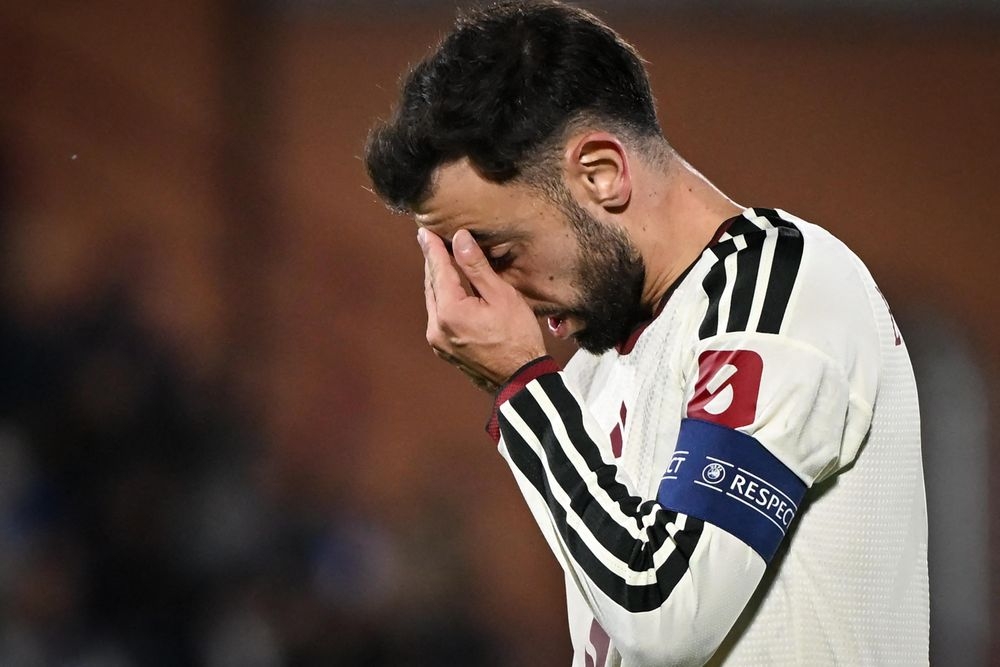
Michael Carrick’s decision to leave Manchester United captain Bruno Fernandes out of Sunday’s 3-0 home defeat by Bournemouth has revived a familiar question in European football: can a manager survive a direct challenge to a club’s most influential player?
Carrick acted after Fernandes publicly criticised his instruction to sit back rather than press high during United’s 4-1 Champions League defeat away to Como. The manager responded by benching his captain against Bournemouth, but the decision proved disastrous.
United produced a passive display and collapsed without their main creative force. Fernandes remained an unused substitute as Carrick turned to academy players, leaving the manager facing a damaging loss of authority and the club’s board with a familiar choice between an expendable coach and an indispensable star.
Football history suggests managers rarely win such confrontations.
Ruud Gullit and Alan Shearer
One of the clearest examples came at St James’ Park in August 1999, when Newcastle manager Ruud Gullit attempted to impose a more fluid tactical approach while growing frustrated by Alan Shearer’s influence in the dressing room.
During a rain-soaked Tyne-Wear derby against Sunderland, Gullit dropped Shearer and his strike partner Duncan Ferguson in favour of rookie Paul Robinson. Newcastle surrendered an early lead and lost 2-1.
Gullit then insisted the team had looked sharper without Shearer. The response from supporters and the Newcastle board was hostile, and the manager resigned three days later, having lost his leverage and reinforced Shearer’s status as an untouchable figure.
Sir Alex Ferguson’s exception
Sir Alex Ferguson demonstrated that a manager can prevail when backed by overwhelming institutional authority.
After an FA Cup defeat by Arsenal in 2003, Ferguson’s anger at David Beckham’s growing celebrity and perceived decline in defensive focus culminated in a flying dressing-room boot striking the midfielder above the eye.
Ferguson later left Beckham out of a decisive Champions League quarter-final against Real Madrid. Although Beckham scored twice after coming on, Ferguson still authorised his transfer to Madrid that summer. His 17 years of trophies and complete backing from the Manchester United board ensured he remained more powerful than the player.
Resistance at Chelsea and Manchester United
In 2012, Andre Villas-Boas attempted to move Chelsea beyond its established core, alienating Frank Lampard, John Terry and Ashley Cole with rigid tactics and distant management.
He left Lampard, Cole and Michael Essien out for a Champions League last-16 tie at Napoli, which Chelsea lost 3-1. Villas-Boas was dismissed two weeks later, while the experienced players were restored by interim manager Roberto di Matteo and helped the club win its first Champions League title.
Jose Mourinho’s dispute with Paul Pogba at Manchester United followed a similar pattern. After stripping the £89m record signing of the vice-captaincy, Mourinho left the French World Cup winner on the bench for a 3-1 defeat by Liverpool at Anfield in 2018-19.
The board sacked Mourinho within 48 hours, with Pogba immediately restored to a central role.
At Real Madrid in 2015, Rafa Benitez also struggled after alienating Cristiano Ronaldo and Sergio Ramos with rigid tactics and detailed training demands. A 4-0 home Clasico defeat by Barcelona intensified the crisis after Ronaldo reportedly told president Florentino Perez that Madrid would win nothing under Benitez.
Perez dismissed him seven months into the job and appointed Zinedine Zidane, who empowered Ronaldo and Ramos as Real Madrid won three successive Champions League trophies.
-
 CAF Champions League: probable pots revealed ahead of Cairo group-stage draw Oct 26, 2026
-
Morocco complete perfect U15 World Cup group stage as Cameroon reach League A Oct 26, 2026
-
Hakimi finishes second among defenders in Ballon d’Or 2026 voting Oct 26, 2026
-
Lamine Yamal wins third straight Kopa Trophy as African talent shines in 2026 ranking Oct 26, 2026




-
AFCON 2025: Fixtures, Results, Scores and Standings Jan 18, 2026
-
Match hero Taiwo Awoniyi reflects on team effort after Chelsea triumph May 5, 2026
-
Leadership and long-term vision key to rescuing Zamalek and inspiring Egyptian football – Hany Abou Rida Nov 5, 2025
-
South African giants Orlando Pirates set to lose influential forward Monnapule Saleng Mar 19, 2025




-
Barcelona v Real Madrid: Catalans backed at 1.65 to win October Clasico Oct 23, 2026
-
Barcelona and Real Madrid meet in pivotal 265th Clasico Oct 23, 2026
-
Sevilla FC v Osasuna: probable line-ups for Monday’s La Liga meeting Oct 25, 2026
-
Champions League: PSG beat Barcelona as Liverpool complete comeback against Villarreal Oct 20, 2026