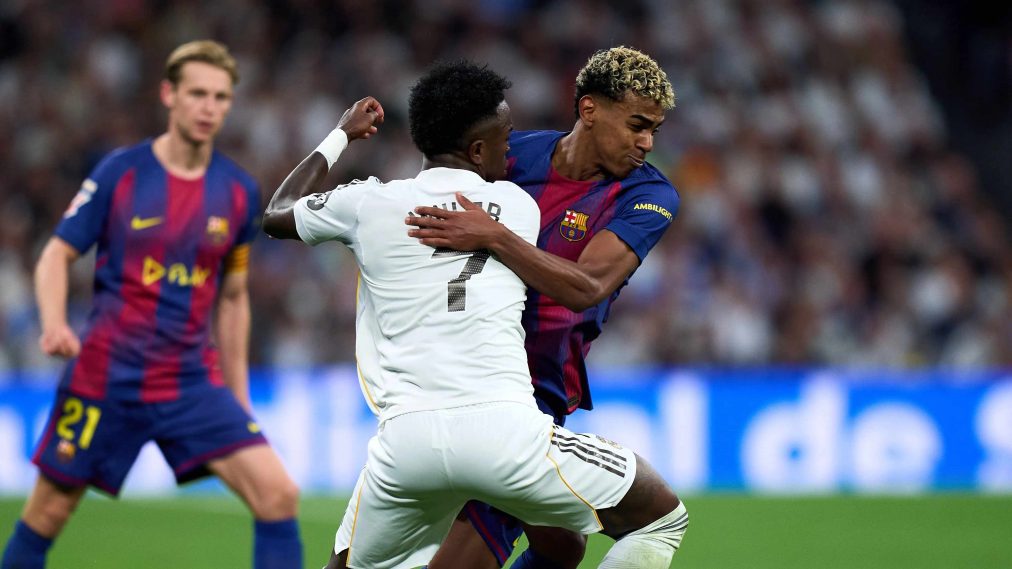
Barcelona and Real Madrid’s El Clasico remains scheduled for Sunday despite riots in central Barcelona that led to about 100 arrests and damage to shops and other property.
The fixture at Spotify Camp Nou is being played in a heightened security environment after clashes between groups of young people and Catalan police on Saturday evening. More than 30 locations were set on fire and 14 commercial premises were damaged or looted, according to Catalonia’s interior minister, Nuria Parlon.
Police said about 100 people had been arrested, including 27 minors, Reuters reported. Incidents around Placa de Catalunya included bins and street furniture being burned, barricades being built and stones and other hard objects being thrown at officers. Shops in the area closed their doors to protect themselves from possible damage.
Police urged people to stay away from Placa de Catalunya and nearby streets for their own safety.
According to La Vanguardia and Spain’s public broadcaster, the gathering had been promoted through online groups in imitation of a student protest movement in France. Reports have not directly linked the unrest to the Barcelona v Real Madrid match.
El Clasico was already classed as high risk
The match had already been designated a high-risk event on 14 October by the permanent committee of the Spanish Government Commission against Violence, Racism, Xenophobia and Intolerance in Sport.
That decision came 10 days before Saturday’s disturbances and was linked to the need for additional security before, during and after a fixture regarded as particularly sensitive because of the longstanding sporting tension between the clubs.
Spanish newspapers AS and Mundo Deportivo reported that extra officers were expected around Spotify Camp Nou and in areas where supporters gather. However, the timing of the classification means it was made before the unrest and was not a response to it.
There had been no official announcement, at the time of publication, from La Liga, the Spanish Football Federation or either club confirming that the match would be postponed or cancelled.
The fixture has a recent precedent for being moved because of security concerns. The match scheduled for 26 October 2019 at Camp Nou was postponed after protests and unrest in Catalonia followed prison sentences handed to several leaders of the separatist movement.
La Liga said at the time that it had acted because of the security situation in the region and information suggesting that groups opposed to a peaceful event might exploit the match. It proposed swapping the venues so the game could be played in Madrid, but both clubs rejected that option. The Spanish Football Federation subsequently arranged for the fixture to take place on 18 December 2019.
A major security operation was mounted before that rearranged match amid fears that the Democratic Tsunami movement would try to disrupt it and use the global attention surrounding El Clasico to communicate political messages.
The current protests have a different background, however, and there is no official information indicating a plan to interfere with Sunday’s match. Any decision in the coming hours is expected to depend on updates from Catalan police and the organisers about supporter movements, security around Camp Nou and access to the stadium.
In 2019, the postponement was announced about a week before the original date. A last-minute decision this time would be more complicated because of security and logistical arrangements, supporter travel and television broadcasting commitments.
-
 Jeremie Obounet Moussangova joins Union Sportive d’Oyem in Gabon Oct 25, 2026
-
Football betting tips for 25 October: Mbappe backed to score in El Clasico Oct 25, 2026
-
Cardoso refuses excuses as Sundowns suffer early CAF Champions League exit Oct 25, 2026
-
Makua questions whether some Kaizer Chiefs players are good enough for the club Oct 25, 2026



-
AFCON 2025: Fixtures, Results, Scores and Standings Jan 18, 2026
-
Match hero Taiwo Awoniyi reflects on team effort after Chelsea triumph May 5, 2026
-
Leadership and long-term vision key to rescuing Zamalek and inspiring Egyptian football – Hany Abou Rida Nov 5, 2025
-
South African giants Orlando Pirates set to lose influential forward Monnapule Saleng Mar 19, 2025




-
Barcelona v Real Madrid: Catalans backed at 1.65 to win October Clasico Oct 23, 2026
-
Barcelona and Real Madrid meet in pivotal 265th Clasico Oct 23, 2026
-
PSG v Barcelona: fiery attacks set up Champions League classic at Parc des Princes Oct 18, 2026
-
Champions League: PSG beat Barcelona as Liverpool complete comeback against Villarreal Oct 20, 2026