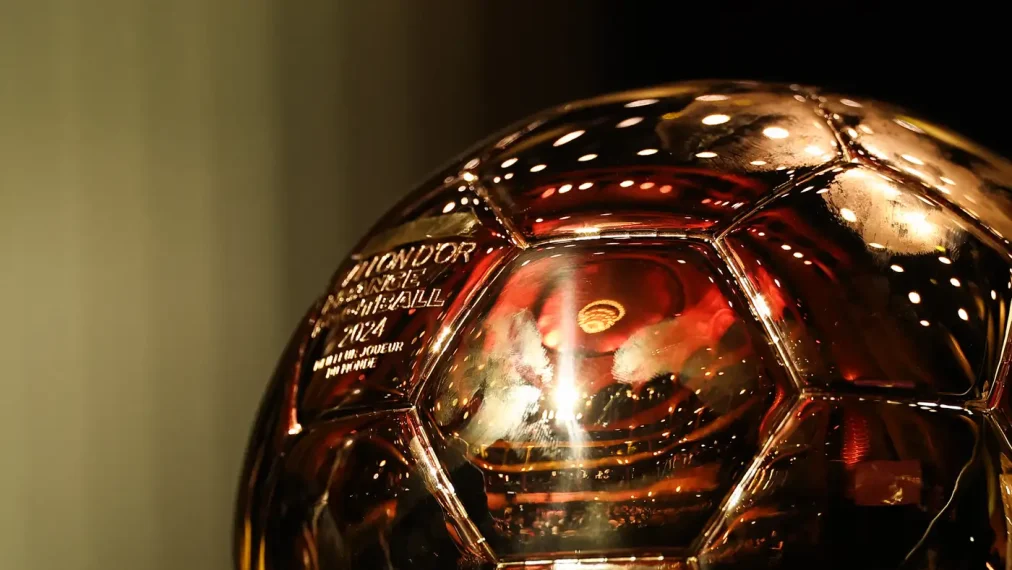
The 70th Ballon d’Or ceremony will take place in London on 26 October 2026, with the world’s leading players competing for football’s most prestigious individual prize after a season-based assessment covering 3 August 2025 to 19 July 2026.
The event, organised by France Football, will be staged in the British capital for the first time in the award’s history. Alongside the men’s and women’s Ballon d’Or, winners will be announced in several other categories, including the Yashin Trophy for the best goalkeeper, the Kopa Trophy for the best young player, and awards for the best coach and club.
The ceremony will be broadcast on beIN Sports News, while a live stream will also be available through Kooora.
The Ballon d’Or has been awarded annually by France Football since 1956. It was created by sports writers Gabriel Hanot and Jacques Ferran and was initially decided exclusively by votes from football journalists.
The prize was originally restricted to European players and was also known as the European Footballer of the Year award. Its eligibility was expanded in 1995 to include players of any nationality, provided they played for European clubs.
In 2007, the award became global and was opened to professional footballers from around the world. Coaches and national-team captains were also given voting rights before the process returned to a journalists-only system in 2016.
From 2010 to 2015, France Football’s award was merged with FIFA’s World Player of the Year prize under the name FIFA Ballon d’Or. That partnership ended in 2016, when France Football restored the original Ballon d’Or name and FIFA relaunched its own award as The Best FIFA Men’s Player.
Season-based voting
France Football changed the basis of the award in 2022. Rather than assessing performances over the calendar year from January to December, voters now consider the European football season, running from August to July.
That means major international tournaments played during the summer, including the UEFA European Championship, Copa America and FIFA World Cup, are assessed as part of the season in which they take place.
The current voting system uses one specialist journalist from each of the top 100 countries in the FIFA men’s world ranking. For the women’s award, journalists from the top 50 countries in the FIFA women’s ranking take part.
The three main criteria are individual performances, decisiveness and influence on the pitch; collective performances and honours; and fair play and sporting conduct. A player’s career achievements are no longer considered, ensuring that the assessment is based on the campaign under review rather than a player’s reputation or previous success.
Thirty players make the final Ballon d’Or shortlist. Each voter selects and ranks their top 10, rather than choosing only five players as under the previous system.
The player placed first receives 15 points, followed by 12 points for second place. The total then decreases progressively, with the player ranked 10th receiving one point. The player with the highest overall total wins the award.
Current holder and record winners
France forward Ousmane Dembele is the reigning men’s Ballon d’Or winner after claiming the 69th edition in 2025.
Lionel Messi holds the record with eight victories, ahead of Cristiano Ronaldo, who has won the prize five times. Johan Cruyff, Michel Platini and Marco van Basten each won it three times.
Alfredo Di Stefano, Franz Beckenbauer, Kevin Keegan, Karl-Heinz Rummenigge and Ronaldo each collected the award twice.
Messi also finished runner-up five times, in 2008, 2013, 2014, 2016 and 2017, and was third in 2007. Ronaldo was second in 2007, 2009, 2011, 2012, 2015 and 2018, and third in 2019.
The historical records of the leading winners are:
– Lionel Messi: eight wins 2009, 2010, 2011, 2012, 2015, 2019, 2021 and 2023; five second-place finishes and one third-place finish. – Cristiano Ronaldo: five wins 2008, 2013, 2014, 2016 and 2017; six second-place finishes and one third-place finish. – Michel Platini: three wins 1983, 1984 and 1985; two third-place finishes. – Johan Cruyff: three wins 1971, 1973 and 1974; one third-place finish. – Marco van Basten: three wins 1988, 1989 and 1992. – Franz Beckenbauer: two wins 1972 and 1976; two second-place finishes and one third-place finish. – Ronaldo: two wins 1997 and 2002; one second-place and one third-place finish. – Alfredo Di Stefano: two wins 1957 and 1959; one second-place finish. – Kevin Keegan: two wins 1978 and 1979; one second-place finish. – Karl-Heinz Rummenigge: two wins 1980 and 1981; one second-place finish. – Luis Suarez: one win in 1960, two second-place finishes and one third-place finish. – Eusebio: one win in 1965 and two second-place finishes. – Bobby Charlton: one win in 1966 and two second-place finishes. – Raymond Kopa: one win in 1958, one second-place finish and two third-place finishes. – Gerd Muller: one win in 1970, one second-place finish and two third-place finishes. – Zinedine Zidane: one win in 1998, one second-place finish and one third-place finish. – Gianni Rivera: one win in 1969 and one second-place finish. – Ruud Gullit: one win in 1987 and one second-place finish. – Lothar Matthaus: one win in 1990 and one second-place finish. – Roberto Baggio: one win in 1993 and one second-place finish. – Hristo Stoichkov: one win in 1994 and one second-place finish. – Andriy Shevchenko: one win in 2004 and two third-place finishes. – George Best: one win in 1968 and one third-place finish. – Allan Simonsen: one win in 1977 and one third-place finish. – Ronaldinho: one win in 2005 and one third-place finish. – Stanley Matthews, Omar Sivori, Josef Masopust, Lev Yashin, Denis Law, Florian Albert, Oleg Blokhin, Paolo Rossi, Igor Belanov, Jean-Pierre Papin, George Weah, Matthias Sammer, Rivaldo, Luis Figo, Michael Owen, Pavel Nedved, Fabio Cannavaro, Kaka, Luka Modric, Karim Benzema and Rodri have each won once.
Men’s Ballon d’Or nominees
The men’s shortlist includes Jude Bellingham, Marc Cucurella, Pau Cubarsi, Ousmane Dembele, Bruno Fernandes, Luis Diaz, Erling Haaland, Gabriel Magalhaes, Achraf Hakimi, Harry Kane, Khvicha Kvaratskhelia, Lamine Yamal, Sadio Mane, Marquinhos and Kylian Mbappe.
The remaining nominees are Lautaro Martinez, Michael Olise, Willian Pacho, Joao Neves, Julian Quinones, Rodri, Nuno Mendes, Vinicius Junior, Declan Rice, Lionel Messi, Fabian Ruiz, Ferran Torres, Dayot Upamecano, William Saliba and Vitinha.
The women’s nominees are Salma Bacha, Barbra Banda, Klara Buhl, Esmee Brugts, Mariona Caldentey, Scarlett Camberos, Kerstin Casparij, Temwa Chawinga, Cata Coll, Melchie Dumornay, Caroline Graham Hansen, Alex Greenwood, Patri Guijarro, Pernille Harder and Yui Hasegawa.
They are joined by Rose Lavelle, Mapi Leon, Lorena, Melvine Malard, Manaka Matsukubo, Vivianne Miedema, Ewa Pajor, Claudia Pina, Alexia Putellas, Wendie Renard, Alessia Russo, Khadija Shaw, Momoko Tanikawa, Caroline Weir and Tessa Wullaert.
Young-player and goalkeeper awards
The nominees for the men’s young-player award include Moroccan Ayoub Bouaddi of Manchester City, Bosnian Kerim Alajbegovic of Juventus, Ivorian Yan Diomande of Real Madrid, Spaniard Pau Cubarsi of Barcelona and Frenchman Eli Junior Kroupi of Bournemouth.
Also shortlisted are Germany’s Lennart Karl of Bayern Munich, Spain’s Lamine Yamal of Barcelona, Algeria’s Ibrahim Maza of Bayer Leverkusen, Switzerland’s Johan Manzambi of Freiburg and Aston Villa, and France’s Warren Zaire-Emery of Paris Saint-Germain.
The women’s young-player shortlist features Dutch player Veerle Baetens of Chelsea, Spain’s Vicky Lopez of Barcelona, Sweden’s Felicia Schroder of Real Madrid, Spain’s Clara Serrajordi of Barcelona and United States international Lily Yohannes of Lyon.
The men’s Yashin Trophy contenders are Yassine Bounou of Morocco and Al-Hilal, Thibaut Courtois of Belgium and Real Madrid, Joan Garcia of Spain and Barcelona, Gregor Kobel of Switzerland and Borussia Dortmund, Emiliano Martinez of Argentina and Chelsea, Edouard Mendy of Senegal and Al-Ahli, David Raya of Spain and Arsenal, Matvey Safonov of Russia and Paris Saint-Germain, Unai Simon of Spain and Athletic Club, and Vozinha of Cape Verde and Colo-Colo.
The women’s goalkeeper nominees are Germany’s Ann-Katrin Berger of Gotham, Spain’s Cata Coll of Barcelona, England’s Hannah Hampton of Chelsea, Brazil’s Lorena of Kansas City and Japan’s Ayaka Yamashita of Manchester City.
Coaching and club awards
The men’s coach of the year shortlist comprises Mikel Arteta of Arsenal, Luis de la Fuente of Spain, Unai Emery of Aston Villa, Luis Enrique of Paris Saint-Germain and Vincent Kompany of Bayern Munich.
The women’s nominees are Jonatan Giraldez of Lyon, Andree Jeglertz of Manchester City, Nils Nielsen of Japan, Pere Romeu of Barcelona and Elena Sadiku of Celtic and BK Hacken.
Five clubs are shortlisted for the men’s club award: Arsenal, Bayern Munich, Bodø/Glimt, Flamengo and Paris Saint-Germain.
The women’s club award nominees are Barcelona, Bayern Munich, Club America, Manchester City and Olympique Lyonnais.
The 2026 ceremony marks the continuation of UEFA’s partnership in organising the Ballon d’Or, which began in 2024. France Football retains control of the award’s name and voting system, while the annual event continues to recognise the leading performers in global football.
-
 Ghana forward Brandon Thomas-Asante targets goals, assists and Premier League impact Oct 20, 2026
 -
Playing in Premier League challenging; you have to be switched on all the time – Brandon Thomas-Asante Oct 20, 2026
-
Jean-Philippe Mateta keen on January Manchester United move as Crystal Palace consider sale Oct 20, 2026
-
Danny Welbeck embraces leadership role in Chelsea’s young dressing room Oct 20, 2026


-
AFCON 2025: Fixtures, Results, Scores and Standings Jan 18, 2026
-
Match hero Taiwo Awoniyi reflects on team effort after Chelsea triumph May 5, 2026
-
Leadership and long-term vision key to rescuing Zamalek and inspiring Egyptian football – Hany Abou Rida Nov 5, 2025
-
South African giants Orlando Pirates set to lose influential forward Monnapule Saleng Mar 19, 2025




-
PSG v Barcelona: fiery attacks set up Champions League classic at Parc des Princes Oct 18, 2026
-
Real Betis v Barcelona: kick-off time, TV details and match preview Oct 16, 2026
-
Porto v PSV: predicted line-ups for Champions League league-phase clash Oct 19, 2026
-
Bayern Munich host Arsenal in heavyweight Champions League clash Oct 19, 2026