
Africans Abroad
Cameroon
Countries
Foreign Leagues
Latest News
Transfers & Rumours
UNIFFAC
Zonal Bodies
Anderson vs Cameroon’s Carlos Baleba: How Man United’s midfield targets measure up in summer rebuild plans
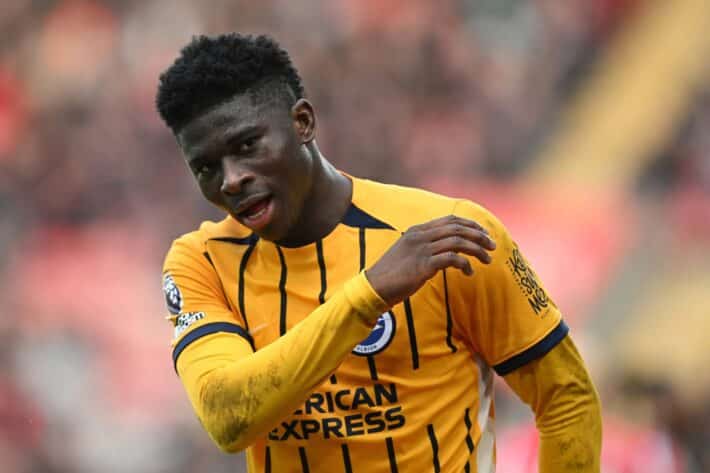
Manchester United’s anticipated summer rebuild is already taking shape, and two emerging midfielders, Elliot Anderson and Carlos Baleba, have surfaced as potential cornerstones for the club’s next phase.
As the Red Devils weigh their long term strategy following another period of managerial uncertainty, the comparison between Nottingham Forest’s Anderson and Brighton & Hove Albion’s Baleba offers a revealing insight into the type of player United could prioritise.
Both midfielders represent modern, high intensity profiles capable of bridging defensive discipline with attacking transition, yet each brings a distinct set of attributes that could influence United’s decision making.
United’s muted presence during the January transfer window was widely expected. The club hierarchy appears determined to avoid repeating past mistakes where recruitment decisions were made without clarity over the managerial direction.
The fallout from Erik ten Hag’s departure, after he was allowed to sign players who later failed to fit the tactical approach of his successor, remains a cautionary tale.
Ruben Amorim’s subsequent exit further reinforced the need for structural patience, leaving technical director Jason Wilcox, chief executive Omar Berrada and minority owner Sir Jim Ratcliffe cautious about committing significant financial resources without certainty over long term leadership.
Michael Carrick’s current caretaker tenure has injected some optimism around Old Trafford, particularly following a promising run of results. However, the club’s leadership remains mindful that stability must precede investment.
While Carrick has strengthened his case for permanent appointment, recruitment planning continues in parallel, ensuring United are prepared to act decisively once the managerial situation is finalised.
Central midfield remains a priority area for reinforcement regardless of who occupies the dugout next season. Bruno Fernandes has been a talismanic figure since arriving in Manchester, consistently driving creativity and leadership.
However, with the Portuguese playmaker approaching his early thirties and persistent interest from lucrative overseas markets, United must plan for eventual succession. Even if Fernandes remains, the squad still lacks a dynamic defensive midfielder capable of combining ball winning authority with forward thrust, reminiscent of past club icons who dominated both defensive and transitional phases.
Manuel Ugarte’s arrival initially promised to address these concerns but has delivered inconsistent returns. Meanwhile, Kobbie Mainoo continues to show exceptional technical promise but is widely regarded as a progressive midfielder rather than a defensive anchor.
This tactical gap has intensified United’s interest in Anderson and Baleba, both of whom have demonstrated the physical and technical versatility required to operate in demanding midfield systems.
At first glance, the two players share several similarities. Baleba, aged 22, is marginally younger than the 23 year old Anderson, placing both firmly within developmental phases that align with United’s renewed focus on youth investment. Their physical endurance, pressing intensity and willingness to contest duels highlight profiles suited to Premier League demands.
Neither player is recognised primarily for goal scoring output, though Anderson holds a slight statistical advantage with three goals and eight assists across 72 appearances for Forest, compared to Baleba’s four goals and two assists in 99 outings for Brighton.
Anderson’s rise has been particularly noteworthy. His ability to drive attacks from deeper positions has made him one of Forest’s most influential transitional players.
His forward passing statistics underline his effectiveness in advancing possession into dangerous areas, with a significant percentage of his progressive distribution reaching the final third. Equally impressive is his composure in retention, maintaining pass completion levels consistently above 80 percent, demonstrating reliability under pressure.
Defensively, Anderson combines aggression with positional awareness. His tackle success rate and impressive ball recovery figures underline a midfielder capable of disrupting opposition rhythm while maintaining structural balance.
His defensive output extends into aerial duels, where he has shown unexpected dominance, adding another dimension to his all action midfield presence. Such attributes have contributed to his recent inclusion in England’s senior international setup, reflecting growing recognition of his consistent Premier League performances.
Baleba, meanwhile, offers a slightly different interpretation of the role. The Brighton midfielder is renowned for his physical robustness and exceptional ball protection, traits that allow him to retain possession even under intense pressing. His tackling numbers reveal a strong success rate, while his involvement in one on one duels highlights a relentless competitive streak comparable to Anderson’s.
Baleba’s ball recovery statistics and progressive carrying ability further demonstrate his capacity to drive his team forward during transitional phases.
From a distribution perspective, Baleba has delivered remarkable volume, completing a substantial proportion of attempted passes. His composure in recycling possession fits Brighton’s possession based structure, while his willingness to advance with the ball mirrors the dynamic style United seek in modern midfield operators.
His progressive carrying figures, which surpass Anderson’s in some areas, illustrate a player capable of breaking defensive lines through direct movement rather than solely relying on passing.
Ultimately, United’s decision could hinge on financial feasibility and the ambitions of the players themselves. Both Brighton and Nottingham Forest have developed reputations as clubs capable of nurturing elite talent, and neither will be eager to sanction departures without significant transfer fees.
However, United’s historical stature and potential return to Champions League competition could prove persuasive factors should negotiations materialise.
Popular News



-

AFCON 2025: Fixtures, Results, Scores and Standings
Jan 18, 2026 -

Leadership and long-term vision key to rescuing Zamalek and inspiring Egyptian football – Hany Abou Rida
Nov 5, 2025 -

South African giants Orlando Pirates set to lose influential forward Monnapule Saleng
Mar 19, 2025 -

Full schedule for 2025 Africa Cup of Nations in Morocco confirmed
Feb 12, 2025

-

Morocco vs Ecuador Friendly: Where and How to Watch
Mar 26, 2026 -

Chile overturn deficit to defeat Cape Verde in FIFA Series clash
Mar 27, 2026 -

Morocco vs. Ecuador: Match details, key talking points and where to watch
Mar 27, 2026 -

Where and how to watch Saudi Arabia vs Egypt friendly ahead of 2026 World Cup
Mar 26, 2026


