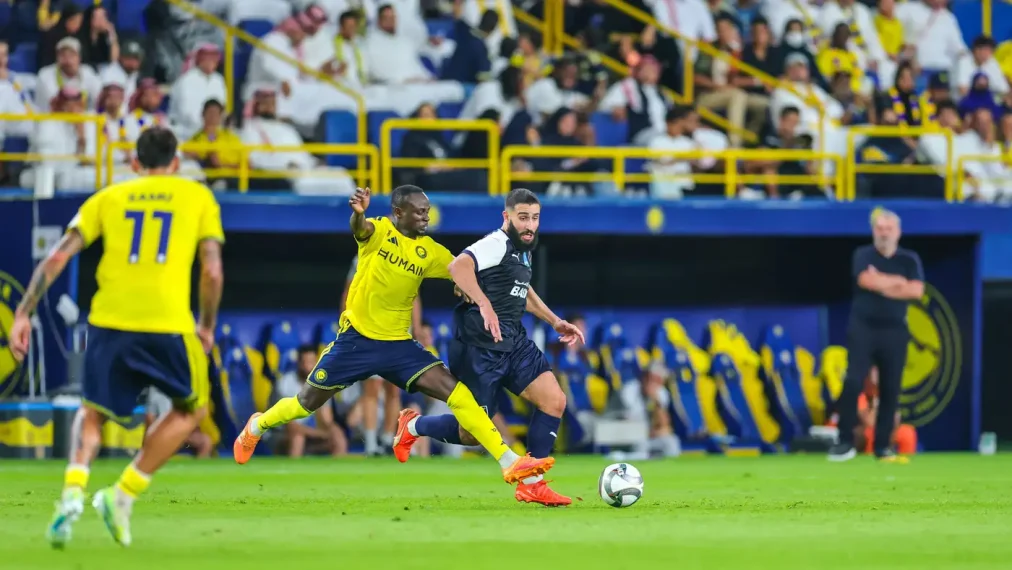
Al-Nassr remain top of the Roshn Saudi League after a strong start to the season, but their 2-1 victory over Abha exposed three tactical weaknesses that could become more costly against stronger opposition.
The issue is not the team’s results, but the details emerging in recent performances. Al-Nassr possess considerable attacking quality, yet they have also allowed opponents opportunities and space that could be punished by teams with greater quality and efficiency in front of goal.
One concern is the way Al-Nassr build play under pressure. Passing errors and poor positioning have appeared at important moments, particularly around the defensive line.
That was evident late in the match against Abha when Mohammed Simakan lost possession in a dangerous area. An Abha player broke through and found himself in a one-on-one situation with the goalkeeper, but missed the opportunity.
The incident may have seemed less significant because Al-Nassr went on to win, but it represented a clear warning. Stronger opponents are unlikely to waste similar chances, and mistakes in passing or positioning close to goal could immediately become costly, especially when Al-Nassr commit a large number of players forward.
Space left during attacking transitions
Al-Nassr’s attacking aggression is one of their principal strengths, but it can also create problems when possession is lost. The team often advances with many players, leaving space behind them for opponents to exploit.
Abha managed to take advantage of that vulnerability on more than one occasion. Al-Nassr appeared particularly exposed when facing quick transitions from defence into attack, raising the prospect of greater problems against a side with more quality in that area.
The team therefore need to find a better balance between pressing and attacking with numbers and protecting the spaces left behind after losing the ball. An open contest against a fast opponent could give the other side an advantage Al-Nassr would prefer to avoid.
The third concern involves the distances between the different lines. At times, a gap appeared between midfield and attack, making it harder to connect play and allowing Abha’s players to move into spaces between the lines.
That problem has also made the absence of Marcelo Brozovic more noticeable. Samu Costa has not yet provided the same influence as the Croatian midfielder, particularly in controlling the tempo, linking the lines and helping the team play out under pressure.
Costa has clear ability, but the comparison with Brozovic highlights the balance Al-Nassr are still trying to recover. If the distance between the lines remains unchanged, opponents who are adept at exploiting central spaces could make life increasingly difficult.
Al-Nassr have the league lead and significant attacking power, which makes correcting these flaws more important. Their progress will depend not only on continuing to win, but also on removing weaknesses before they turn into dropped points.
Those three problems defensive errors, space during transitions and gaps between the lines may not yet be visible in the table. Unless Al-Nassr address them early, however, they could become genuine obstacles in their pursuit of the title.
-
 Bafana Bafana to host Benni McCarthy’s Kenya in Johannesburg AFCON qualifier Oct 17, 2026
 -
Maghreb de Fes and ASEC Mimosas reveal probable line-ups for CAF Champions League tie Oct 17, 2026
-
Maghreb de Fes face a l’ASEC Mimosas in first-ever CAF Champions League meeting Oct 17, 2026
-
Leeds v Manchester United: Mbeumo backed at 3.4 as sides meet in Premier League derby Oct 17, 2026




-
AFCON 2025: Fixtures, Results, Scores and Standings Jan 18, 2026
-
Match hero Taiwo Awoniyi reflects on team effort after Chelsea triumph May 5, 2026
-
Leadership and long-term vision key to rescuing Zamalek and inspiring Egyptian football – Hany Abou Rida Nov 5, 2025
-
South African giants Orlando Pirates set to lose influential forward Monnapule Saleng Mar 19, 2025




-
Real Betis v Barcelona: kick-off time, TV details and match preview Oct 16, 2026
-
Roma v Real Madrid: home side tipped to score first in Champions League clash Oct 12, 2026
-
Atletico Madrid v Manchester United: probable line-ups for Champions League clash Oct 12, 2026
-
Celta Vigo v Juventus: Probable line-ups for Europa League encounter Oct 14, 2026