
Africa’s growing confidence redefines its rivalry with Brazil
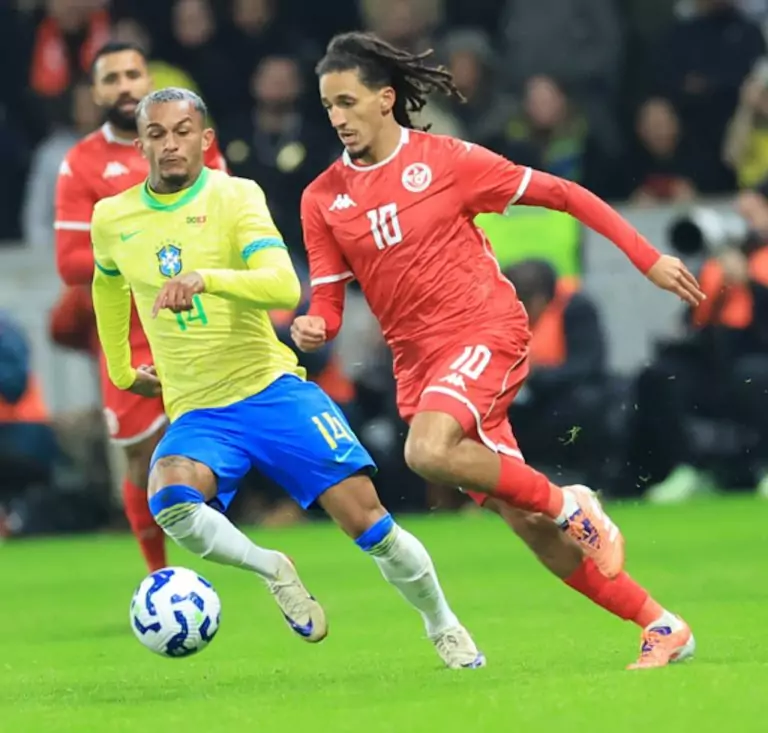
Tunisia’s 1–1 draw with Brazil in Lille has reinforced a striking shift in international football: African teams no longer approach the Seleção with fear or resignation.
Once viewed as an untouchable superpower, Brazil now faces African opponents who compete with organisation, confidence and, increasingly, the belief that they can win.
The November 2025 international window offered another glimpse into this new dynamic.
Brazil opened with a 2–0 victory over Senegal before being held to a disciplined and assertive Tunisian side.
For years, meetings with Brazil carried an aura of inevitability for African nations.
That sense of hierarchy has eroded, replaced by more balanced contests and a growing catalogue of African resistance.
Tunisia’s performance in Lille stood out for its composure and clarity.
Compact in defence and assured in possession, the Eagles of Carthage absorbed pressure with maturity and repeatedly unsettled a Brazil side keen to distance itself from recent disappointments against African opposition.
Their draw did more than frustrate the five-time world champions; it highlighted how routine such resilience has become.
Senegal remain perhaps the most emblematic example of this transformation.
Their landmark 4–2 triumph over Brazil in Lisbon in June 2023 captured global attention and altered perceptions of what African teams could achieve on the biggest stages.
The defeat Brazil inflicted on Senegal in November 2025, while authoritative, did not erase the symbolic weight of the earlier victory.
Senegal’s success broadened expectations and reaffirmed Africa’s tactical and technical growth.
Morocco delivered a similar statement in March 2023 when the Atlas Lions beat Brazil 2–1 in Tangier.
Their approach—structured defending, coordinated pressing and sharp transitions—showed not only that African teams could compete, but that they could outthink Brazil in key moments.
The win was celebrated widely across the country and further intensified the shift in continental self-belief.
Even in defeat, teams such as Guinea have demonstrated the narrowing gap.
Their 4–1 loss in 2023 included the opening goal and several sequences that forced Brazil into uncomfortable positions.
Though the result favoured the Brazilians, Guinea’s willingness to attack and the problems they posed marked yet another indication of Africa’s growing conviction.
Cameroon’s history with Brazil stretches further back, long before the recent surge in African success.
Their 1–0 win at the 2022 World Cup, courtesy of Vincent Aboubakar’s dramatic goal, joined another famous 1–0 victory in 2003 at the Confederations Cup led by Samuel Eto’o.
These results laid some of the earliest foundations for the belief African teams now carry.
Nigeria’s unforgettable 4–3 comeback victory over Brazil in the semi-final of the 1996 Atlanta Olympics remains one of the most iconic chapters in this evolving relationship.
The brilliance of Jay-Jay Okocha, Nwankwo Kanu and the rest of that generation demonstrated that African teams could overturn even the strongest Brazilian side—an achievement that still resonates today.
Across decades, Africa’s perspective has shifted from admiration to challenge.
Rather than shrinking in the face of Brazil’s tradition, African teams now confront the Seleção with ambition and tactical maturity.
They press higher, attack with purpose and refuse to be overwhelmed by reputation alone.
The result is a series of increasingly competitive encounters in which Brazil’s dominance can no longer be taken for granted.
Confidence and experience, built from historic achievements and recent performances, have replaced the trepidation of the past.
And with every assertive display, Africa solidifies its place as an equal—not a spectator—in the global rivalry with Brazil.
Popular News



-
AFCON 2025: Fixtures, Results, Scores and Standings
Jan 18, 2026 -

South African giants Orlando Pirates set to lose influential forward Monnapule Saleng
Mar 19, 2025 -

Leadership and long-term vision key to rescuing Zamalek and inspiring Egyptian football – Hany Abou Rida
Nov 5, 2025 -

Full schedule for 2025 Africa Cup of Nations in Morocco confirmed
Feb 12, 2025
-

Lamini Fati set for Real Madrid breakthrough opportunity
Mar 5, 2026 -

Spanish prosecutors seek 10-year prison sentence for Rafa Mir as legal case deepens
Mar 6, 2026 -

Achraf Dari denied contract exit as Al Ahly SC settle dues
Feb 28, 2026 -

FIFA suspends Algeria’s Youcef Belaïli for one year over Ajaccio dispute
Mar 6, 2026