
AFCON 2025: Late penalty drama fuels debate in Morocco’s win over Tanzania
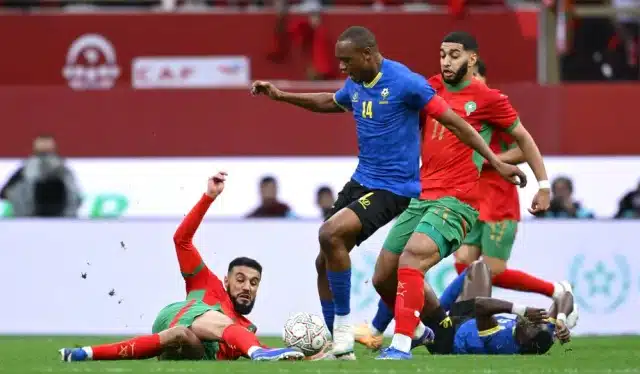
A single decision in the dying seconds was enough to ignite debate across the continent, overshadowing Morocco’s narrow and hard-fought victory over Tanzania in the Africa Cup of Nations last 16 and turning the spotlight firmly on refereeing calls under pressure.
Morocco progressed to the quarter-finals after a tense encounter that never followed the script many had anticipated.
The Atlas Lions were widely expected to cruise past a Tanzanian side that advanced from the group stage with just two points, but instead found themselves locked in a physical, emotionally charged contest that tested both their patience and composure.
The match featured several controversial moments, beginning with an early collision between Tanzania’s goalkeeper and Morocco striker Ayoub El Kaabi.
Moroccan players vehemently appealed for a penalty, believing the forward had been impeded, but the referee dismissed their claims, allowing play to continue and setting the tone for a night of close calls.
The most explosive moment arrived deep into stoppage time. A Tanzanian player went down inside Morocco’s penalty area after challenging Adam Masina for a loose ball, prompting immediate and furious appeals from Tanzania for a spot kick that could have forced extra time.
Once again, the referee remained unmoved, triggering animated protests and heated post-match discussion.
Egyptian broadcaster Ahmed Shobier weighed in on the incident, describing the atmosphere around the tournament as “completely ignited” following Morocco’s victory.
“The atmosphere has completely ignited at the Africa Cup of Nations. Morocco achieved a very difficult victory. The fans turned out in large numbers and everyone was expecting a big win against a team that qualified from the group stage with only two points.”
He added: “Tanzania put Morocco under severe pressure, but the Atlas Lions achieved what was required, which was qualification for the quarter-finals.”
He continued: “At the end of the match there was a controversial play. I watched it carefully and I believe it should not be awarded as a penalty. There is a possibility of a foul, but the greater likelihood is that it is not a penalty.”
He concluded: “Congratulations to Morocco on reaching the quarter-finals, but even greater praise goes to Tanzania, given the very large gap in level and resources, to the point that Moroccan fans began to hold their breath ahead of the tough clash against Cameroon.”
Beyond the controversy, the performance itself told a compelling story. Tanzania’s discipline and resilience frustrated Morocco for long spells, narrowing the perceived gap between the two sides and leaving Moroccan supporters visibly anxious as the clock ticked down.
In the end, Morocco achieved the primary objective: progression. Yet the night belonged as much to Tanzania, whose spirited display earned widespread admiration despite elimination.
Popular News




-

AFCON 2025: Fixtures, Results, Scores and Standings
Jan 18, 2026 -

Leadership and long-term vision key to rescuing Zamalek and inspiring Egyptian football – Hany Abou Rida
Nov 5, 2025 -

South African giants Orlando Pirates set to lose influential forward Monnapule Saleng
Mar 19, 2025 -

Full schedule for 2025 Africa Cup of Nations in Morocco confirmed
Feb 12, 2025

-

PSG youngster Senny Mayulu switches allegiance to DR Congo as World Cup dream beckons
Apr 5, 2026 -

Seven Eritrea players reported missing in South Africa after AFCON qualification
Apr 5, 2026 -

Wilfred Ndidi slams officiating after Besiktas defeat to Fenerbahce in Istanbul derby
Apr 6, 2026 -
FIFA president Gianni Infantino set for key trip to Algeria
Apr 7, 2026
