AFCON 2025: Knockout phase set for gripping start after breathless group stage
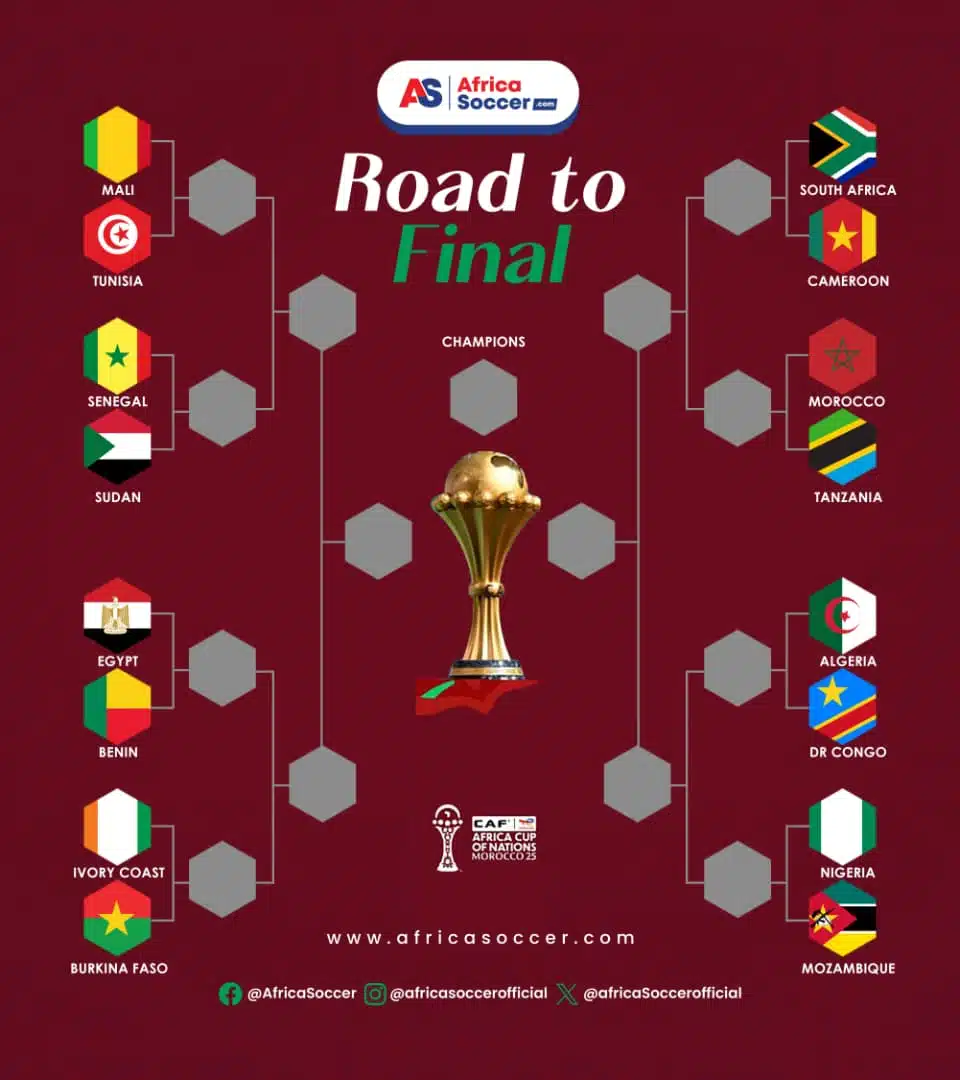
The Africa Cup of Nations takes a brief two-day pause before the competition resumes on Saturday with a last-16 programme that promises a compelling blend of heavyweights, underdogs and long-standing rivalries across Morocco.
After a group phase that delivered goals in abundance and ensured every major contender progressed, attention now turns to the first elimination round, beginning on 3 January with two contrasting ties.
In Tangier, Senegal – widely viewed as one of the tournament’s most complete sides – will meet a Sudan team that quietly slipped into the knockout bracket despite scoring just once.
The meeting pits pedigree against pragmatism, with the 2021 champions expected to dominate possession against opponents who have made a habit of surviving on the margins.
Later that evening in Casablanca, Mali face Tunisia in a contest that is far harder to predict. Mali advanced without a victory, drawing all three group matches, while Tunisia arrive on the back of a mixed sequence of results.
The Carthage Eagles’ defeat and draw in the group stage have raised questions about their momentum, but their experience in tournament football makes them dangerous opponents for a Malian side still seeking its first win.
Sunday is headlined by the host nation. Morocco return to action at the Prince Moulay Abdellah Stadium in Rabat, where they take on Tanzania knowing that expectations are rising with every match.
The Atlas Lions are chasing a second continental crown, exactly half a century after lifting their first, and the home support is expected to be formidable.
The evening fixture in the capital brings together South Africa and Cameroon, both of whom finished second in their respective groups.
It is a particularly poignant encounter for Bafana Bafana coach Hugo Broos, who will come up against the same Cameroonian side he led to AFCON glory in 2017.
The knockout narrative continues on Monday with two further storylines.
Egypt, record holders with seven titles and last crowned in 2010, meet Benin in Agadir in a meeting that has never before occurred at this stage of the competition.
For the Pharaohs it is another step in a long quest to reconnect with a glittering past, while the Cheetahs are aiming to carve out a historic run of their own.
Later that night in Fez, Nigeria take on Mozambique.
Under the guidance of Eric Chelle, the Super Eagles have impressed with the best attacking record of the group stage, scoring eight times, and arrive as favourites against a Mozambican side whose very presence in the last 16 is already being celebrated at home.
Tuesday’s programme opens in Rabat with what many observers consider the tie of the round: Algeria against DR Congo at the Prince Moulay El Hassan Stadium.
The venue has been kind to both teams in recent months, with Algeria winning all three of their group matches there and the Leopards recording crucial World Cup qualifying results on the same pitch.
Both camps have played down any sense of advantage, with their coaches describing the contest as a 50-50 affair.
The last-16 concludes in Marrakech with Ivory Coast, the defending champions, facing Burkina Faso.
It is a meeting rich in intrigue, pitting the holders against a Stallions side eager to upset the established order.
Round of 16 schedule
Saturday, 3 January 2026
Tangier, Grand Stade de Tanger (17:00): Senegal v Sudan
Casablanca, Stade Mohamed V (20:00): Mali v Tunisia
Sunday, 4 January 2026
Rabat, Prince Moulay Abdellah Stadium (17:00): Morocco v Tanzania
Rabat, Al Medina Stadium (20:00): South Africa v Cameroon
Monday, 5 January 2026
Agadir, Adrar Stadium (17:00): Egypt v Benin
Fez, Fez Sports Complex (20:00): Nigeria v Mozambique
Tuesday, 6 January 2026
Rabat, Prince Moulay El Hassan Stadium (17:00): Algeria v DR Congo
Marrakech, Grand Stade de Marrakech (20:00): Ivory Coast v Burkina Faso
The quarter-finals are scheduled for 9 and 10 January, the semi-finals on 15 January, with the final set for 18 January at the Prince Moulay Abdellah Stadium – the stage where Africa’s next champion will be crowned.
Popular News




-

AFCON 2025: Fixtures, Results, Scores and Standings
Jan 18, 2026 -

Leadership and long-term vision key to rescuing Zamalek and inspiring Egyptian football – Hany Abou Rida
Nov 5, 2025 -

South African giants Orlando Pirates set to lose influential forward Monnapule Saleng
Mar 19, 2025 -

Full schedule for 2025 Africa Cup of Nations in Morocco confirmed
Feb 12, 2025