
AFCON 2025: How Edouard Mendy coerced Brahim Diaz into Panenka gamble
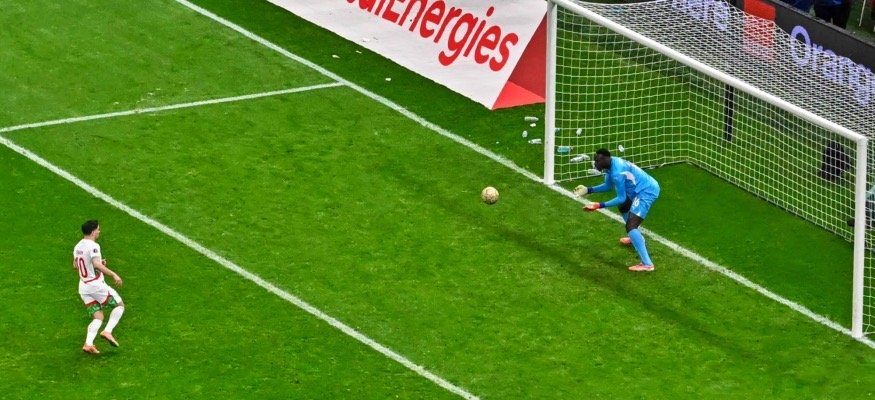
The 2025 Africa Cup of Nations final will be remembered less for Senegal’s extra-time winner and more for the decisive psychological duel that unfolded from 12 yards.
In the closing moments of normal time, Morocco stood on the brink of history when Brahim Díaz stepped up to take a stoppage-time penalty that could have delivered the kingdom its first AFCON title since 1976.
Instead, Edouard Mendy emerged as the central figure, reading the moment, the player and the technique to swing the final Senegal’s way.
Díaz opted for a Panenka, delicately chipping the ball down the middle. Mendy barely moved. The Senegal goalkeeper waited, gathered the ball calmly, and watched disbelief ripple around the stadium. Within minutes, the match was in extra time. Soon after, Senegal were champions.
A moment of audacity, a wave of disbelief
The immediate reaction was one of shock and anger among Moroccan supporters. In a final, in stoppage time, with a nation watching, the margin for error is non-existent.
The Panenka, while celebrated when it works, carries a reputation for arrogance when it fails. Díaz’s execution was soft and predictable, and the consequence was brutal.
Yet the choice itself was not without precedent. Football history is full of elite players who have trusted the same technique on the biggest stages.
Lionel Messi has used it. Zinedine Zidane famously attempted it in the 2006 World Cup final. The difference, as this final underlined, lies not just in courage, but in context and in the opponent standing on the goal line.
Mendy’s penalty expertise
For Mendy, this was not an accident. The Senegal goalkeeper has built a reputation for reading penalty takers rather than committing early. While many goalkeepers gamble by diving to a corner, Mendy often delays, shaping his body as if he will move before holding his ground at the last second.
This tendency has been evident throughout his career. During his time at Chelsea, he produced an almost identical save against Sergio Agüero in the 2020–21 season, when the Argentine attempted a Panenka. On that occasion, as with Díaz, the striker was left embarrassed, and the goalkeeper vindicated.
Díaz appeared unaware, or at least dismissive, of that pattern. The Morocco forward gambled on Mendy committing early. Mendy gambled on Díaz overthinking the moment. The goalkeeper won.
The Panenka explained
The Panenka is designed around one assumption: that the goalkeeper will dive. By chipping the ball gently down the middle, the taker exploits the empty space left behind. Antonín Panenka, who invented the technique, spent years refining it before unveiling it in the Euro 1976 final shootout.
The philosophy is simple but risky. If the goalkeeper stays central, the taker is exposed. If the goalkeeper dives, the taker looks like a genius. In high-pressure moments, goalkeepers rarely resist the urge to move. That rarity is what gives the Panenka its power, and what makes Mendy’s composure so valuable.
Psychology over power
In penalty situations, technique matters, but psychology matters more. A powerful strike into the corner removes uncertainty. A Panenka invites a battle of nerves. In this final, Mendy embraced that battle. He sold Díaz the illusion of movement, waited for the decisive touch, and let the pressure crush the taker.
Former Tottenham midfielder John Bostock, himself a frequent Panenka taker, once noted that goalkeepers are “forced” to choose a side in crucial moments. Mendy defied that convention. By standing still, he accepted the risk of ridicule in exchange for the chance of glory.
“I’ve always thought about the Panenka in decisive moments, because the goalkeeper is forced to go to one side and dive. I was genuinely surprised to see Mendy stay still, because in crucial moments I always notice that goalkeepers tend to choose one side.”
Senegal’s extra-time winner completed the job, but the final turned on that single penalty. Díaz will replay the moment endlessly. Mendy, meanwhile, added another chapter to his reputation as a goalkeeper who thrives under pressure.
In a final defined by tension and emotion, it was patience, not power, that proved decisive.
Popular News




-
AFCON 2025: Fixtures, Results, Scores and Standings
Jan 18, 2026 -

South African giants Orlando Pirates set to lose influential forward Monnapule Saleng
Mar 19, 2025 -

Leadership and long-term vision key to rescuing Zamalek and inspiring Egyptian football – Hany Abou Rida
Nov 5, 2025 -

Full schedule for 2025 Africa Cup of Nations in Morocco confirmed
Feb 12, 2025
-

FECOFOOT president Jean-Guy Blaise Mayolas slapped with life prison sentence over money laundering, embezzlement, and forgery
Mar 10, 2026 -

Kaizer Chiefs weigh Fernando da Cruz return as head coach talks emerge
Mar 11, 2026 -

Welayta Dicha vs Sidama Bunna 3:1, 2026-03-08, Ethiopia Premier League Match Report and Result
Mar 8, 2026 -

Kaizer Chiefs sporting director refuses to comment on Benni McCarthy speculation
Mar 7, 2026