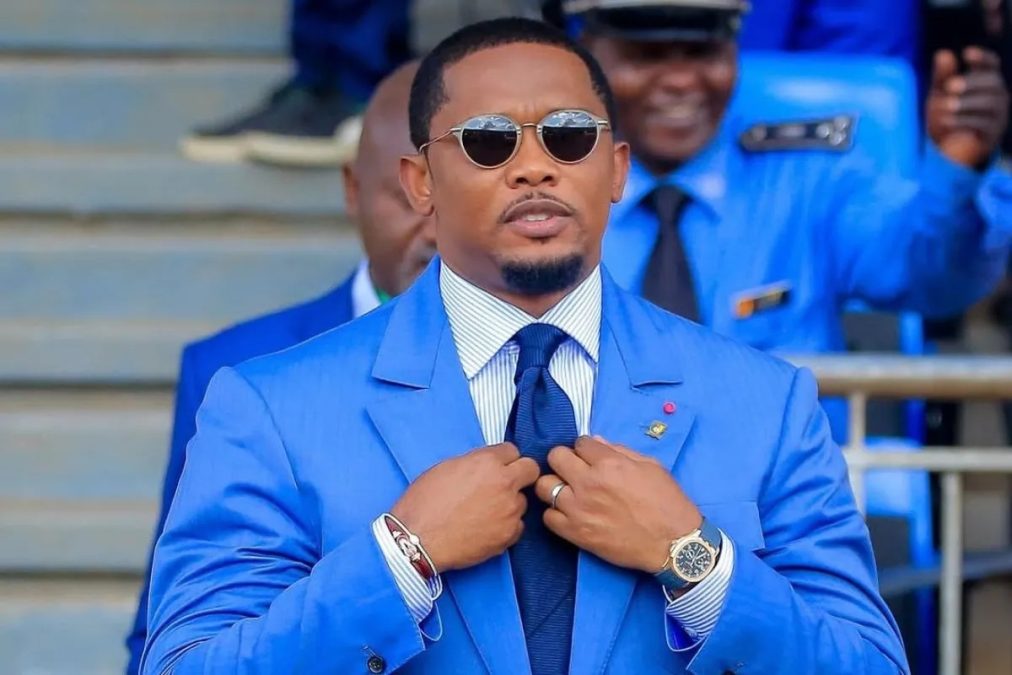
Samuel Eto’o has launched a series of sharp public attacks on French football personalities Daniel Riolo and Christophe Dugarry, while presenting himself as a defender of African football’s independence.
The president of the Cameroon Football Federation (Fecafoot) responded to both men within a few days, comments that appear significant given growing speculation that he could seek the presidency of the Confederation of African Football (CAF).
The former FC Barcelona striker has increasingly intervened in issues extending beyond the affairs of Cameroon’s national federation. His latest statements have put him at the centre of debates involving the continent’s football authorities and their relationship with Europe.
Riolo described Eto’o as a “complete disgrace” after the former Cameroon international backed Gianni Infantino’s re-election as FIFA president.
Eto’o replied on Instagram: “Mr Riolo, win an election in your country and then we can speak to each other as equals.”
The response was not only personal. Eto’o also insisted that African football leaders should be able to make their own decisions and defend their own interests.
“Africa must now defend its own interests,” he wrote.
Two days later, Dugarry became the target of another forceful response. The 1998 World Cup winner had described the ovation given to Infantino by African football leaders as corruption, linking it to the 25 million dollars promised to federations.
Eto’o responded: “As stupidity sometimes has the particularity of persisting,” before pointing out that all 211 FIFA member associations, including those in Europe, were covered by the financial package.
The Fecafoot president also called on Dugarry to apologise and objected to the former France international presenting CAF president Patrice Motsepe as a friend.
“You operate in different worlds and your responsibilities are not comparable,” Eto’o said.
Across both exchanges, Eto’o positioned himself as a defender of the continent’s football institutions and their autonomy in the face of criticism from Europe. That stance has added weight to questions about his political ambitions within African football.
In October, the British newspaper The Guardian reported that several African officials were positioning themselves for the succession to Motsepe, whose term ends in 2029. Eto’o, who sits on the CAF executive committee, was named among them.
The Cameroonian is also reported to have played a major role in the return to a biennial Africa Cup of Nations. According to Cameroonian journalist Remy Ngono, Eto’o helped persuade the organisation to abandon plans for a four-yearly tournament. The proposal had initially been announced by Motsepe without prior consultation.
Eto’o’s defence of African interests is not new. However, his public support for FIFA’s president and his reported influence over an issue as popular as the Africa Cup of Nations schedule have given him a growing presence at both continental and institutional level.
His decision to publicly defend Motsepe is also notable, given that he is reportedly interested in succeeding the South African.
Eto’o has not publicly declared an interest in the CAF presidency or announced a candidacy. But as the race to replace Motsepe begins to attract attention, his positioning is increasingly difficult to ignore.
-
 Samuel Eto’o’s outspoken defence of African football raises CAF succession question Nov 29, 2026
-
Adama Kenema beat Awassa Kenema 2-0 in Ethiopia Premier League Match Round 7 Nov 29, 2026
-
Simba SC name Kassali and De Reuck in starting XI for CAF Champions League opener against Orlando Pirates Nov 29, 2026
-
RS Berkane make winning CAF Champions League start with 4-1 victory over Colombe Nov 29, 2026



-
AFCON 2025: Fixtures, Results, Scores and Standings Jan 18, 2026
-
Match hero Taiwo Awoniyi reflects on team effort after Chelsea triumph May 5, 2026
-
Leadership and long-term vision key to rescuing Zamalek and inspiring Egyptian football – Hany Abou Rida Nov 5, 2025
-
South African giants Orlando Pirates set to lose influential forward Monnapule Saleng Mar 19, 2025




-
Morocco insiders confident of CAS victory in bitter AFCON title dispute with Senegal Nov 23, 2026
-
AFCON 2025: CAF will respect CAS ruling on Morocco-Senegal final dispute – Motsepe Nov 24, 2026
-
Morocco and Mali lead Africa’s charge at 2026 FIFA U-17 World Cup Nov 23, 2026
-
Barcelona drop Hamza Abdel Karim and Lamine Yamal from Sabah clash Nov 23, 2026