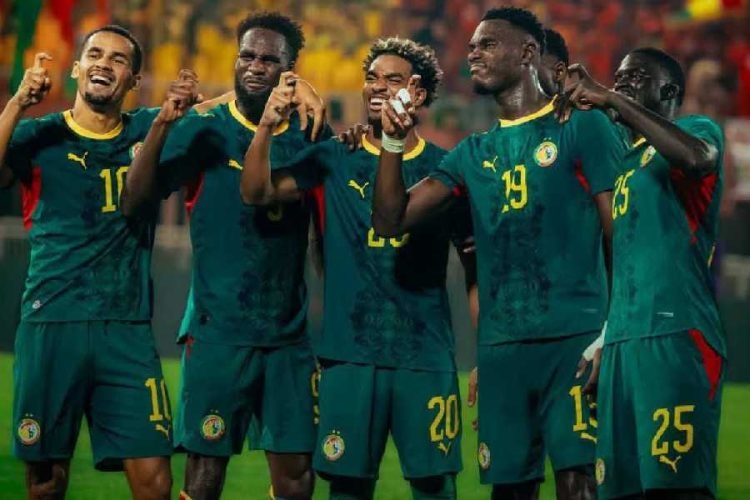
Senegal are the highest-ranked African side in the latest CIES Football Observatory assessment of nations with the strongest young talent pools, with Cote d’Ivoire, Morocco and Ghana also making the world’s top 15.
The ranking, published on Wednesday, 25 November 2026, assessed 80 men’s national teams by examining the experience of their under-23 internationals at the highest level. The results highlight the depth of emerging talent across Africa.
Senegal occupy 11th place worldwide, ahead of Denmark, Norway and the United States. The Lions’ position reflects the number of young players already established in senior football, including AS Monaco midfielder Lamine Camara.
Camara is the highest-rated Senegalese player under 23 included in the study, with an individual score of 84.4.
Four African nations in the top 15
Cote d’Ivoire are 12th, Morocco 13th and Ghana 15th, completing Africa’s representation near the top of the standings.
The four African teams are:
– 11th: Senegal – 12th: Cote d’Ivoire – 13th: Morocco – 15th: Ghana
Cote d’Ivoire also have the highest-rated individual player among the four nations. Yan Diomande has a score of 86.9, higher than Camara’s 84.4, but the Elephants remain below Senegal in the overall ranking.
That difference reflects the study’s emphasis on squad depth rather than the quality of one outstanding prospect. The assessment considers the strength of a nation’s wider group of young players with senior experience.
Spain top the global ranking with an index of 84.2. France are second on 81.0, while England are third with 80.9.
Argentina, Italy, Brazil, Germany, Belgium, Portugal and the Netherlands complete the top 10, with Senegal just outside that group.
How the CIES ranking is calculated
The Football Observatory did not base its table on national-team results or the market values of players. Instead, it focused mainly on the amount of top-level football played by eligible under-23 internationals.
For each country, researchers selected the 20 best-qualified players and counted the minutes they had played in official senior competitions during the previous 12 months.
The calculation also factors in the standard of the leagues in which those players compete. League strength is measured using club performances in continental competitions over a 10-year period. As a result, a minute played in the English Premier League, regarded as the benchmark, carries more weight than one played in a less highly rated league.
Players are given different weightings in the final index. The leading player contributes 100%, while the 20th-ranked player contributes 5%.
The positions of Senegal, Cote d’Ivoire, Morocco and Ghana underline the continent’s growing supply of young footballers already exposed to the demands of professional football. Their next challenge will be to turn that potential into sustained success at international level.
-
 Senegal lead Africa’s four-strong presence among football’s top youth nations Nov 25, 2026
-
CAF Awards 2026: Ten nominees shortlisted for African Goal of the Year Nov 25, 2026
-
Algeria U17 and Dominican Republic U17 meet with Group J momentum at stake Nov 25, 2026
-
Algeria U17 face Dominican Republic U17 in crucial Group J meeting Nov 25, 2026


-
AFCON 2025: Fixtures, Results, Scores and Standings Jan 18, 2026
-
Match hero Taiwo Awoniyi reflects on team effort after Chelsea triumph May 5, 2026
-
Leadership and long-term vision key to rescuing Zamalek and inspiring Egyptian football – Hany Abou Rida Nov 5, 2025
-
South African giants Orlando Pirates set to lose influential forward Monnapule Saleng Mar 19, 2025




-
U17 World Cup 2026: Full schedule for Morocco and where to watch Nov 19, 2026
-
Nice v Paris Saint-Germain: injury-hit champions face confident hosts in Ligue 1 Nov 19, 2026
-
Nice face formidable PSG as leaders chase eighth straight Ligue 1 win Nov 20, 2026
-
Chelsea v Leeds: Blues backed to edge tight Premier League contest at Stamford Bridge Nov 20, 2026