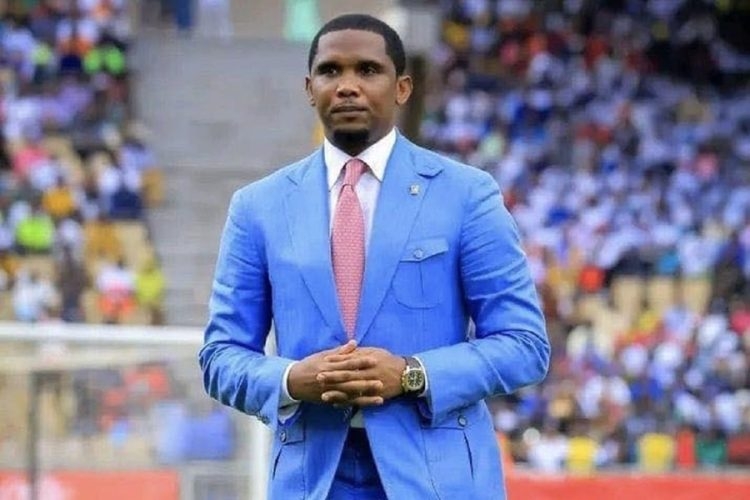
Samuel Eto’o has hit back at Daniel Riolo after the RMC commentator condemned the former Cameroon captain’s decision to support Gianni Infantino for the FIFA presidency.
The president of the Federation Camerounaise de Football (FECAFOOT) responded publicly in a message published on Instagram on 25 November 2026, accusing Riolo of judging those who take responsibility in football while remaining an observer.
The dispute began during After Foot on RMC, where Riolo criticised the backing given to Infantino by several African football leaders ahead of the FIFA president’s re-election bid.
Eto’o was singled out in particular. Riolo, who had previously admired the former FC Barcelona striker, described him as a “honte integrale” and said his position was “profondement indigne”.
The commentator also questioned the stance taken by African football officials, arguing that their support for Infantino sent a damaging message after a series of episodes he regarded as humiliating for the continent.
Eto’o rejects outside judgement
In his lengthy reply, Eto’o defended the right of African football leaders to make their own decisions without being subjected to criticism from outsiders. He set the responsibilities of those involved in running the game against the position of people who comment on it from outside the decision-making process.
The Cameroon Football Federation president also defended Patrice Motsepe, the president of the Confederation of African Football, whose position had been discussed by Riolo.
Eto’o questioned Riolo’s authority to pass judgement on people carrying responsibilities within football and challenged the idea that African officials should have their choices dictated or validated by external observers.
The former Cameroon international made clear that he was not withdrawing his support for Infantino. Instead, his response presented that backing as a decision he was entitled to make and one he was prepared to defend publicly.
He ended his message by insisting that African football must take greater responsibility for defending its own interests. His words reflected a broader argument about who should speak for African football and who should determine its priorities.
The exchange has therefore moved beyond a personal disagreement between Eto’o and Riolo. It has exposed wider divisions over the governance of world football, the influence of African leaders and the continent’s role in major FIFA decisions.
Eto’o has fully accepted the consequences of his position and rejected the suggestion that it should be discredited by an outside commentator. Riolo, meanwhile, has maintained his strong criticism of African support for Infantino.
What began as a television discussion has now become a public dispute, with neither side appearing ready to retreat.
-
 Samuel Eto’o responds to Daniel Riolo criticism over Gianni Infantino backing Nov 25, 2026
-
Romania and Cameroon aim to end U17 World Cup group campaign on a winning note Nov 25, 2026
-
Romania U17 and Cameroon U17 meet in Qatar with both seeking first win Nov 25, 2026
-
Katsande says Mokwana and Phili can drive Kaizer Chiefs revival Nov 25, 2026


-
AFCON 2025: Fixtures, Results, Scores and Standings Jan 18, 2026
-
Match hero Taiwo Awoniyi reflects on team effort after Chelsea triumph May 5, 2026
-
Leadership and long-term vision key to rescuing Zamalek and inspiring Egyptian football – Hany Abou Rida Nov 5, 2025
-
South African giants Orlando Pirates set to lose influential forward Monnapule Saleng Mar 19, 2025




-
U17 World Cup 2026: Full schedule for Morocco and where to watch Nov 19, 2026
-
Nice v Paris Saint-Germain: injury-hit champions face confident hosts in Ligue 1 Nov 19, 2026
-
Nice face formidable PSG as leaders chase eighth straight Ligue 1 win Nov 20, 2026
-
Chelsea v Leeds: Blues backed to edge tight Premier League contest at Stamford Bridge Nov 20, 2026