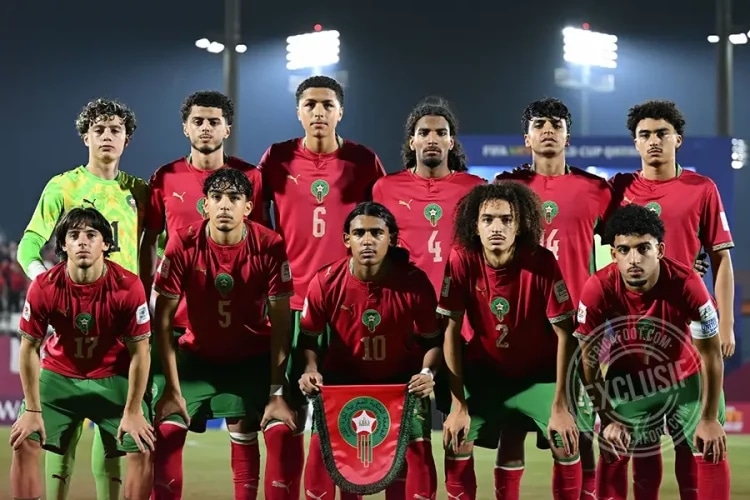
Morocco U17 were held to a 2-2 draw by China on Monday, 23 November, in their second group match at the 2026 U17 World Cup in Qatar, with Hamou Mouhal warning that several technical and tactical weaknesses must be addressed before their meeting with Spain.
The former Hassania d’Agadir player, now a youth development coach at the club, said the contrast with Morocco’s 6-0 victory over Fiji was largely explained by the different levels of organisation of the two opponents.
Fiji had left significant space and applied limited pressure to the ball, allowing Morocco to control midfield, dictate the tempo and create repeated chances. Their individual quality also gave them an advantage in duels and attacking situations, although it concealed weaknesses that Fiji were unable to exploit.
China, by contrast, defended with greater discipline, closing spaces and restricting the movement of Morocco’s attacking players. Their goal in the second minute made the task even more difficult, allowing them to defend in a compact block and attack quickly on the counter.
Mouhal said Morocco struggled with slow passing, insufficient movement off the ball, a failure to create regular numerical advantages on the flanks and an over-reliance on individual actions. He also identified problems after possession was lost, with several players advancing at the same time and leaving space behind them for China to exploit.
The midfield did not always provide enough cover to delay those counter-attacks, while the early deficit appeared to affect Morocco’s decision-making. In their attempt to level the score quickly, they sometimes sacrificed patience and accuracy in possession.
Morocco improved after the interval following changes by manager Ahmed Kantari. They used the width of the pitch more effectively, attacked through the flanks and delivered more crosses. Ziyad Baha reduced the deficit from the penalty spot in the 64th minute before Rami Lougman secured the equaliser in added time.
Mouhal viewed the comeback as evidence of the squad’s character, but said it should not distract from the collective problems exposed during much of the game. He believes the match against Spain will provide a test of Morocco’s tactical maturity and their ability to combine individual talent with greater defensive discipline.
Among the players to impress him, Mouhal named Adam Soudi, who maintained the form he showed against Fiji; Ziyad Baha, for taking responsibility for the penalty when Morocco were two goals behind; and Nassim Laarej, whose willingness to help build attacks stood out despite China allowing little space.
He identified Ismail El Aoud as one of the players below expectations after efforts in the 9th, 12th and 50th minutes failed to produce a decisive finish. Adam Bouhdadi was criticised for difficulties with positioning, covering and tracking, although Mouhal stressed those issues were also collective. Mehdi Lahmadi, meanwhile, had limited influence in a slow and poorly connected attacking performance.
Mouhal said Morocco must improve their ball circulation, defensive balance and transitions against Spain to show their win over Fiji was based on more than the opponents’ weaknesses.
-
 Morocco U17 rescued by late China draw but tactical flaws exposed Nov 24, 2026
-
Could Morocco overturn CAS ruling? Two Swiss court precedents offer a possible route Nov 24, 2026
-
Lille v Bayern Munich: Bavarians backed to lead at half-time in Champions League clash Nov 24, 2026
-
Cavin Johnson backs Rushwin Dortley and Thabo Moloisane partnership at Kaizer Chiefs Nov 24, 2026


-
AFCON 2025: Fixtures, Results, Scores and Standings Jan 18, 2026
-
Match hero Taiwo Awoniyi reflects on team effort after Chelsea triumph May 5, 2026
-
Leadership and long-term vision key to rescuing Zamalek and inspiring Egyptian football – Hany Abou Rida Nov 5, 2025
-
South African giants Orlando Pirates set to lose influential forward Monnapule Saleng Mar 19, 2025




-
AFCON 2027 qualifiers matchday 3 & 4: All fixtures and results Nov 17, 2026
-
U17 World Cup 2026: Full schedule for Morocco and where to watch Nov 19, 2026
-
AFCON 2027 Qualifiers: South Africa bounce back with win over Kenya Nov 17, 2026
-
AFCON 2027 qualifiers: Morocco edge Niger in 1-0 victory to secure qualification Nov 17, 2026