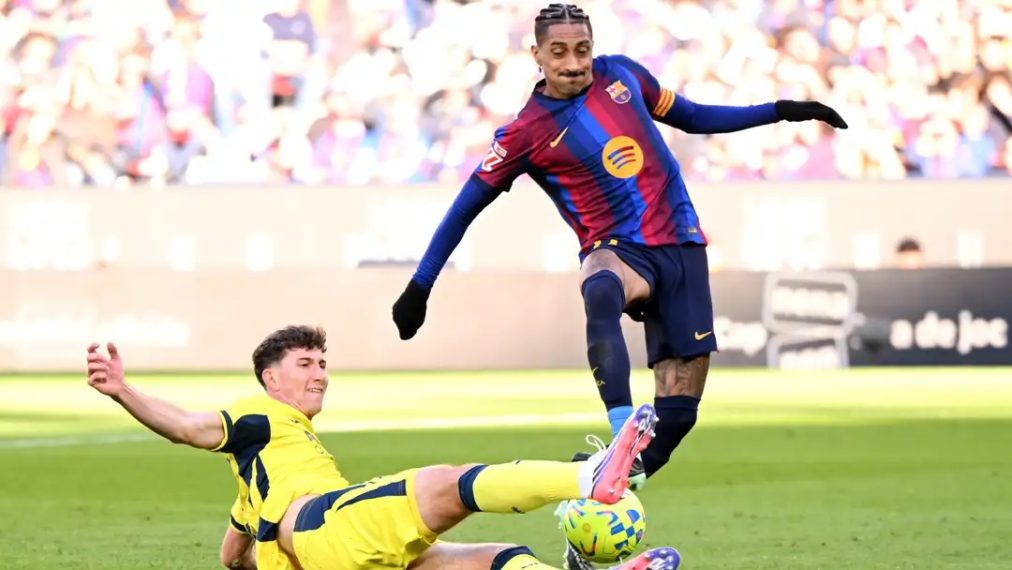
Raphinha produced the key moment at both ends of the pitch as Barcelona recovered from two goals down to beat Villarreal 3-2 at Camp Nou on Sunday, despite the captain’s name appearing neither on the scoresheet nor among the assists.
Villarreal took an early lead through Tajon Buchanan and Tani Oluwaseyi, leaving Barcelona facing a difficult fightback. The home side began their recovery in the second half when Gerard Martin pulled a goal back, before Fermin Lopez levelled the score. Barcelona then completed the comeback when Pau Navarro turned the ball into his own net.
The sequence that led to Barcelona’s second goal, however, began with an important contribution from Raphinha, according to Marca.
Pedri lost possession in midfield, giving Villarreal the opportunity to launch a rapid counter-attack into the space left in Barcelona’s defensive shape. Raphinha immediately recognised the danger and sprinted back towards his own goal to prevent the visitors from advancing into a more threatening position.
The Brazil forward showed impressive urgency as he raced beyond several Villarreal players and recovered the ball close to the corner flag. His intervention ended the counter-attack and allowed Barcelona to turn defence into attack.
Raphinha’s involvement did not end with winning possession. He continued his run upfield and helped Barcelona build a swift counter of their own, moving the ball to his team-mates as they progressed towards the Villarreal penalty area.
He eventually found Lamine Yamal, who supplied the final pass for Fermin Lopez. The midfielder made no mistake, finishing the move to score Barcelona’s second goal and bring them level.
The goal highlighted the collective effort behind the comeback. While Fermin Lopez took the final touch and Lamine Yamal provided the assist, the attack had been made possible by Raphinha’s recovery run and his work in restarting the move.
Raphinha was appointed Barcelona captain by manager Hansi Flick at the start of the season, during a period of change and significant absences within the squad. The decision reflected the Brazilian’s standing in the dressing room, where team-mates already recognised his influence before he formally took on the armband.
His leadership has also been expressed through his willingness to encourage those around him and work tirelessly for the team. This season, Raphinha has become one of Flick’s most important players, contributing in attack while also providing the physical effort required to press, regain possession and support the defence.
His actions against Villarreal offered a clear example of that role. Rather than watching the opposition break forward or waiting for a team-mate to intervene, Raphinha covered a long distance to win the ball back and then continued running to support the attack that produced Barcelona’s equaliser.
That contribution made him an understated figure in the comeback, even as the attention went to Fermin Lopez and Yamal. Raphinha’s intervention was the turning point that gave Barcelona the chance to score again and complete their recovery.
-
Badou Zaki focuses on Jordan progress amid reports over his future Nov 23, 2026
-
 Ramiz Zerrouki’s half-time dressing-room intervention sparks FC Twente win Nov 23, 2026
-
 Amine Gouiri scores and assists again despite Marseille defeat Nov 23, 2026
-
 Algeria name squad for Nigeria double-header ahead of 2028 Olympic qualifiers Nov 22, 2026


-
 AFCON 2025: Fixtures, Results, Scores and Standings Jan 18, 2026
-
 Match hero Taiwo Awoniyi reflects on team effort after Chelsea triumph May 5, 2026
-
 Leadership and long-term vision key to rescuing Zamalek and inspiring Egyptian football – Hany Abou Rida Nov 5, 2025
-
 South African giants Orlando Pirates set to lose influential forward Monnapule Saleng Mar 19, 2025

-
 AFCON 2027 qualifiers matchday 3 & 4: All fixtures and results Nov 17, 2026
-
 Cote d’Ivoire close in on AFCON 2027 qualification against Gambia Nov 16, 2026
-
 AFCON 2027 Qualifiers: South Africa bounce back with win over Kenya Nov 17, 2026
-
 U17 World Cup 2026: Full schedule for Morocco and where to watch Nov 19, 2026