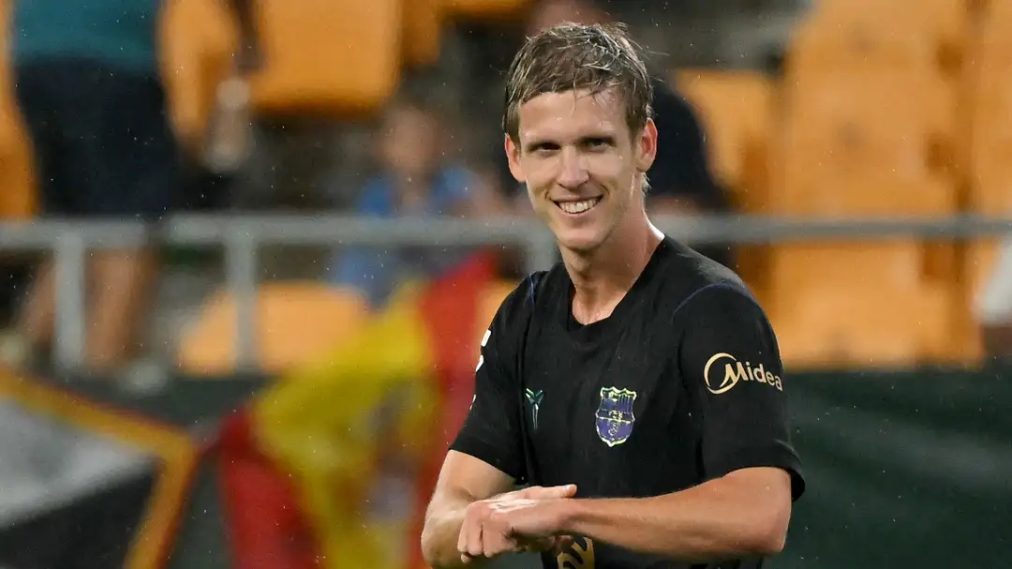
Dani Olmo’s month-long absence has exposed his importance to both Barcelona and Spain, with recent results highlighting the range of qualities he brings to their collective play.
Spain’s defeat by England, Barcelona’s loss in the Clasico and a poor first-half display against Atletico Madrid have all underlined the creative gap left by the attacking midfielder, according to Spanish newspaper AS.
Against England, Spain struggled to cope with the physical strength of Thomas Tuchel’s side and lost the precision normally associated with their football under sustained, high pressing.
Olmo’s ability to receive the ball between the lines could have offered Spain a way to regain control and restore their rhythm. Ander Herrera, who combines a playing career with extensive football analysis, has described Olmo as “the best player in the world between the lines”, praising his positioning, ability to turn with the ball and skill in escaping markers.
His absence was also reflected in the tactical details of the match at Riyadh Air Metropolitano. One of England’s centre-backs moved forward to track Mikel Merino, whose characteristics are markedly different from Olmo’s.
The Barcelona player’s movement to receive possession and ability to switch the direction of attacks might have presented England with different problems and created additional threats.
Statistics from the last World Cup reinforce that assessment. Olmo made 175 movements to receive the ball between the lines, one of the highest totals in the tournament. The figure illustrates how he provides passing options and helps team-mates play through pressure.
Barcelona’s missing link
Olmo’s influence extends beyond the aspects captured by data. His technical and tactical contribution is also seen in how he adapts his performance to the demands of each match.
A possible return against Villarreal would therefore provide Barcelona with what can be described as a quiet revolution in their play. Olmo helps organise the team in possession, while also disrupting opponents through his movement and ideas.
He contributes to building attacks and controlling the tempo, but can also move intelligently to unsettle defensive structures. His responsibilities do not end when Barcelona lose the ball: he leads the press, keeps the lines closer together and offers defensive cover to team-mates.
Those qualities were missed during the Clasico, when Barcelona lacked a link in the attacking third and their build-up became rushed and disjointed. The team faced similar difficulties for large periods against Atletico Madrid.
Barcelona’s defensive organisation was also affected by losing possession in unsuitable areas. The team’s pressing structure became less effective, particularly when players were not sufficiently connected in individual battles.
Olmo is particularly adept at judging when to press, closing passing lanes and restricting an opponent’s options. At the last World Cup, he attempted 305 pressures, the highest figure recorded by any player, underlining the work he performs to help recover possession and preserve his side’s defensive balance.
That does not make Olmo solely responsible for results or capable of correcting every weakness. It does, however, demonstrate the exceptional value he offers within a team.
At a time when football increasingly rewards individual attention, Olmo places his ability at the service of collective objectives. He accepts the role each match demands and does not need reminding that he is no more important than his team-mates a mentality that adds significantly to his value on the pitch.
-
 Real Madrid agree Brahim Diaz contract extension until 2031 with €1bn release clause Nov 20, 2026
-
Eli Junior Kroupi favors Barcelona move despite interest from PSG and Arsenal Nov 20, 2026
-
Senny Mayulu rules out PSG exit and reaffirms commitment to PSG Nov 20, 2026
-
Ismaila Sarr backs Senegalese stars for 2026 African Player of the Year Nov 20, 2026


-
AFCON 2025: Fixtures, Results, Scores and Standings Jan 18, 2026
-
Match hero Taiwo Awoniyi reflects on team effort after Chelsea triumph May 5, 2026
-
Leadership and long-term vision key to rescuing Zamalek and inspiring Egyptian football – Hany Abou Rida Nov 5, 2025
-
South African giants Orlando Pirates set to lose influential forward Monnapule Saleng Mar 19, 2025




-
AFCON 2027 Qualifiers: Check out full group standings Nov 15, 2026
-
AFCON 2027 qualifiers matchday 3 & 4: All fixtures and results Nov 17, 2026
-
Mali fight back to beat Rwanda and maintain perfect CAN 2027 qualifying record Nov 13, 2026
-
African football transfer round-up: Sturm Graz sign Araphat Mohammed as Real Madrid close Latif Issman deal Nov 14, 2026